
What I learned during this FIFA Women’s World Cup above all else is that there still remains some humanity to go along with the fanatical devotion we ascribed to big time sports.
The biggest moment of the tournament didn’t occur during Canada’s matches, or amidst the United States’ flurry of goals in the final, or even as a result of the numerous controversial officiating decisions.
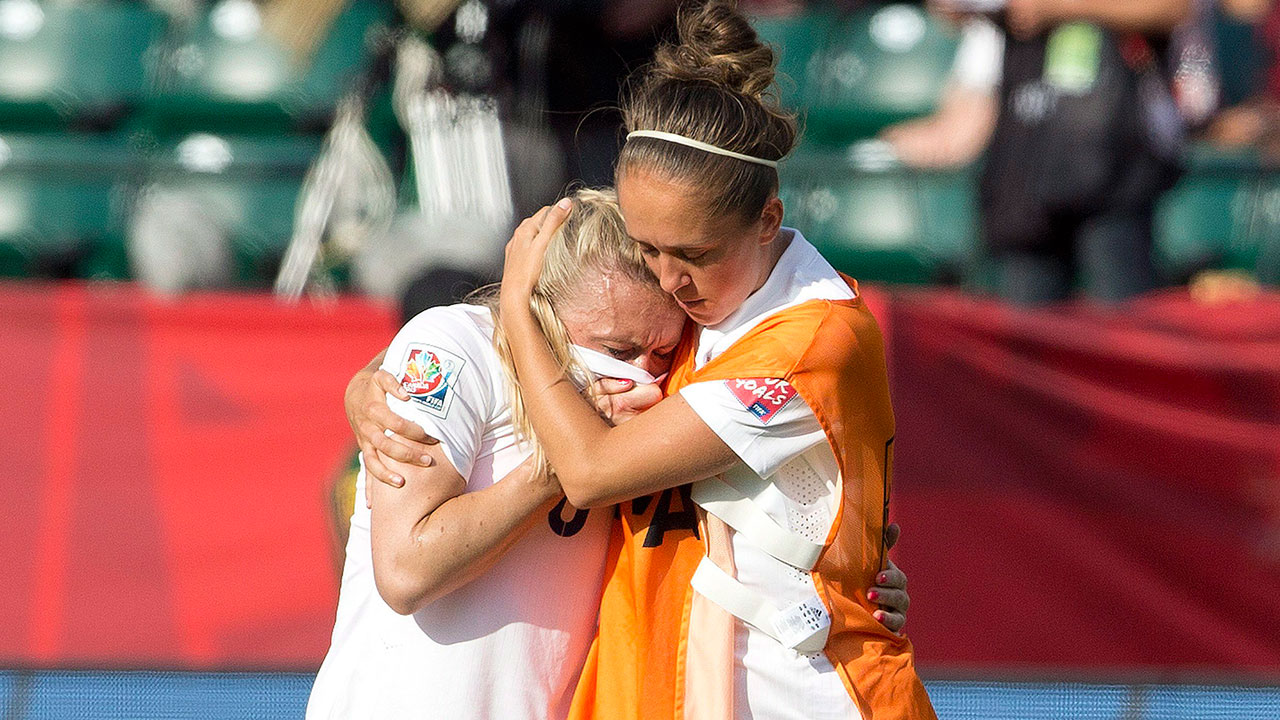
The moment everyone spoke about around the water cooler was Laura Bassett’s own goal and her ensuing inconsolable state. It was watching the worst moment of someone’s life play out in HD, broadcasted for the world to see. Yet for me that’s not the moment that had the most impact.
What mattered was the redemption. Not when Lianne Sanderson was brought down in the area winning a penalty kick in extra time versus Germany in the third-place game. Not when Fara Williams slotted home a goal to break the dead lock, but when the full-time whistle blew and the entire England team and staff all rushed to celebrate around Bassett. It was THE moment of the World Cup because it showed you exactly how everyone felt about the tournament’s darkest moment.
The past response given to her countrymen Gareth Southgate and David Beckham was the opposite when their blunders cost England World Cup glory. I’m not saying the level of vitriol should be more like the men’s game, in fact I’m saying the exact opposite. Bassett received overwhelming support, and the hashtags #IWillStandWithBass and #ProudofBassett were created to help further mobilize the support.
https://twitter.com/landondonovan/status/616417028283367424
https://twitter.com/gopleasestay22/status/616625957848391680
After her mistake, Bassett wanting nothing more than to hide, and said she would “prefer if nobody knew her name.” Ironically the centre back would go on re-tweet articles where she admitted to yearning for anonymity.
The sad truth is nobody knew her name beforehand. Everybody knows it now. Yet it showed that even in a sport where fans are often characterized as hooligans or racists or worse, they are, just like Bassett, “human.”
The best part of humanity is exemplified in those who pull over when they see someone with a blown tire. Imagine if we rolled down the window and screamed at other pedestrians in distress as we drove by? That’s pretty much what we do in the sporting culture—we don’t just relish victory but delight in others’ defeat. We see this all the time in sport and it’s only exacerbated with the invention of social media.
It’s not just sports but our society in general that permits a rubber necking culture. Our newscasts lack human interest stories, but more and more bounce from one social train wreck to the next. If it bleeds it leads, so to speak, which is what made the digital group hug Laura Bassett received even more special.
The closest and must extreme comparison to Bassett we have is fellow soccer star Andreas Escobar. Like Bassett, Escobar was trying to cut out a pass and ended up deflecting it into his own net. Escobar’s infamous own goal for Columbia occurred in a match against the United States at the 1994 World Cup. Escobar was murdered back home and it is widely speculated that his role in Columbia being eliminated from the World Cup was directly related.
Yet despite the odd troll here and there, the reaction to Bassett’s error was overwhelmingly positive. She received support after her initial mistake, which was later consummated further as bipartisan viewers took on the cause to root for both she and England in a normally meaningless third place game.
I can’t put my finger on why our response to Bassett is the diametrical opposite to the way fans normally behave. Is it because in Bassett we see our daughters and can’t bring ourselves to criticize? Are there less mean memes because our mother could have made the same mistake and been the one crying? Or because these players aren’t in the public eye long enough to build up rivalries causing us to hate their team and by proxy the players who play for them?
Whatever the reason we’d be better off to take a step back and not be so toxic in our criticism of the world’s best athletes. It must be an odd dynamic for a pro athlete who is at the top of their field, in the 99.9 percentile at what they do, being criticized when they fail by people who most likely aren’t as good as them in anything, never mind their sport.
Let’s not get distracted from the fact that sports are a distraction. The Golden State Warriors won the NBA title but some of the same socio-economic issues that take place in Oakland but that don’t rear there ugly heads on the other side of the bay in San Francisco remain. Nothing happening in sports is life or death so we shouldn’t treat it as such. Sports are a distraction from real world problems; they don’t solve them so we shouldn’t be so pointed in our criticism. The stakes aren’t that high.
What sports can do is remind us of the virtuous qualities we should look to exhibit in our daily lives. That’s what England did, exhibiting teamwork, camaraderie, support and resilience. Laura Bassett, specifically, was the strongest symbol of the above characteristics because her anguish was so public and raw but those qualities ran through the team.
Let’s take a page from the playbook from the fans of the FIFA Women’s World Cup. When we are discussing how we can better support women’s sports, let’s broaden the conversation to not just resources and TV ratings but reassurance. Let’s support male professional athletes the way we supported Laura Bassett, a female athlete, with the same level of empathy and humanity, because their pain and anguish is just as strong.