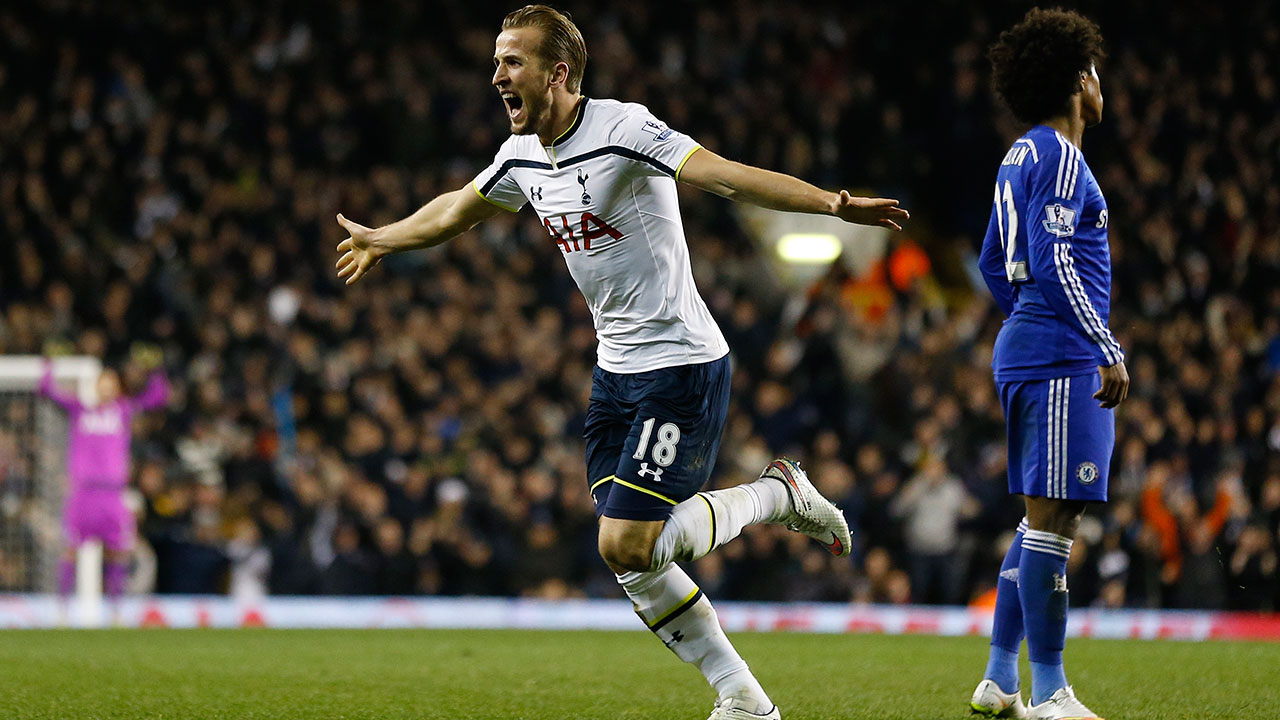

There is a tendency to talk about Tottenham’s “Amazing Harry Kane” in a certain way. His 22 goals this season, including two in Saturday’s North London Derby win over Arsenal, coupled with his steep rise from nowhere to somewhere, has been described as “heroic,” “Roy of the Rovers stuff” or some variation of the same sentiment, on repeat all season.
The implication—or even the overt evocation—is that Kane’s achievements are romantic, rather than logical: they’re somehow mystical or miraculous, because he doesn’t look like he should be able to keep conjuring them up like he is.
This is in some ways a nice story to tell, but also slightly condescending for a man who at 21 years of age has scored more goals across all competitions than anyone else playing in the Premier League this season. Worse still, the overall effect of it is that we could be, collectively, under-appreciating “Heroic Harry;” treating him as some kind of ongoing fluke or over-developed good-news story that’s gone too far, rather than realising that, actually, he might be doing so well because he is really quite good.
Soccer Central podcast: SPORTSNET.CA’s Soccer Central podcast, hosted by John Molinaro and James Sharman, takes an in-depth look at the beautiful game and offers timely and thoughtful analysis on the sport’s biggest issues. To listen and subscribe to the podcast, CLICK HERE.
Behind this possibly misguided approach to Kane is, I think, a misjudgement that comes from us, the watching public, rather than Kane, the helpless footballer. When we see what we think of as an underdog (someone with fewer resources to call upon than his opponent) winning a fight, we very often frame it as a David versus Goliath miracle—we say that it is, to some extent, beyond explanation. We do this because it reinforces our pre-existing world view, even after something new (an unexpected victory) has come along to undermine it.
But it’s a mistake. The logical thing to do is to question the old logic which has been undermined: the credentials of the underdog should be reassessed and the resources at his or her disposal should be re-valued to reflect that it turned out to be possible for them to win.
If we use these terms for Kane, he’s not miraculous, his strengths have merely been undervalued; and, specifically, right now I think he’s just good in ways we don’t often associate with football players who become very good.
Much of his game is at a high level. For persistence, he’s probably at the top of the league alongside only Alexis Sanchez. For strength on the ball, he’s entering the Yaya Toure category. For relentlessly getting shots on target, he’s in old school Jermain Defoe territory. And for catching goalkeepers unaware with early shots, he’s a bit like early Wayne Rooney. These are all exactly the kind of attributes which might help you score more in the current season than Sergio Aguero.
Our problem in recognising them is that none of them are the usual prized assets in a striker, like being able to curl a ball in from 20 yards or sprint at brilliantly high speed or dribble past defenders like they aren’t there.
When Kane dribbles past defenders, he makes it look exactly like they are there and he lacks a high-end first touch to smooth out any half-hearted impressions of him as a low-end player punching above his weight player. So, with fewer of the usual shortcuts to realising how exactly Kane is good, we resort to thinking of him as an underdog and calling his successes miraculous.
Arguably, Tottenham and Mauricio Pochettino’s successes this season have come from realising all of this already. Pochettino spent the opening months of this season deciding not to use Kane in Premier League games, despite his goals in the Europa League. Even when he’d come off the bench and score in those Premier League games, there was a lag in recognition from Pochettino, who didn’t start him in the league until Nov. 9th. But finally Emmanuel Adebayor and Roberto Saldado made way and Kane came in, and, oh look, Tottenham hasn’t had any inclination to look back since.
With Kane leading a young, unfussy team schooled in Pochettino’s high, hard pressing style, Spurs have just moved up the table, ahead of Arsenal and Liverpool. With Pochettino now firmly in team Kane, together they look a neat match: both considered unlikely victors in strong categories (the race for fourth is brilliantly tight this season) but both effective nonetheless.
Player and team the form combination in the league right now—which isn’t to say that Kane has instantly become a world-class star in a world-class team or that this isn’t just a spell of extreme form that will eventually give way to a more medium-sized goal-output and less exciting league position. Rather, it’s to point out that what’s happening right now hasn’t appeared from nowhere and doesn’t represent a David versus Goliath addition to Tottenham “folklore.” It’s a logical result of a player doing a lot of things to a high level—in a team doing the same.
So, in effect this is the dullest rebrand in history. He’s not “The Amazing, Miraculous Harry Kane,” he’s just Harry Kane. And, you know, he’s good and that.
Ethan Dean-Richards is a London-based writer. Follow him on Twitter