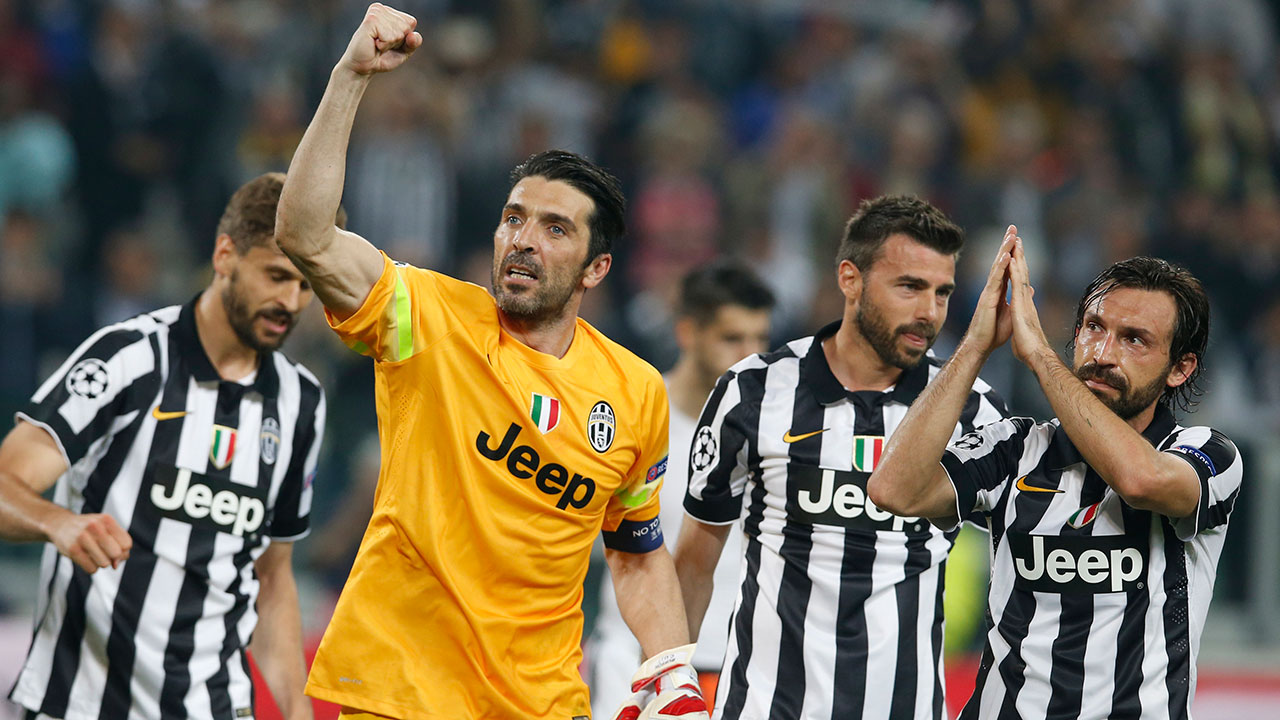

Back in 2006, Juventus was relegated from Serie A to Serie B, emasculated by the Calciopoli scandal and facing an identity crisis.
The Italian giants had always defined themselves by their successes and now, charged with rigging refereeing appointments, two league titles had been stripped away from them, along with, potentially more damagingly, the means to win more. Juve was suddenly lacking in success.
Big name players left, coach Fabio Capello left and immediately after a gloriously unlikely Italian World Cup win, the party was over at The Old Lady, replaced instead by the steady slog of trying to overcome a nine-point deduction from its points tally to win back promotion to Serie A, even then knowing it would inevitably be a diminished force.
Saturday programming alert: Watch Juventus vs. Barcelona in the UEFA Champions League final live on Sportsnet ONE and Sportsnet World. Coverage starts with our pre-game show at 2:00 pm ET/11:00 am PT. || Sportsnet World NOW || Broadcast schedule
Suffice to say, then, it has taken a while to recover from that position, so that now, in 2015, Juventus finds itself once again back at the top, heading into a Champions League final against Barcelona that it believes it can win. Success has been a nine-year process, not a one-off event, and it has required time, effort and intermediate failure in order to quietly coax it out. The cameras and corporate sponsors will all be in place this coming Saturday in Berlin, but in 2006 when the club drew 1-1 to Rimini in its first Serie B game only 10,500 people were there to see it.
Let us reminisce about how one of those sets of circumstances became the other. It began with loyalty.
In the dark—or, worse, drab—days that followed relegation, the difference between a short stay in the second division and an indefinite one was that weird, intangible quality, the value of which is impossible to calculate precisely: loyalty. Zlatan Ibrahimovic, Patrick Vieira, Fabio Cannavaro, Lillian Thuram, Gianluca Zambrotta and Emerson all left what had the year previously been one of the all-time great Juve squads, winning the league with 91 points. But the season that followed in Serie B was about those who stayed.
In the prime of their careers, Gianluigi Buffon, Alessandro Del Piero, Pavel Nedved, Mauro Camoranesi and David Trezeguet all played, for one season only, as second division players. They won the title. From a distance, it never appeared spectacular or fun, and with four losses and ten draws it was no procession, but the players who stayed still won the title. Or rather, they won a title; the club was still nine years away from even getting a proper shot at the title it really wanted.
If those players had moved on, either literally or emotionally, then there’s surely no way Juve would be turning out at the pinnacle of European football this Saturday. Success is a temperamental business and, as countless “big clubs” have shown, the longer you don’t have it, the harder it is to get it back. The drift into obscurity is a tricky one to address, so a quick return was essential and, here, loyalty made that happen. Del Piero, for one, top scored with 20 league goals that season.
Unfortunately for Juve, as the nine year time gap suggests, even a quick return to the top division doesn’t necessitate a quick return to the top of the top division and beyond, however. Winning Serie B merely ensured the drop was more of a reasonably-sized hill than a cliff: the gradient to get back up was still steep, as the next few seasons would show.
Five managers turned up in the three years that followed promotion. Didier Deschamps actually left the club before the end of the promotion campaign, to be replaced for two games by Giancarlo Corradini. Claudio Ranieri came in to take over full time and finished third in Serie A, but was sacked before the end of the next season after juddering form and dull performances. Ciro Ferrara replaced Ranieri but lasted just a few months, the replacement replaced himself by Alberto Zaccheroni in January 2010 and the club eventually finishing seventh in Serie A while being knocked out of the Europa League by Roy Hodgson’s Fulham.
“The Wilderness Years,“ where failure came in regular doses and players such as Amauri and Christian Poulsen arrived as “high-profile” signings, continued for one more year under Luigi Del Neri—the club finishing seventh in Serie A once again. At this point, from someone with no real connection to the club, and therefore no great desire to see it succeed, there seemed very little prospect of the cycle of mediocrity being broken. Why would it be, you had to ask.
But then three answers came at once: a new stadium, a new manager, and Andrea Pirlo.
After spending almost four years running through the repertoire of “What Not to Do”—appointing managers with no experience, or too much, buying players who never came good, all amongst a context of constant shuffling of personnel—suddenly, in 2011, a run of correct decisions came into being.
The new stadium was a no-brainer: newly expanded and newly shiny, the haves and have-nots in mega-stadium building is increasingly a dividing line in the battle to sit at the top table in club football. The new manager, Antonio Conte, represented smarter, subtler thinking: a former player, he was a believer in the club, but had also just successfully led Siena to promotion, making him a young, in form manager, on the up, rather than the down. He was the balanced appointment that had been lacking in the “Wilderness Years.”
Then there was Pirlo. Let go by AC Milan as a 32 year-old central midfielder, Juve saw what Milan couldn’t: if you managed him carefully, he could still define a winning team. Conte flanked him with Arturo Vidal and Claudio Marchisio and it resulted in a compelling combination of strength, guile and speed. Suddenly Juventus hadn’t signed a greying, past-it midfielder, it had signed the cleverest midfield schemer in world football, for free.
In combination, these three correct decisions, arriving all but in tandem almost instantaneously propelled the club beyond the mediocrity which it had been mired in. The team pressed impressively high up the pitch, main rival, Inter Milan, was beaten twice and the league title arrived in Conte’s first season in charge, coming without a single defeat, as an added yet substantial bonus. It was though the repeated mistakes had all been got out of the way and, suddenly, perfection had turned up.
That season, and those correct decisions, was the start of what we’re seeing now—and what we’re going to see on Saturday. Loyalty saved the club, but gave way to the up and mainly down “Wildnerness Years;” Conte’s arrival marked and also sparked the arrival of the third phase of post-Calciopoli development: the bit where Juventus has gone on a miraculous run of correct decisions.
Soccer Central podcast: SPORTSNET.CA’s Soccer Central podcast, hosted by John Molinaro and James Sharman, takes an in-depth look at the beautiful game and offers timely and thoughtful analysis on the sport’s biggest issues. To listen and subscribe to the podcast, CLICK HERE.
Another title followed the unbeaten season. Then another one after that. The team solidified around Pirlo, improved upon steadily and smartly: Paul Pogba arrived and immediately got the game time that Alex Ferguson wouldn’t trust him with; Carlos Tevez arrived and got the trust he wasn’t allowed at Manchester City; the spine of the team, Buffon, Giorgio Chiellini, Leonardo Bonucci, Pirlo, Marchisio and Vidal remained neatly in place, playing in a hugely effective three-at-the-back formation.
Each new decision—be it technical, tactical, managerial or economic—kept coming good. And when Conte left to manage the Italian national side last summer, the run continued. An unpopular appointment at the time, greeted with eggs and spitting on his first day in charge, Massimiliano Allegri changed the formation, brought in Alvaro Morata and arranged his tactics around opponents—and it worked.
The Serie A title arrived again this season, AS Roma held off with ease this time around. But, eventually, if you make this many consecutive correct decisions as a club they tend to accumulate and you get more than just league titles. That’s what’s happened. Under Allegri’s leadership Juventus has just done what it could never manage under Conte: it’s beaten a heavyweight in the Champions League (Real Madrid) and it’s progressed to the final for the first time in 12 years.
What we will witness on Saturday in Berlin, then, is the culmination of the third phase. The club will, finally, after nine years, have recovered all the way from its mid-2000s identity crisis; it can, finally, define itself once again through its successes. And that, dear reader, is the process by which disaster turned back into success; by which Juventus ended up back in front of the cameras and the corporate sponsors; back in the big-time.
Now it just has to beat Barcelona.
Ethan Dean-Richards is a London-based writer. Follow him on Twitter