
After a dramatic and exhilarating ending to last season’s La Liga—Atletico Madrid clinching the title on the final day at the Camp Nou—the upcoming Spanish campaign has very big shoes to fill.
Real Madrid stockpiled a boatload of superstar talent over the summer, as did their rivals Barcelona. Not to be outdone, Atletico did some good business as well this off-season in an attempt to stay level with the two traditional Spanish giants.
Here are the top five burning questions ahead of opening day on Aug. 13.
Soccer Central podcast: SPORTSNET.CA’s Soccer Central podcast, hosted by John Molinaro and James Sharman, takes an in-depth look at the beautiful game and offers timely and thoughtful analysis on the sport’s biggest issues. To listen and subscribe to the podcast, CLICK HERE.
Can Atletico Madrid repeat?
Atletico has lost the element of surprise, though, that is of little significance to Diego Simeone. Shock and awe wasn’t a tactic in his dossier last season. Instead, the Argentine manager exhibited a work ethic similar to Pep Guardiola—day and night preparation proved to be extremely successful.
However, a trio of the club’s most important pieces were sold over the summer, which makes a repeat performance highly unlikely. Diego Costa was sold for €42 million to Chelsea, as was left-back Felipe Luis (€22 million). Also gone is influential goalkeeper Thibaut Courtois, returning to Stamford Bridge after three years on loan at the Vicente Calderon. In return, los Rojiblancos spent large to plug the holes and make sure last season wasn’t simply a lucrative one-night stand. A combination of Mario Mandzukic (€24 million) and Raul Jimenez (€11.5 million) have been given the responsibility of recouping Costa’s offensive output, and Guilherme Siquera (€11 million) steps in for the recently departed Luis.
If that wasn’t enough, the arrival of French winger Antoine Griezmann (€33 million) from Real Sociedad should ease any remaining anxiety and calm the minds of supporters. Back to back titles isn’t a realistic ambition, but Atletico will be competitive and push Spain’s big two.
The new ‘Galactico’ era begins
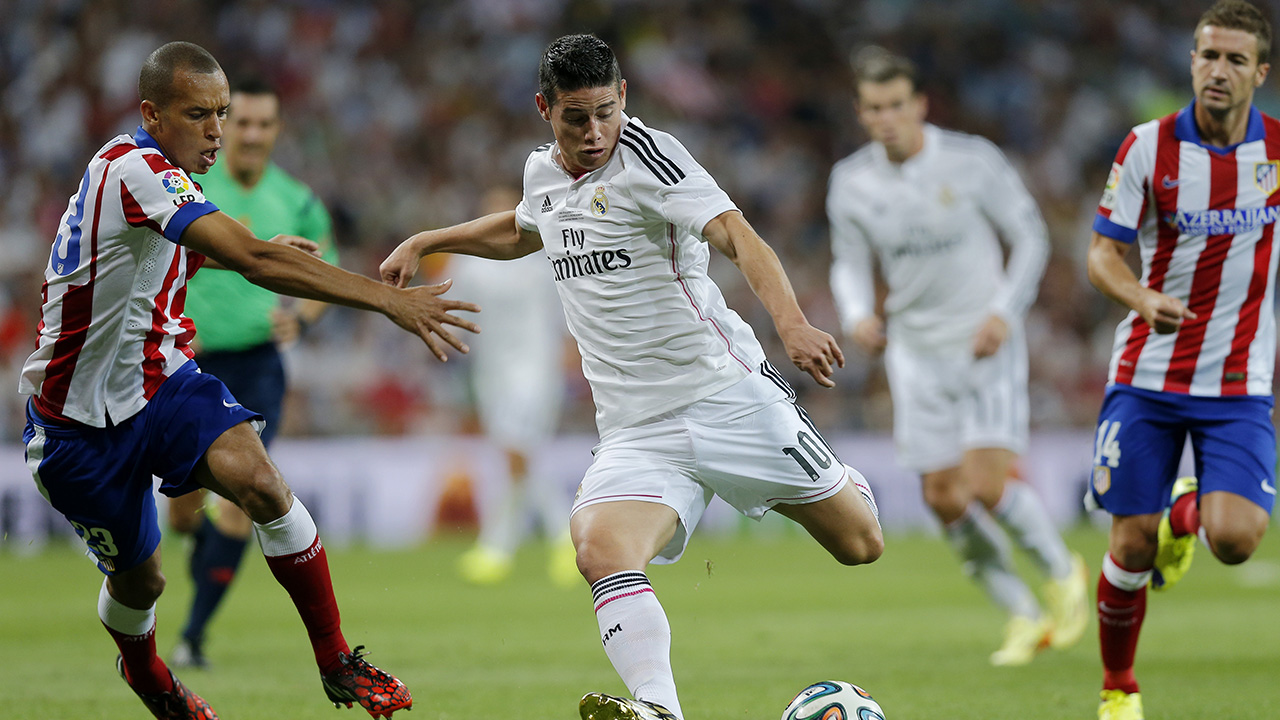
When you have the financial strength to field a tam that includes Luka Modric, Toni Kroos, James Rodriguez, Gareth Bale, Cristiano Ronaldo and Karim Benzema, the Galactico label is quite fitting.
Real Madrid have already pocketed some silverware—beating Sevilla 2-0 to claim the UEFA Super Cup—giving everyone a glimpse of what’s to come. Approximately €125 million worth of talent was sitting on the bench—Carlo Ancelotti is a lucky man—and the ability to change shape and bring in multiple impact substitutions has become standard practice at the Estadio Santiago Bernabeu.
Surprisingly, the current European champions have improved over the off-season, with the rumoured Radamel Falcao purchase expected to be made official before the transfer window shuts.
Depth is a non-issue, which is why a few players are reportedly heading for the exit (Sami Khedira and Angel Di Maria) and a few have already departed (Alvaro Morata and Diego Lopez).
Has Barcelona transformed into a Catalan version of the ‘Galacticos’?
The Blaugrana’s famed La Masia academy hasn’t exactly dried up, but the production line has definitely slowed down. Cristian Tello has been loaned out to FC Porto for the season, and Isaac Cuenca was allowed to leave on a free to Deportivo La Coruna—both have struggled to break through into the first team. Barcelona have also cut their loses with a couple of past youth system graduates, with the permanent sales of Jonathan dos Santos (Villarreal) and Bojan Krkic (Stoke City).
The cycle of failed prospects unable to live up to their potential is outnumbering the decorated list of current first-teamers. The extraordinary & controversial expenditure on Neymar was not the beginning, but the launch pad into a new mindset of spending. It began with the purchase of Zlatan Ibrahimovic (€77 million)—five years on, Luis Suarez has arrived for €94 million despite a FIFA imposed suspension that will see the Uruguayan miss the first fourth months of the season.
Step by step, the Catalans are going against their long-serving principles and following in the footsteps of their most hated rivals—granted not to the same degree, but pretty close. Marc Bartra (centre-back) and Martin Montoya (right-back) are the latest academy graduates on the fringes of Luis Enrique’s squad, with Rafinha and Sergi Roberto lower down the pecking order. Regardless of a brand change, a front-three of Suarez, Neymar and Lionel Messi could very well be the most dangerous attacking trio in world football.
For a limited time get Sportsnet Magazine’s digital edition free for 60 days. Visit Appstore/RogersMagazines to see what you’re missing out on.
The best of the rest
A combined fee of approximately €63 million was spent by the four teams in the hunt for European places: Valencia (€35 million), Sevilla (€14 million), Real Sociedad (€13 million) and Athletic Bilbao (€1 million). It goes a long way in giving an accurate depiction of the uneven playing field.
Athletic sold Ander Herrera to Manchester United for €40 million, Sevilla recouped €40 million off the sales of Ivan Rakitic (Barcelona) and Alberto Moreno (Liverpool), Jeremy Mathieu was poached by Barcelona from Valencia for €22 million, and Real Sociedad made a total of €46 million for Antoine Griezmann (Atletico Madrid) and Claudio Bravo (Barcelona).
The gap continues to widen between the quartet and the league’s big three. Sevilla made five low-cost new signings, while Athletic were quiet on the transfer scene and will be pinning their hopes on giving a handful of academy graduates a run in with the first team. Sociedad made a significant splash with the purchase of Alfred Finnbogason (€9 million) from Heerenveen—the Icelandic striker scored 29 goals in 31 Eredivisie appearances last year. Valencia also did some good business with the acquisition of Sampdoria centre-back Shkodran Mustafi (€9 million) and Benfica midfielder Andre Gomes (€16 million).
Basement living
Newly promoted Eibar and Cordoba are in real trouble and will find life in the top-flight extremely difficult. The 74 year-old Basque club is making its La Liga debut after being crowned champions of the Segunda, though they came close to being relegated to the third-tier for not meeting the financial standards required to compete in the Primera. A campaign was launched by Eibar over the summer and the crisis was averted.
Cordoba returns via the playoffs—beating Las Palmas on away goals—having spent the last 42 years of plying their trade in the bottom-tiers of Spanish football. Deportivo La Coruna will also return triumphantly to La Liga, bouncing straight back up after being relegated in 2012. Champions of the top-division 14 years ago, Depor have fallen through the trap door twice in their last four campaigns. They should be safe this year, given the teams around them are in a far worse off situation—Elche, Almeria and Rayo Vallecano.