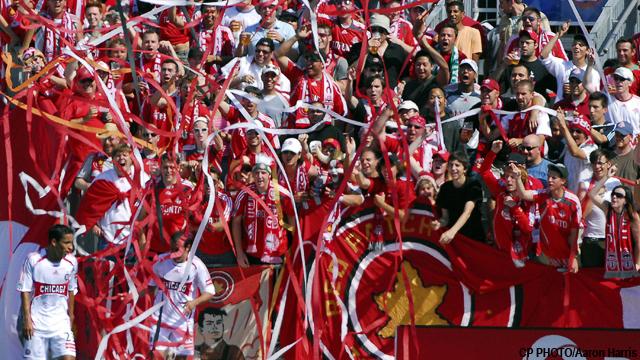

There are a couple of ways that football supporter culture within Major League Soccer varies from that within other countries, and other North American sports.
First of all, the relationship between MLS and its fans is particularly symbiotic. Supporters groups and the atmosphere they bring have played a huge part in the rise in the league’s popularity in the last few years. That trend is clearly continuing, as evidenced by NBC’s latest MLS promo for their coverage of the league that focuses entirely on supporters, without even a football to be seen, never mind one being kicked.
Second, there seems to be a genuine sense of camaraderie and respect between supporters of different teams. It’s something I’ve experienced when attending TFC away games, as well as in 2010 when supporters from every MLS team came to Toronto for the MLS Cup. There was a sense that we’re all in this together, and there was an appreciation of what others are struggling with as members of a growing but still small group fighting for stability in a market saturated with more popular sports.
In other countries where the existence of the league itself can be taken for granted, antipathy can easily prosper, leading to problems such as hooliganism, or the schadenfreude displayed by some at Rangers’ recent slide into administration. Given the history of the old North American Soccer League, and the fact that MLS has gone through contraction, those attitudes shouldn’t exist here. Simply put, MLS needs the supporters in the stands a lot more than other leagues throughout the world, and because of that, the supporters need each other.
These two factors continue to play a role in the development of the Independent Supporters Council, formed in 2009 and currently boasting representatives from 26 different supporters groups within MLS and other North American leagues. The Red Patch Boys, a TFC supporters group, is one of those 26.
I spoke with former president Boris Aguilar, who was present at the latest ISC meeting in Portland, and he told me, “RPB was at the first meeting in Seattle and when our representative met back with the executive council we knew that it would be worth being actively involved. Supporter rights (are) something very important to the Red Patch Boys and we have always maintained that having one strong unified voice sends a stronger message than 19 individual ones.”
That sense of strength in numbers is very important for what the ISC is trying to accomplish.
“By speaking with a singular voice for all recognized supporters groups regarding issues that may be specific to one group, but that affect all, ISC can effectively use the collective leverage of all groups to protect the interests of each individual group,” said Jason Corliss, board member of Red Bull New York’s Viking Army SC in a Feb. 15th press release.
While supporters issues may differ from team to team, the ISC is working for the adoption of a league-wide supporters’ Bill of Rights to “ensure the rights of all home and away supporters at any stadium in the United States and Canada to:
A place in each stadium for home and away supporters to stand, sing, and cheer;
The use of all safe, legal methods of showing support, including but not limited to flags, banners, drums, instruments, overhead banners and safe pyrotechnics;
Clear and consistent written guidelines for home and away supporters;
Minimum league standards for the accommodation of away supporters;
Security personnel with an understanding of and training in supporter culture; and
Consistent, fair, race-neutral, even-handed and evidence-based enforcement of stadium rules and regulations.”
Aguilar said, “It’s important for the league to see that we are prepared and very willing to work alongside them (MLS) in order to adopt uniform rules that benefit the league, supporters and all fans of the beautiful game.”
Having said that, that “S” in ISC does stand for supporters, and there are a few plans that show they’re also willing to use their leverage to push for an increased presence with which the league may not be all that comfortable. One such proposal is to have five per cent of stadium capacity set aside for away supporters if demand is there, which could, for example, see TFC having to make room for over 1,000 Montreal fans at BMO Field.
Other initiatives include scrapping the end of season Supporters Roundtable, and instead inviting league officials to join them at the second day of their annual meeting, as well as re-appropriating the Supporters Shield, which would entail organizing the administration and funding of a new trophy.
As passionate as they are about their own teams and the league as a whole, ISC members and delegates want supporters’ importance to the league to be acknowledged, and for the league to work with them to provide the most advantageous situation for their efforts to flourish.
What it all basically comes down to is that, as Aguilar noted, “The ISC is working hard to have uniform rules across the league that not only benefit supporters, but benefit the average fan. We want to be able to have everyone, regardless of affiliation, to have the best time possible while watching football.”
It’s in the league’s best interests to work with them. With that symbiotic relationship still very much a reality, what’s good for the supporters is good for the league.
The Independent Supporters Council was founded in 2009 to advocate for the fair treatment of home and away supporters, promote supporter culture, and oppose racism and bias in the stadium. For more info, please go to www.soccersupporters.org.
Duncan Fletcher is a Toronto-based writer and key contributor to Waking the Red, a blog about Toronto FC and Canadian soccer. Follow Duncan on Twitter.