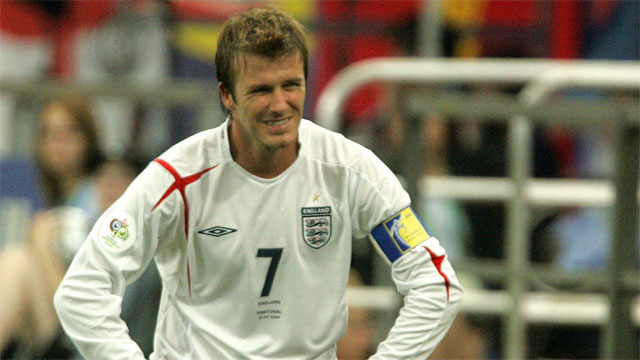

So it will end for David Beckham not at Old Trafford or Wembley Stadium or the Bernabéu or San Siro, or any of the other iconic football cathedrals he graced during his glittering career.
Instead, Beckham’s last match as a professional appropriately comes for Paris St-Germain against Lorient at the Stade du Moustoir. It’s appropriate because Stade du Moustoir doesn’t feature natural grass but a synthetic surface; synthetic meaning artificial. A surface that looks like real grass but isn’t. Something that isn’t quite what it appears to be — just like Beckham.
It’s a perfect canvas for the swan song of the modern game’s most overblown, overrated and overhyped player.
Lots of embarrassingly fawning testimonials will be written in the coming days about Beckham, the former England captain and global soccer star who announced his retirement on Thursday. This column will not be one of them.
Let’s be clear up front so there is no confusion over this correspondent’s view on the matter. David Beckham was a good player. A good player. At times, he was a very good player. But he wasn’t a great player.
It may seem like splitting hairs or quibbling. But precise language is important here because we’re talking about accurately and objectively recording a person’s legacy, and we can’t afford to throw around adjectives like “great” in such a reckless and haphazard fashion. Otherwise, those words lose meaning or become watered down.
And when it comes to describing his on-field skill, overall ability and the quality of his performances over the length of his career, the word great simply does not apply to David Beckham. It just doesn’t. Greatness eluded him.
The Italians, bless their souls, are known for their quirky proverbs, and one in particular perfectly encapsulates the essence of Beckham the player: “Tutto fumo e niente arrosto” — All smoke and no roast.
Translation: All sizzle and no steak. That was David Beckham.
A global sports icon? Of course. Caring father? Absolutely. Passionate and tireless ambassador for the game? Yes. Generally a nice guy? Sure. Helped to increase the awareness about MLS? Yup. A champion at club level? There’s no debate.
But a great player? Not on your life.
Great applies to many of Beckham’s comrades in arms at Manchester United (Ryan Giggs, Paul Scholes and Roy Keane), his teammates abroad (Zinedine Zidane, Luis Figo and Andrea Pirlo) and to his current crop of midfield contemporaries (Xavi, Andres Iniesta and Bastian Schweinsteiger).
It doesn’t apply to Beckham. He wasn’t in the same stratosphere as the aforementioned greats of the game. Let’s not pretend he was.
Even the one thing Beckham was famous for, the one thing he seemed to have a monopoly on and that was his trademark wasn’t unique. Those who claim that no player could “bend it like Beckham” are clearly unfamiliar with the likes of Juninho, Roberto Carlos, Alessandro Del Piero and countless others who were just as dangerous from set pieces and could curl deadly accurate balls into the box.
Beckham was, and still is, a marketing phenomenon; a global brand unmatched in the sports world. And therein lies the problem when discussing him — his celebrity clouds the issue.
Bluntly, the worldwide attention Beckham received was grossly incommensurate with his skills as a player, and his status as a cultural icon is totally incongruent with his standing as one of the top stars of the game. And while the media shares in the blame for that, so does Beckham.
He was never one to go about his business in a quiet and dignified manner. Almost everything in his life was amplified and publicized by his entourage of handlers, and made available for public consumption. He could have lived a quiet life, secure in the fact he was blessed with talent and a certain amount of athletic ability. Instead, he was an unapologetic self-promoter who loved to draw attention to himself and rarely met a paparazzo he didn’t like.
And it worked, because he was routinely the centre of attention and subject of discussions in soccer circles, far more than his skills as a player deserved.
Honestly, would we even be discussing Beckham right now if he didn’t look like a Calvin Klein underwear model? If he wasn’t married to a pop star wife? If he didn’t grace the cover of magazine and billboards around the world? If we restricted the discussion entirely to matters on the pitch?
We wouldn’t.
Let’s also call a spade a spade when it comes to his England career.
A narrative has been allowed to gather credibility over the years, painting Beckham as one of England’s best players. The fact that he earned more caps for the Three Lions (115 of them) than any other outfield player and that he was member of a select group of players to score in three separate World Cups is offered up as evidence.
And then there are the events of Oct. 6, 2001 at Old Trafford when he scored that goal to send England through to the World Cup. That one marvelous and dramatic free kick has been eulogized ad naseum, held up as incontrovertible proof that cometh the hour, cometh David Beckham.
But a more balanced reading of his tenure with England’s national team reveals a career blighted with far more failures than successes.
Yes, he scored a wonderful goal against Greece. But what did he do against Argentina (World Cup ’98), Romania (Euro 2000), Brazil (World Cup ’02), Portugal (Euro ’04) and Portugal again (World Cup ’06) when it mattered most?
That iconic moment against the Greeks should not wipe out the memory of the many important games on the big stage when he routinely didn’t show up — like when he jumped out of a tackle that led to Rivaldo’s goal at the 2002 World Cup, spurring a comeback by Brazil and resulting in yet another early exit by England.
The countless times he was a passenger in critical World Cup and European Championship games are conveniently forgotten and glossed over because they don’t fit into the myth of Beckham the Conqueror.
That he made over 100 appearances was hardly evidence of his importance to England. In the modern game, caps are handed out like candy to kids at Hallowe’en. And the fact Beckham was called into the squad for so many international tournaments, even when he wasn’t 100 per cent fit, said far more about England’s lack of genuine quality than Beckham’s class.
Little wonder, then, that England never achieved anything while Beckham was a major focus of the team. It certainly wasn’t for a lack of trying or commitment on his part. But the truth is that like so many of the Premiership’s “Golden Generation,” Beckham failed to live up to the hype and never really delivered for his country — not in any substantial way.
David Beckham accomplished a lot of which he should be proud. He earned countless trophies and medals at club level. He won individual awards and plaudits. He had millions of adoring fans.
But greatness? No, he never achieved that.