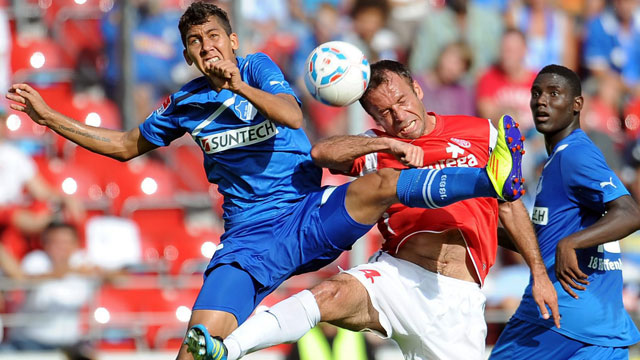

Call them the ‘village team,’ or the club with neither history nor tradition. Call Hoffenheim what you like, but the team from the tiny town in South-West Germany is off to a better start than expected after narrowly escaping relegation last season.
Those who didn’t follow the ending of the 2012-13 Bundesliga campaign too closely missed an unforgettable finish when TSG 1899 Hoffenheim beat Champions League finalists Borussia Dortmund in its final game on the road. Hoffenheim managed to convert two penalties in the final 15 minutes to slip above automatic relegation and into the playoffs, which they won assuredly 5-2 on aggregate against Kaiserslautern.
Soccer Central podcast: Sportsnet is proud to announce the launch of the Soccer Central podcast, hosted by James Sharman, Brendan Dunlop and Thomas Dobby. To listen and subscribe to the podcast, CLICK HERE.
Even Dortmund fans don’t like to be reminded of that match. It depressingly carries with it a sense of guilt in helping Hoffenheim to stay alive, and it all happened inside one of Europe’s most atmospheric football homes, the Westfalenstadion.
But bygones are bygones. Hoffenheim has come out as one of the entertaining and “bang-for-your-buck” sides in the Bundesliga this season by scoring 28 goals, second highest in the league behind Dortmund and just ahead of leaders Bayern Munich and third place Bayer Leverkusen.
It’s the blend of players that make Hoffenheim’s attacking game possible. Midfielder Roberto Firmino, and attackers Anthony Modeste and Kevin Volland possess the type of chemistry many attacking sides can only envy. The strength of that bond is illustrated in their combined 18 goals this season.
If Hoffenheim can keep their young talent together, the future will be bright. The team’s average age is only 24, with two of their promising players—Brazilian Firminio and Germany’s Volland are 22 and 21 respectively. Volland, of course, is already seen as a key part of the next Bundesliga’s next generation. It’s no wonder Hoffenheim locked up the player until 2017. The club’s commitment to young blood will also have it bring in another talented youngster in Jiloan Hamad from Swedish Champions Malmo in January.
But for all the offensive power, Hoffenheim’s defensive frailties haven’t gone unnoticed. The back four is weak and for every goal the team has scored, they’ve also conceded one—their 28 goals against being the league’s highest. It’s nearly the same pace as last season, when they allowed 67 goals, the highest in the league and nearly enough to drop Hoffenheim into the second division.
Scoring prowess aside, Hoffenheim certainly belongs closer to the bottom of the table. But it’s that unexpected offensive threat that has helped them stay in the middle so far. Even last week it wasn’t too farfetched to suggest Hoffenheim were capable of stealing a point or three from Bayern Munich.
But very few teams can beat Bayern, and though Hoffenheim lost 2-1 it’s a scoreline they can accept with pride. While they were hugely outshot, it was a hard-fought victory for Bayern. The match even prompted Pep Guardiola to notice weaknesses in his side and declare he must further amend his concept. No small praise for their opponents, given Bayern’s stature and form.
European Football Weekly: Sportsnet 590 The FAN’s Dan Riccio, Derrick Brandao and Gord Brunt take an in-depth look at the beautiful game on the European Football Weekly podcast. For more details and to listen to past shows, CLICK HERE
It’s a long way for where Hoffenheim once was. In the span of 10 years the team from a village of barely 3,000 residents rose from the fifth division to the Bundesliga. The rise has fostered intense dislike for Hoffenheim, who many see as being artificially elevated by their rich owner, software magnate Dietmar Hopp.
Last season was one of the club’s most disastrous after falling to its lowest finish since joining the top league. The blend of idealism and naivety of the first campaign when they placed seventh and confidently reckoned even winning the title [for which the club could be somewhat forgiven since they were Herbstmeister (fall/winter champions)] are over.
The next two seasons brought some stability as the club comfortably maintained a mid-table position. Those not too familiar with Hoffenheim should know the club was once home to Demba Ba, Vedad Ibisevic, Chinedu Obasi, Luis Gustavo and Carlos Eduardo. But like many small teams keeping talent of that calibre from bigger clubs is never easy and it was only a matter of time before they were lured away.
Hopp and the club initially wanted to create a side depending largely on youth products and young talent, but then experimented by bringing in a slew of expensive signings. When that failed, Hoffenheim went back to its original concept. So for all the legitimate criticism of Hopp, the one positive is the money he’s spent on youth development and training facilities.
While manager Markus Gisdol’s has a decent record with the team since taking over from Marcus Kurz last spring, if there’s no defensive improvement this team will likely face the same fate as last season. The team is only five points clear of the bottom and it doesn’t take much to have them hovering around the relegation zone once more.
Alima Hotakie is a Toronto-based writer. Follow her on Twitter.