THE CANADIAN PRESS
TORONTO — Goalkeepers at next summer’s World Cup in South Africa may need to brush up on their geography — but they’ll be getting some help in physics.
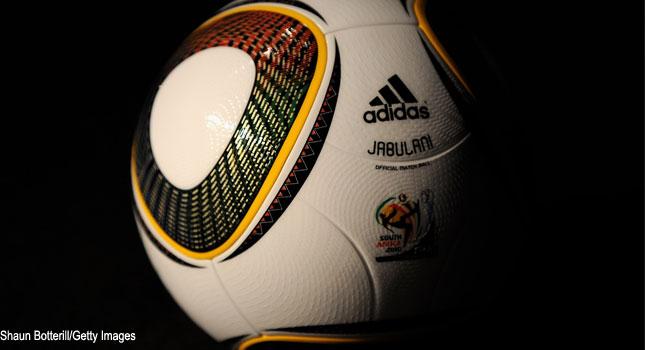
Adidas unveiled its World Cup match ball Friday to coincide with the official group draw. The 32-team soccer tournament kicks off June 11 in Johannesburg and Cape Town, with preliminary-round fixtures split among nine host cities, whose varying altitudes will affect the game — and the new ball.
The Jabulani (which means "to celebrate" in isiZulu) is the 11th World Cup ball Adidas has designed — and according to product line manager Chris Miall, the early feedback is positive.
"The players like it," said Miall. "(It has been tested) in the Bundesliga with Bayern Munich, and some of the MLS teams have been given the ball in advance, and it is well approved by the players."
Through the years, match balls at major soccer events have earned their share of complaints. Goalkeepers at Euro 2008 felt the tournament ball was too wobbly, particularly from long distance. Outfield players contended the ball was often too light, resulting in kicks that sail over the goal.
Adidas has responded with new technology aimed at satisfying everyone.
The Jabulani features eight 3D panels moulded together on the inside, making it as round as any ball preceding it. The surface features grooves designed to make the ball’s flight path true, limiting instances where the ball will duck and dip in mid-air. The ball is also easier to grip, thanks to thousands of small raised bumps.
"You’re getting a true spin, so that it’s predictable for both the fielder kicking or passing the ball as well as the goalie," said Miall. "There’s also the grip, so when the goalie is diving out for it, it will stick to his gloves as opposed to slipping right through."
The innovations should provide some relief for ‘keepers, who will need all the help they can get in South Africa.
A new study done by Adidas shows that altitude at the World Cup will have an impact of up to five per cent on a ball’s speed. That means, according to the study seen by The Associated Press, that a free kick from 20 yards during the final at the Soccer City stadium in high-altitude Johannesburg will reach the goal line five per cent faster than it would at the Moses Mabhida stadium in sea-level Durban.
The translates into a free kick travelling at an average 126 km/h at high altitude, compared to 120 km/h at sea level.
Miall said that, while the Jabulani may not account for variances in altitude, it should follow whatever path the kicker desires.
"It’s designed to go truer," said Miall. "If your goal is to kick the ball straighter, it will fly as you struck it. If your goal is to ‘bend it like Beckham’, then it will bend like it’s supposed to."
Former Toronto FC star Danny Dichio said ball technology has come a long way since he first broke in with Queens Park Rangers in England in the early 1990s.
"When I first started, we were using medicine balls, it was that long ago," said the 35-year-old Dichio, who retired in September. "But you can see significant changes in the ball even over the past few World Cups.
"Now you come in with a ball like this … compared to when I first started playing, it’s night and day."
Dichio realizes that some people might wonder why Adidas bothers to tinker with the ball so much. But he says world-class athletes deserve a world-class ball.
"Without (a good ball), the game is nothing," said Dichio. "The puck never changes in hockey, but (in soccer) the ball is everything. I’ve been in games before where a referee changed the ball three times because people were complaining about it.
"Teams put a lot of preparation into the World Cup. A lot of these guys will be training with these balls when they go into their camps. They have to train with them."
The new ball is also appealing to the eye. The Jabulani features 11 different colours — representing not only the number of players in a team’s starting lineup, but also the 11 official languages and the 11 communities of the host country. The World Cup runs from June 11 to July 11.
The ball, which is went on sale following Friday’s World Cup draw, will sell for $150.
Miall said he wouldn’t be surprised if engineers were already working prototype balls for Euro 2012 or the 2014 World Cup.
"They’re always pushing forward," said Miall. "We plan our product 18 months in advance of when it actually sells. I promise they’re already looking at how they can make this ball better.
"They’ll take the results they’ll see from the World Cup, and if there are complaints from the players for whatever reason, they’ll take those into account and make the next ball better. Our goal is to make the best soccer ball in the world."
— With files from The Associated Press.