BY GARY MELO
sportsnet.ca
When the World Cup kicks off in South Africa next month, fans across the globe will don their national colours to root for their countries of heritage.
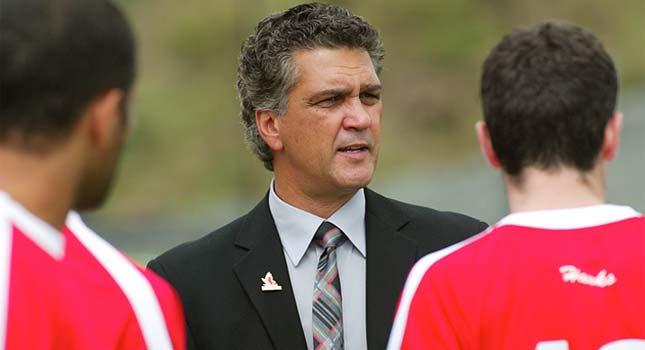
For American-born coach Dan Gaspar, it’s his roots that summoned him to next month’s tournament.
Gaspar was hired by the Portuguese soccer federation to serve as goalkeeper coach on manager Carlos Queiroz’s staff for South Africa 2010. Born to Portuguese parents in South Glastonbury, Conn., it’s a challenge that Gaspar takes great pride in tackling, ever since receiving the e-mail invitation from Queiroz on New Year’s eve of last year.
“My blood is Portuguese,” said Gaspar, who initially resented having to learn the Portuguese language as a child. “If it wasn’t for my parents’ commitment and love for their culture, I would not have had this opportunity today. So I’m extremely proud to be a Portuguese-American.”
 Dan Gaspar will give sportsnet.ca an insider’s view of the 2010 World Cup as Portugal’s goalkeeper coach. Watch for Gaspar’s blogs throughout the tournament as he provides a perspective of what it’s like to be on the pitch and in the clubhouse with Team Portugal in South Africa.
The opportunity stems from a unique relationship that Gaspar shares with Queiroz, one that began nearly 20 years ago, well before the head coach went on to manage at Real Madrid and serve as No. 2 in command at Manchester United.
During Queiroz’s first stint as national manager, the Portuguese team was invited to the U.S.A. Cup in 1992, a four-team, round-robin tournament that also included Italy and Ireland. Gaspar, volunteering as a liaison between Queiroz’s squad, U.S.A. Soccer and a local Portuguese club, issued a challenge to the young, up-and-coming manager.
“The challenge I presented him with was, ‘If we, as a small nation, can produce the best players in the world like Eusebio, why is it that we haven’t been able to develop one of the top goaltenders in the world?’ So he persuaded the (Portuguese) federation to let an American-born coach to come over and help them.”
Gaspar first worked with the national team during preparation for Portugal’s final World Cup qualification match against Italy in 1993. A Roberto Baggio goal secured a 1-0 victory for the Azzurri, eliminating the Portuguese from contention for the 1994 World Cup and shattering Gaspar’s dream of taking part in the world’s most prestigious tournament on his home soil. He has worked with the national squad on a few occasions since then, but rejoins a program that has made significant strides since that devastating defeat at the San Siro stadium.
“I think the national team has grown tremendously since then,” Gaspar said. “Back in those days, when the Portuguese national team played Italy or Brazil or Argentina or England, there was some concern and fear of losing; some doubt on whether or not they could compete. Those days are in the past. That’s history. The Portuguese national team of today is confident that they are capable of beating anyone in the world.”
Portugal has flirted with success on the international stage in the last decade, earning results the nation hasn’t seen since its third-place finish at England 1966. Heartbreaking semi-final losses to France at Euro 2000 and again at World Cup 2006 as well as a second-place finish as hosts of Euro 2004 has shown that the national program is capable of contending at this summer’s showpiece.
“We are optimistic that we are a capable team, but we also have to understand that this is a competition that has been built up for two years with 204 nations in 850 games and now is down to 32 teams.”
Just making that final cut of 32 teams proved difficult for Portugal. A sluggish start to the qualifying campaign forced them into must-win scenarios down the final stretch and, ultimately, into a tricky, two-legged playoff against Bosnia-Herzegovina.
“There were probably a few people who thought Portugal weren’t capable of qualifying when they had to win their last six matches, but they did. That’s a tribute to the coaching staff and the players, to their commitment and pride. And that has prepared us for the battle. We are battle-tested now.”

Just how much stronger the squad is following its qualification journey will be tested early in South Africa. Portugal was drawn into what many consider to be the “Group of Death,” joining the world’s No. 1-ranked Brazil, Ivory Coast and North Korea in Group G. According to Gaspar, however, any group at the World Cup can be considered dangerous.
“I really don’t believe we are in the “Group of Death.” I believe they are all groups of death. I believe any team is capable. You have the Brazils, Italys and Argentinas who have a history and will more than likely be a factor but then there are always surprises at a World Cup. I think the game of soccer itself can be so unjust. Often times, you can be a team that dominates and plays a beautiful game, but in the end you don’t always get the result you deserve.”
Players have been trickling into the Portuguese camp — based in the northern part of the country so the team can train at a higher altitude — since last Friday as domestic leagues across Europe wrapped up. The full squad is expected to arrive by Saturday and the team leaves for South Africa on June 5, touching down six days before the tournament kicks off. They will hold two training sessions a day as well as preparation matches against Angola, Cape Verde and Cameroon — three nations that play more of an African-style game, something Portugal will see in its opening match against Ivory Coast on June 15.
The challenge facing the coaching staff in the next few weeks will be to create team unity, a task that Gaspar doesn’t take lightly considering the long road he’s taken to earn this opportunity.
“Our goal as a staff is to make sure the team has one goal to play for, one jersey, one dream, one heartbeat, one national anthem. We want to create a family atmosphere and I will do everything I can to help achieve that because this has been a long journey for me, a 16-year journey, with many sacrifices along the way. These things don’t happen overnight and they do happen for a reason. I believe this was my destiny.”
And a long road it has been. Gaspar, in his fifth year as head coach of the University of Hartford men’s soccer team where he was a student athlete from 1974-1977, has worked on three different continents at all levels of the game. His head coaching resume includes a stint with the Connecticut Wolves, who played in the USL’s A-League against the Toronto Lynx, and the Hartford Portuguese soccer team, whom he led to the finals of the U.S. Open Cup. He’s also worked with Queiroz several times before, during spells with the New York Metrostars (now the New York Red Bulls) of Major League Soccer, Nagoya Grampus of Japan’s League Division 1 and the South African national team.
Gaspar’s ventures overseas would not have been complete without stops at the club level in his parents’ native Portugal. He’s worked with the “Holy Trinity” of Portuguese soccer, spending time at Sporting CP, Benfica and FC Porto. All his travels, however, were made with the sole purpose of bringing that experience back to the U.S., even if it meant passing up the final two years of his contract with one of Europe’s biggest clubs.
“I always dreamt about going overseas to learn as much as I could about our beautiful game, where soccer was immersed in the culture,” Gaspar said. “However, my ultimate goal, to fully complete the circle, was to return to my alma mater. And when that opportunity was presented to me, I embraced it even though I had two years left on my contract with FC Porto. Any normal soccer person might tell you that I was crazy to leave FC Porto, but I always felt I wanted to return to share my unique experiences and develop the game in the United States.”
Gaspar also continues to work at the grassroots level, playing key roles with the Connecticut Soccer School and Star Goalkeeping Academy, a program he founded that works with players as young as 10 years old right up to professionals on an international level. The camp trains goalkeepers in all facets of game, including mental and physical preparation as well as in-match sessions.
“You can train the goalkeeper on a separate island from the rest of the team to refine their skills, but to fully maximize their development they have to play the game. Dan Gaspar isn’t the best goalkeeper coach in the world. The game is the best goalkeeper coach in the world. We try to combine those two components (skill development and in-game experience) to maximize their growth.
“We live, eat and breathe the art of goalkeeping and the art of soccer.”
And beginning on June 11, the rest of the world will join Gaspar in doing the exact same.
Dan Gaspar is the head coach of the University of Hartford men’s soccer team and founder of the Star Goalkeeper Academy. He will be blogging for sportsnet.ca during the 2010 World Cup in South Africa while serving as goalkeeper coach for the Portuguese national team.