THE CANADIAN PRESS
MONTREAL — Tennis Canada hopes the addition of four clay courts at its facility in Montreal will help develop better all-around players.
The covered courts unveiled Wednesday are the centrepiece of $5.2 million in improvements to the centre, with costs shared between Tennis Canada and three levels of government. Previously, the facility only had indoor and outdoor hard courts.
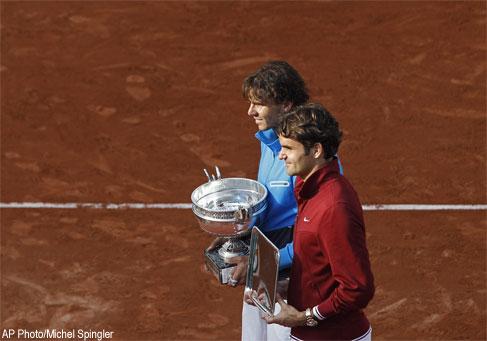
The new surfaces at the National Tennis Centre will give elite players a chance to learn the game both on the quick hard courts that are most common in North America and on the slower clay that is the widely used in Europe and South America.
The courts are made of a green clay called Har-Tru, which is easier to maintain than the red clay used at the French Open and other tournaments.
Davis Cup captain Martin Laurendeau says it’s important for players to learn how to play on clay, where they can slide into strokes, where points are longer, and where a wider variety of shots are needed than on hard courts or grass.
"On hard courts, you can blast your opponents off the court," he said. "Things happen quicker. The footing is much better so you can line up your shots and lay into them.
"In other countries, they play on clay since they’re four years old, so they learn all the subtleties — working the whole court, not relying on power alone, but wits. Physically you need to be in much better shape. But the biggest difference is psychologically. You’ve got to run more and work your point three or four shots ahead. It’s more like playing chess."
Laurendeau says the courts may help the men’s Davis Cup and women’s Federation Cup teams prepare for clay court ties in other countries, but the biggest benefit will go to kids working their way up the ladder.
"Ultimately, it’s the youngsters who are going to learn how to slide, use a drop shot and angle shots and not play three or four shot rallies, but 12 or 14 shot rallies," he said. "And when they turn professional, their base will be really solid and they’ll be able to play on slow and hard courts."
On hand for the announcement were several members of Canada’s junior team, including 16-year-old Kimberley-Ann Surin, daughter of Olympic sprint relay gold medallist Bruny Surin.
"It’s good for me because I’m not used to playing on it," said Surin, a strong server who admits her game is not best suited to clay. "Canadians are not really good on clay. It’s not our favourite surface, so it’s going to be good."
Space is an issue at the centre, which is in a public park, so the new courts were put on a new floor added to the main building. Large garage-style doors all around can be opened in summer and closed in winter to make it a year-round facility.
Clay courts have some give, so the ball slows a little and bounces higher than on hard courts, allowing players to get to shots they wouldn’t have a hope of returning on a faster surface.
Green clay is slightly faster and has a little less bounce than red, but the game is almost the same, says Tennis Canada vice-president Eugene Lapierre.
"It’s a dream we’ve had since we started the national centre," he said. "We hired coach Louis Borfiga from France, who had worked with the top French players, and the first thing he told us was ‘You guys need clay courts.’
"There weren’t many options, so we decided to build it on the roof. It was a crazy idea. I’ve never seen that anywhere in the world."
Also added were new gym, classroom space, expanded locker-rooms and a coaches office.
Tennis Canada put up $1.3 million of the cost, the same as the city of Montreal. The Quebec government threw in $1.6 million and the federal government $1 million.