Content warning: this story contains discussions of suicide. If you or someone you know is struggling and needs help, please contact the 9-8-8 Suicide Crisis Hotline.
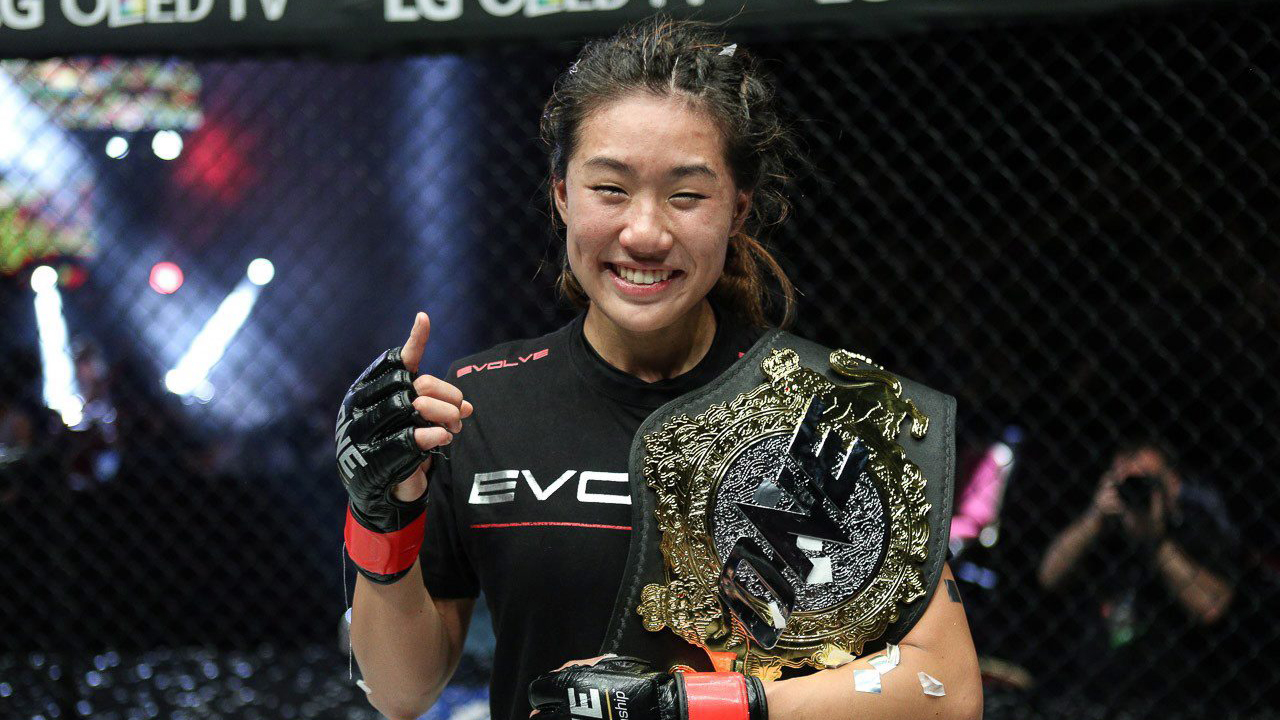
At the beginning of 2023, Angela Lee Pucci was unsure about her next steps.
The Vancouver-born mixed martial artist hadn’t fought since losing her ONE Championship women’s strawweight title in October 2022, and was reeling from a much greater loss outside of the cage just a few months later.
On Dec. 26, 2022, her younger sister, Victoria, took her own life. A budding mixed martial artist herself, she was 18 years old.
“I didn’t know what I was gonna do with myself, and I needed something to focus on,” said Pucci, speaking with Sportsnet recently on the eve of what would have been Victoria’s 21st birthday. “I was thinking about channelling all these different emotions, doing a lot of reflection myself, thinking that — it wasn’t my place, it’s not anyone’s place to tell Victoria’s story about what had happened with her, but I can share from my own experience the things that I’ve gone through, and I also didn’t want to hide the fact that my sister died by suicide.
“My family was very much against me speaking out about that, and I just don’t think that it’s something — I didn’t want people to think it was something our family was ashamed about. For me, it’s not about that. I think everyone goes through challenging times, and it’s just more about how can we support them through it? The fact is, we all go through ups and downs, we all struggle, and how can we support one another to get out of those tough times?
“That was all of 2023,” she added. “The early months of the year were kind of a blur, and I was thinking to myself, ‘Well, I want to do something to help people,’ which is something that my sister always wanted as well, and I tried to think, ‘What’s something I can do in my own way?’
“So I started with me and sharing my story, in hopes that it would help other people as well.”
In September of that year, Lee Pucci announced her retirement from mixed martial arts, and shared her own story in a powerful, difficult piece entitled “Resilient” on The Players’ Tribune.
In the piece, the now 28-year-old fighter explained that the car accident she had in November 2017 was, in actuality, a suicide attempt.
Set to defend her atomweight title, the pressure and stress of her situation all became too much for the young star, and the night of Nov. 6, she climbed into her car intent on ending her life. She sped down a familiar road she routinely traveled to go to the gym and veered her car into the guardrail.
She survived, suffering burns and bruises, but never disclosed what really happened publicly until penning her story for The Players’ Tribune.
That was also where she spoke about her sister’s death, and the creation of FightStory, the organization whose stated mission is to be a platform “where fighters unite to revolutionize combat sports, inspire hope, and champion a global movement of mental and physical wellness.”
Addressing the issue
In her book Stars At Last, author Jessica Jocelyn penned a poem entitled “burn the family tree down” that reads as follows:
I am the villain for not being meek
for not falling into place
with the
long line of women before me.
silence meant survival
but I don’t just want to exist,
I want to live.
I am the first to start the smoke
so that my daughter
can breathe fire.
Lee Pucci shared it with me, and identified it as a resonant piece that helped crystallize for her that the time for addressing her own mental health issues and the larger need to discuss these issues openly is now.
“You can’t just keep turning away and choosing not to see it; you can’t keep sweeping it under the rug,” she said. “This is an issue that’s growing by the day, and it’s important that we all come together to realize that and take action towards doing better, especially for our next generation.
“I think in the U.S. more people are open to talking about it, but we still have a long way to go. Men have a harder time speaking up, speaking about it just because of the stigma, and then you go into the fight world, and fighters are supposed to be portrayed as these warriors, so that makes it even harder.
“But we’re trying to slowly peel those layers and show people that even though we might be fighters or entertainers or actors — whoever you maybe put on a pedestal — they are just like you. We’re all the same. We’re all going through this human experience, and seeing people like athletes, entertainers as people, as human beings, having more grace and compassion and empathy for each other and also for ourselves (is tremendously important).
“I come from Asian heritage, and the culture there is still very much,” she continued, pausing to find the right words.
“We still need a lot of work,” Lee Pucci said with a chuckle. “There is so many generational things about speaking up, and I think it’s so crazy, I’m so done with that. That’s why I shared my story. I’m pretty much yelling from the rooftops.
“There is this one poem or saying that I came across and it’s saying ‘burn the family tree down,’ and it’s pretty much like ‘whatever has been happening stops with me, and I choose to be different, have a different way of doing things for my daughter, how I want her to grow up feeling safe and able to communicate what she’s going through.’
“I just think we can always do better, so why don’t we?”
One of the ways that FightStory wants to help in that regard is through its Mental Fight Kit, a collection of exercises and tools designed to assist combat-sport athletes navigate the mental challenges that present themselves before, during and after fights, as well as in day-to-day life.
“I’m so excited about the Mental Fight Kit because I don’t think there is anything like this out there right now, but it is so needed,” said Lee Pucci. “There’s going to be so many different concepts and exercises and tools in here that are going to help with the fight mindset when you’re preparing, leading up to your fight, but its going to help with outside of the cage as well because fighting is just a season of our lives, and life is a lot more than that.”
For the former ONE Championship two-division champion, everything comes down to making mental health a relatable issue, and showing people that they are not alone in their struggles.
“(We want to show that) mental health, mental performance is not such a scary topic; something they can break down and understand,” began Lee Pucci, who noted the Mental Fight Kit will go through its testing phase throughout the remainder of 2025, with an anticipated launch at the outset of next year. “At the end of the day, we go through these experiences, we learn something from it, and we try to pass it on, share the knowledge because it’s not that life is going to be all great all the time.
“There are going to be difficulties and things you’re gonna have to overcome, but if you hear from someone that has walked that path, and learn from there experiences, pick up something that can help you…”
She paused momentarily.
“If we can help one person or save one person,” continued Lee Pucci. “That was what I told myself in the beginning: if we can help one person, it will all be worth it.”
Others joining the fight
Last weekend, UFC lightweight Jared Gordon scored a first-round knockout win over Thiago Moises in Las Vegas to get himself moving in the right direction again following a couple years of hard-luck losses and frustrating setbacks.
Speaking with Michael Bisping inside the Octagon following the win, the 36-year-old veteran gave thanks to Jesus and his wife Christina, and his sponsors, Diamond Recovery and YoungLA, before turning his attention to his role with FightStory and the effort the organization is making to help combat sports athlete.
“I’ve partnered with Angela Lee, who started FightStory to help combat athletes with mental health issues, anything from sports psychology, anxiety, stress; fight camp stuff,” said Gordon, who is in long-term recovery and has always been candid about his previous issues with drug abuse, as well as his desire to help those in need. “We’re here to help. UFC has partnered with us, and all we want to do is help.”
Gordon explained how he came to be a part of the Board of Directors for FightStory when we spoke ahead of his last appearance in the Octagon.
“Angela Lee is a mutual friend of my buddy Mike Bayer,” began Gordon. “We created a relationship and he was like, ‘My friend Angela has started this thing — you must know her story with her sister who took her own life. I think that you should give her some direction, especially with the UFC, and being that you’re a mental health advocate as well, I think it would be a perfect fit.’
Gordon reached out, the two began talking, and he quickly got onboard with the project.
“We started talking and we were able to compile a team of people who created a platform which will be used to support combat athletes in fight camps with mental health stuff. There are a lot of moving pieces, but we’re working hard, we’ve got a lot going on, and we’re going to be able to offer a lot of support to a lot of people.”
For the UFC veteran, the synergy between his own desire to help others and the approach FightStory is taking was a perfect match — and it put him in a position where everything he’s wanted to do with his career outside of the cage is finally falling into place.
“I’ve always said that my purpose is to help people, so this means a lot to me,” said the Queens, N.Y., native and Kill Cliff FC representative. “I’ve lost so many people and everyone in this world has been impacted by addiction or mental health disorders in one form or another.
“Coming from where I came from to where I am now, it’s insane. I always wanted to help people and now I’m doing it. This is what I fight for, this is why I do it. I keep fighting because I need the platform, and I need to climb as high as possible because the higher ranked I am, the more reach I have.
“I’m not just a fighter now,” he added. “I’m a board member with FightStory and the UFC has me doing other things. This is where I wanted to get in my career, what I always wanted to do, and I’m happy to have this opportunity.”
As Gordon mentioned in his post-fight time with Bisping, Lee Pucci and the team at FightStory recently announced that the UFC had come onboard as an official charitable corporate partner, with the support of the mixed martial arts leader serving as a massive boost for the organization.
“Honestly, we are so thrilled and really grateful for them being willing to make it a priority — not just bring awareness to the importance of mental health, but actually taking steps to support their athletes and their well-being,” Lee Pucci said when asked about the partnership with the UFC. “They didn’t need to do that: I’m not a fighter from their organization, but I think that it speaks volumes to who they are as an organization and hopefully sets an example for other organizations to follow.”
Next steps
For Lee Pucci, opening up about her own struggles and the launch of FightStory has been a complicated, emotional journey, with the highs of seeing others benefit from her sharing her story, offset by the deep sadness and feeling of loss she carries every day.
“I think it helped me just as much as it helped others, but it was also really difficult at the same time, because each time that I felt I was talking about my own story, my own journey,” she began, taking a beat to gather herself before expanding.
“FightStory is so close to my heart because of why it was founded.
“Every time I was thinking about my story or telling it, it reminded me that I wished my sister got that second chance; I wish she was here. It was pretty painful. Other people sharing their experiences and that it was helping them also helped to balance those feelings, but it was a lot.”
Difficult as it has been — and will continue to be — it’s speaking about those emotions, identifying those struggles and being open about them in a space where such conversations have historically not taken place that is, at its core, the north star for FightStory.
And in addition to continuing to build out the Mental Fight Kit to get it ready for its launch next year, Lee Pucci is hoping to have more of those conversations in gyms throughout North America and around the globe, knowing just how important doing so can be.
“We are looking to do more events here and there,” she said when asked what more people can expect to see from FightStory in the coming months. “I would love to go down to Florida and have Jared host a FightStory event there.
“What we like to do is share our skills and expertise, which is fighting, but then we also gather people around and have a talk. Doing those two things — everyone training and then everyone sitting down on the mat, sharing stories, being open — it’s so crazy to see, because usually on the mats because with that fighter mentality of putting up your walls, breaking that down and taking those steps towards change, normalizing those conversations about ‘we all good through this, and how can we get better together, leaning on each other’ (is amazing).
“So more FightStory events, and hopefully more partnerships to come,” she added. “Hopefully this partnership with the UFC will encourage more companies to want to consider prioritizing athlete mental health.”
For more information on FightStory, please check out their website: fightstory.org
Editor’s note
If you or someone you know is having thoughts of suicide, help is available. You are not alone. For readers in Canada, here are some resources.
— Crisis Services Canada, which can be reached by phone at 833-456-4566.
— Residents of Quebec can call 866-277-3553 (APPELLE).
— Regional text messaging services can be found on the Crisis Services Canada website.
— Kids Help Phone, which can be called toll-free at 1-800-668-6868. A text option exists too by texting CONNECT to 686868.
— Hope for Wellness Help Line, a service available to all Indigenous peoples across Canada who need immediate crisis intervention that provides experienced and culturally sensitive help-line counsellors if you want to talk. An online chat option exists too.