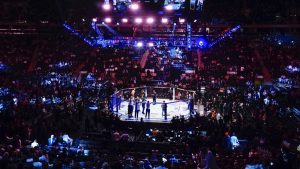
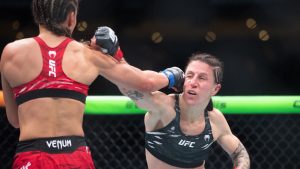
LOS ANGELES — Before Joe Rogan could even finish congratulating him following his second-round TKO of top-10 lightweight Jalin Turner at UFC 300, Renato Moicano, blood staining his swollen right cheek, grabbed the mic and took over.
“Joe (expletive) Rogan!” he bellowed, veins protruding from his neck. “I am a huge advocate of the First Amendment. And let me tell you something. Today, I want — of course I want the ($300,000) bonus. But they're not going to give me. Because somebody asked — they say, 'Hey, this is (expletive) Disney. You cannot curse.' So, I’m not going to do my speech.”
And then, without breaking breath, he did his speech anyway.
“I love America. I love the Constitution. I love the First Amendment. I want to carry and own (expletive) guns. I love private property. And let me tell you something. If you care about your (expletive) country, read Ludwig von Mises and the six lessons of the Austrian economic school, (expletive)!”
Yes, that would be the long-dead free-market economist von Mises, whose critiques of socialism and embrace of a free-market system governed by human nature and individual liberty rather than the state made him a forefather of the modern libertarian movement.
And yes, Moicano is in fact referring to von Mises’s 1979 text, Economic Policy: Thoughts for Today and Tomorrow, which contains a series of lectures he gave in Buenos Aires in the late 1950’s reflecting on his philosophies of capitalism, interventionism, and the evolution of social systems.
And of course you didn’t come here for any of that. But you didn’t flip on the UFC for it, either. Yet, there Moicano was, thrusting political philosophy and economic theory into a world of half-naked men and women fighting in a cage for entertainment. See, we told you politics and sport are inseparable.
“I’ve been in the UFC for 10 years. And I didn’t have many fans,” Moicano says. “And now, some people like my work, like what I say, think I’m funny. And I’m happy with that. … But, to be honest with you, I don’t care too much. I’m not here to please anybody. I just want money.”
Freewheeling stream of consciousness like that, delivered at full octave during his raucous, unpredictable post-fight interviews, has helped transform Moicano from an unflashy featherweight prospect who hit a wall just as he reached the weight class’s upper echelon in his late-20’s, into a bellicose lightweight veteran who’s forced his way up the divisional ladder with a stylistic renaissance in his mid-30’s, reeling off four wins in a row.
It's a remarkable feat. There’s an alternate path, one many fighters before have taken, on which Moicano accepts he reached his UFC ceiling, grows bitter, dispassionately fights out his contract, and spends what’s left of his career taking what cheques he can get from lower-tier promotions to make ends meet. But Moicano’s story is one of ingenuity and spirit, as corny as that sounds.
Watch UFC 311 on Sportsnet+
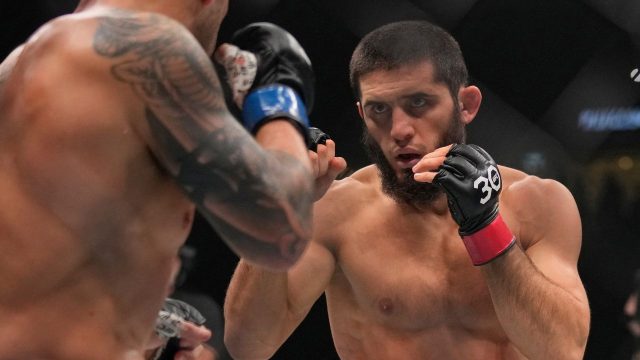
Islam Makhachev faces Renato Moicano for the lightweight title and Merab Dvalishvili takes on Umar Nurmagomedov for the bantamweight championship. Watch UFC 311 on Saturday, Jan. 18 with prelim coverage beginning 8 p.m. ET / 5 p.m. PT, and the pay-per-view main card starting at 10 p.m. ET / 7 p.m. PT.
Purchase the event
He reckons the turning point was the birth of his first son, Isaac, in 2020.
“I say, 'man, I'm (expletive). Now I have to take care of him for the rest of my life. I need money. I need a better house. I need to take care of stuff,'” Moicano recalls. “So, that changed this whole process — mindset and stuff. Because fighting is very real. If you lie to yourself with fighting, you're going to end up losing again.
“I remember old days, fighters, they used to gas out on fighting. They say, 'No, I have something in my nose. I have to get my nose fixed and I'll be fine.' No, this is just a lie. You have to look at yourself and say, 'What are you doing bad? What are you doing wrong? What do you have to correct?'"
For Moicano, that meant a strategic evolution that’s seen the orthodox striker rely less on his boxing and lean heavily into a foundational aspect of his game — grappling. It’s a skill he’s been training since he was eight, but one he didn’t utilize in his featherweight days because he was worried the energy cost of shooting takedowns would make him less effective as fights wore on.
The problem wasn’t the wrestling — it was the conditioning. So, naturally, he began drilling that. A lot. Round after round of hard grappling at American Top Team in Coconut Creek, Fla. Takedown after takedown. Reversal after reversal. With time, Moicano’s cardio improved. And his confidence on the mats returned.
Moicano’s ability to exert control on the ground, chaining each technique into the next to continually stay one move ahead of his squirming opponent, is the kind of second-nature flow only accessible to those who have been rolling since childhood. But his improved conditioning has allowed him to add devastating striking from top position, diversifying Moicano from the submission artist we saw earlier in his career. He now has multiple ways to take you out of a fight if you let him get you on your back.
That approach was critical against Turner, a much longer fighter who Moicano was never going to overcome if he accepted a striking match at distance. And if there was any question of that, it was answered by Turner dropping Moicano with a counter left late in the first round.
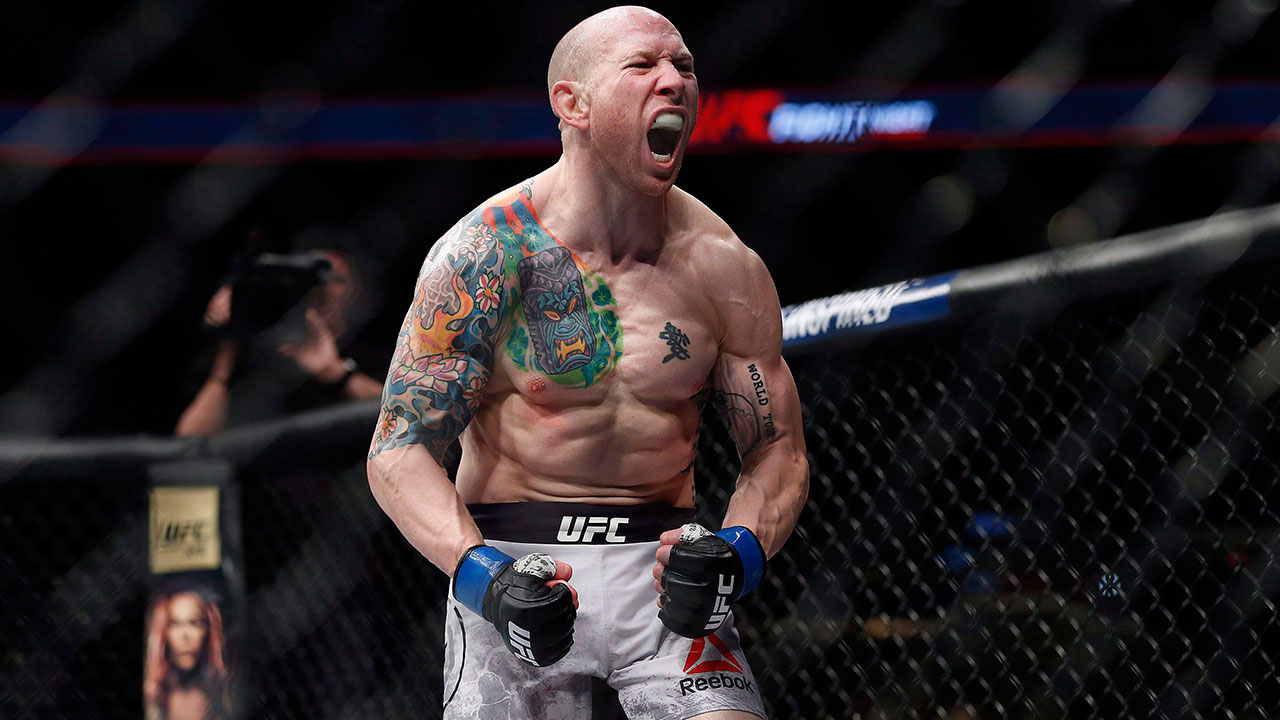
But Turner lacked urgency in seeking a finish, which was all the space Moicano needed to get back to his feet, still wobbled, and find his way to the end of the round. In the second, likely still seeing stars, Moicano forced the fight into his world, transitioning effortlessly from a double leg takedown to mount, before calmly and patiently working his way to the ground-and-pound finish.
Even his win prior — a unanimous decision over stout knockout artist Drew Dober — saw Moicano shooting early and often, landing three of five takedown attempts over the first two rounds and finishing the fight with over 10 minutes of control time. Same thing his last time out in September, fighting well-rounded French prospect Benoit Saint Denis in Paris, when the new tactics took on a new level of necessity.
After suffering a training injury three weeks before the event, Moicano began the Saint Denis fight with a severely compromised shoulder that worsened quickly as his clavicle separated from his AC joint, creating a protrusion near his neck. But Moicano gritted through it, spending the majority of the first round dishing out punishing ground-and-pound that ultimately swelled Saint Denis’ face to the point he couldn’t see, let alone continue fighting.
So, that’s one half of Moicano’s late-career breakout. The other is individuality. The fight business is an entertainment business, like it or not. Audiences crave eccentric personalities. A four-fight win streak against tough opponents often isn’t enough for an athlete to breakout like Moicano has. You must be interesting. People need to want to watch you fight. And for many, Moicano’s appeal and elevation to fan favourite has more to do with what he says after his bouts than what he does during them.
“I have been in UFC for a long time — but people don't know me because back in the day my English was not that good and I didn't have the same mindset,” says Moicano, who honed his self-taught English through gym interactions and online gaming. “In Brazil, it's very bad if you talk like I'm talking right now. People judge you and they say, 'Hey, you have to be humble.' But this is the fight game. People want to hear that, you know?”
Moicano’s always been high-energy and a little off kilter, but as he was climbing a pair of divisional ladders over the past decade, his post-fight interviews were typically boilerplate. Here he is after his 2014 debut when he choked out Tom Niinimaki and used his mic time mostly to atone for a lack of action in the fight:
The other things to take away from that moment? No branded UFC kit. The cornerman in board shorts and a tank top. A baby-faced Jon Anik conducting the post-fight interview as part of a B-team commentary desk for a Brazil card. That’s how long Moicano’s been around.
Flash forward to 2020 and, after sinking a first-round rear naked choke on Damir Hadzovic to win his lightweight debut, Moicano was somewhat more animated, speaking smooth English to a Brazilian crowd. But he still stuck mostly to his usual talking points of family, respect, and God, before suggesting he fight Paul Felder next and calmly asked Michael Bisping what he thought of the matchup:
Moicano first mentioned his infatuation with money a year later when he slept Jai Herbert on a UFC Apex card, but he was restrained in doing so, talking about how he’d use his winnings to help pay off his house. The true turning point came when he earned the seventh rear naked choke stoppage of his career against Alexander Hernandez at UFC 271 in Texas:
Moicano absorbed the generous pop that Houston crowd gave him and carried it into his next win — yet another rear naked choke, this time in a short-notice fight with Brad Riddell at Madison Square Garden — when he really went in post-fight:
“(Explitive) Joe Rogan!” he started, cutting off the planet’s most popular podcaster. “What’s up, biggie apple? This man’s the guy. Hey, where we at? I thought we were in New York. New York is (expletive) awesome!”
A maestro of the moment, Moicano let the commotion calm and allowed Rogan his share of the stage. He answered a question directly. He shared perspective on his career. He let the crowd swell back up. He grabbed the mic again.
“Hey, Renato, I have to be on the (expletive) ranking, man!,” he roared. “This is disrespect. I took a fight, five-round fight, in four days’ notice. Short day notice. I was (expletive) drinking beer, eating steaks in Brazil. And they called me, and I’m come here, I travel 24 hours, and (expletive) disrespect me. I want the (expletive) bonus. Moicano. Wants. Money!”
And a star was born. Moicano’s continued turning up the volume since, bookending his unanimous decision over Drew Dober early last year by shouting out his 62-year-old father’s newborn (you read that right), pledging to continue doing his part to populate the world, and sharing his goal of pursuing policework and becoming a SWAT team member when his fighting career is over.
Then came the Turner fight, after which he weaved from a book recommendation to a podcast plug to cutting a WWE-style promo about the need to feed his family and fulfill his dreams.
And finally, September’s win over Saint Denis in Paris, when he stupefied Bisping with broken English, shared his reflections of visiting The Louvre, denounced the 1789 French Revolution, and called democracy a fallacy while recommending the crowd read Hans-Hermann Hoppe’s Democracy: The God That Failed.
“You have to understand — in Brazil, Jose Aldo, Anderson Silva, they were my idols when I was young. I wanted to be like these guys who are humble, old souls,” Moicano says. “But then I lost to Jose Aldo. And I lost to Korean Zombie (Jung Chan-sung). And everybody that was cheering for me started to criticize me on the internet. 'Ah, this guy's bad. This guy's a bum.'
“And then I realized, (expletive) the fans, you know? Why am I here? To make money. And then this whole character, this whole persona, come up. … I realized, (expletive) that. (expletive) everything. I'm Just going to be myself. I will enjoy fighting. I will talk some (expletive).”
Indeed. There is a deeper examination to be had about how the complexities of Brazilian politics and culture, intersecting with the chaotic and unrestrained world of MMA, have influenced Moicano’s libertarian views. And he’ll spend half an hour walking you down that road of political self-determination if you ask. He isn’t out here referencing von Mises for show.
But Moicano would like to be known as more than an offbeat character who has everyone anticipating what he’ll say next. He’d like to be lightweight champion. And the next obstacle in his way as he continues this unlikely late-career charge up the rankings is lightweight veteran Beniel Dariush, a Brazilian jiu-jitsu black belt and multiple time world no gi champion.
In Turner and Saint Denis, we’ve seen Moicano defeat highly touted prospects. In Riddell and Dober, we’ve seen him best heavy-handed veterans. But Dariush’s grappling pedigree presents a much different challenge at UFC 311. There’s also no longer an element of surprise. Moicano’s late-career tactical adjustments have been laid bare on film. His tenacity, too. No one’s underrating him anymore.
“He’s obviously a veteran. He has a lot of fights, a lot of experience. All the tools. But I think what makes him special is his game planning,” Dariush said. “Him and his team are able to put together a really good gameplan. His last fight, you could say Benoit is more athletic, more dangerous. But within 30 seconds of the fight, the timing of that takedown, the way he got that takedown, it completely changed the fight.”
As competition continues to improve, and Moicano’s game continues to age, can he keep this going? Is he about to become one of the more unlikely lightweight title contenders we’ve seen in eras? We’re about to find it.
But even if not, Moicano’s showmanship gives him a better landing should he reach another plateau. Most fighters recoil from that limitation back into relative obscurity. But Moicano’s given fans a reason to watch his fights, and thus a reason for UFC to continue featuring him prominently on cards, whether he’s a legitimate contender or not.
“I think he’s understood, in order to captivate people, what he needs to say. And he says it well. He’s got a lot of charisma,” Dariush said. “He doesn’t say anything crazy to me. But it’s the way he says it. He actually makes perfect sense in a lot of things he says.”
Perhaps the following scene will help you decide whether you agree with that. Wednesday, at the fighter hotel in downtown Los Angeles, someone asked Moicano, innocently, with no expectation of an economic lecture, how he was. He said, "life is good," because “Bitcoin’s almost ($100,000) again.” And before long, off he went.
“But I think the most important thing is not how much Bitcoin is going to be in price. Because that's not what Bitcoin is about. Bitcoin is about private property ownership. Decentralization, less government,” Moicano lectured, touching on America’s GDP to debt ratio, the interest rate environment, inflation hedges, the Strategic Petroleum Reserve, and game theory. “It's not about the price. Because I think Bitcoin doesn't have a top. Because fiat currency doesn't have a bottom, you know? I don't know if you follow economics.”
No, Renato. Not quite like you do.