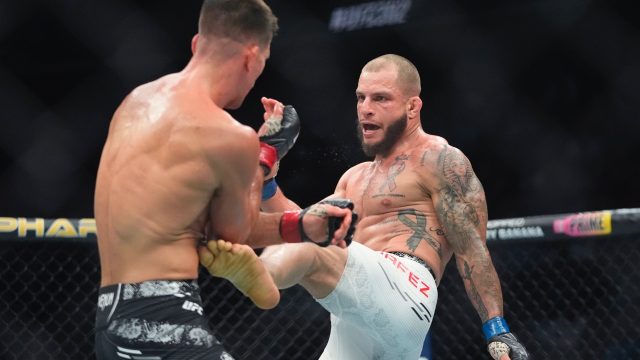
Welterweight fighter Bassil Hafez has been suspended one year for a violation of the UFC’s anti-doping policy.
The organization announced a 12-month ban that stems from an out-of-competition sample from Hafez on March 20 that was positive for ipamorelin, which is listed as a prohibited peptide hormone on the “Peptide Hormones, Growth Factors, Related Substances, and Mimetics” category of the policy’s prohibited list.
Hafez had actually announced on social media earlier in the week that he was going to be suspended for the failed test and explained it was due to “a mistake that happened during my recovery.”
The 34-year-old American hasn’t fought since losing to Oban Elliott at UFC 309 in November 2024 and has since undergone multiple surgeries to repair various injuries.
“I took a supplement during my healing process that ended up containing a banned substance,” Hafez explained in a caption to the video he posted to social media. “I had provided the clinic with the banned substance list and made it clear that those ingredients were not allowed, but it still ended up being included in the mix.
“At the end of the day, it falls on me for not double- and triple-checking before taking it. Being injured and sidelined from the sport I’ve spent the last 16 years training for has been incredibly rough, both mentally and physically. The could’ve, would’ve, should’ve won’t change anything now.
“I’ve been tested my entire career (17 times to be exact) and have never had a positive test or any issues before this. All I can say is that mistakes happen, and I’ll learn from this.”
Combat Sports Anti-Doping, the organization that independently administers the UFC ADP, confirmed in a statement late Wednesday that Hafez has been fully co-operative throughout the investigation.
“Hafez provided full and complete cooperation as defined under the UFC ADP,” the CSAD statement read. “His cooperation included identifying and introducing CSAD to a wellness clinic he had used to obtain substances he believed were permitted for injury recovery purposes. Hafez has not competed since November 2024 due to injury and did not have a bout scheduled at the time the sample was collected.
“Evidence gathered during the investigation indicated that, although Hafez claimed he was unaware that a product provided to him by the wellness clinic contained ipamorelin, he acted with gross negligence by consuming the product without conducting adequate due diligence regarding its ingredients and their prohibited status.”
Hafez’s sanction began retroactive to the date of the failed test, which means he won’t be eligible to compete again until March 20, 2027.
According to the UFC ADP test history database, there have been 1,842 total samples collected in 2026 as of May 22, when the database was last updated.
Among the 675 athletes tested, Hafez has been the second-most tested fighter on the UFC roster this year. He has been tested five times. The only fighter with more so far has been Conor McGregor’s 11 drug screenings.
McGregor hasn't fought in nearly five full years and was previously suspended for 18 months after three separate whereabouts violations between June to September 2024.
The Irish superstar’s suspension ended in March and the UFC announced McGregor will return to action at UFC 329, when he headlines that July 11 event in Las Vegas against Max Holloway.
Hafez is the fifth UFC athlete to be suspended in 2026 for a UFC ADP violation. The others are Caroline Foro (six months), Iasmine Lucindo (nine months), Alibi Idiris (one year) and Mohamed Usman (2.5 years).
Hafez has been on the UFC roster for nearly three full years at this point but has only fought thrice in the organization. He notably debuted with a split decision loss in a Fight of the Night-winning effort against Jack Della Maddalena, who would go on to become a welterweight champion.
His lone win at the UFC level was a decision over Mickey Gall two years ago at UFC 302.


 4:25
4:25 3:20
3:20 1:55
1:55