There was something special about World Extreme Cagefighting.
The defunct mixed martial arts organization founded by Reed Harris and Scott Adams in 2001 and absorbed by the UFC in 2010 had a signature blue canvas, a smaller cage and eventually became the global hub for the sport’s top talent in the lighter weight classes as it played a vital role in the growth of MMA in North America.
Some of the UFC’s most talented and popular fighters from the late aughts into the mid-2020s got their feet wet under the WEC banner before being introduced to a wider fan base once they later exchanged their blue WEC gloves for the black UFC four-ouncers.
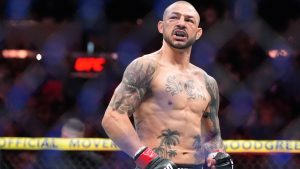
At UFC 327, featherweight fan favourite Cub Swanson competed in the final contest of his 45-fight career and, in doing so, became the last WEC alumni to appear in the UFC.
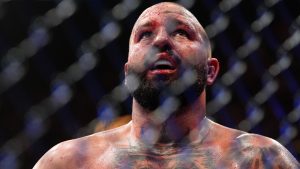
The 42-year-old had a vintage performance and earned a first-round technical knockout victory after teeing off on Nate Landwehr to end his fighting career in storybook fashion.
Swanson used his signature dynamic striking and movement to pick apart his opponent and pick up a KO/TKO win for the 15th time as his wife and children excitedly watched from cageside, while standing beside the President of the United States, no less.
A surreal moment for the Swanson clan.
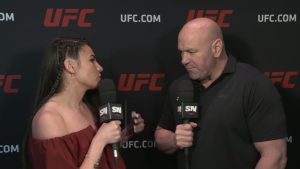
Swanson told Sportsnet afterwards he felt “in the zone” before and during the matchup, but also acknowledged “it was a lot of pressure” given the circumstances.
MMA is such a brutal, unforgiving sport that fighters retiring on their own terms and going out on a winning note the way Swanson did rarely happens – especially at the highest level.
A longtime staple of the famed Jackson Wink MMA Academy in Albuquerque, N.M., Swanson began training in MMA in his early 20s after a rough upbringing in Palm Springs, Calif., and he eventually made his pro debut in 2004. He was submitted by eventual UFC featherweight Shannon Gugerty in a mere 15 seconds in his first attempt at sanctioned MMA, but persevered and won his next 11 fights, one of which was a TKO of Gugerty to avenge his prior loss.
Swanson joined a burgeoning WEC roster in 2007 and went 6-3 during his 3.5-year tenure in the organization. Two of his losses there were inside a minute at the hands of former UFC lightweight champion Jens Pulver, and another was when he was the victim of future UFC Hall of Famer Jose Aldo’s iconic eight-second flying double-knee knockout. His other was a decision against future UFC title challenger Chad Mendes.
After losing his UFC debut to fellow WEC standout Ricardo Lamas in late 2011, Swanson went on a roll and won six in a row in the UFC. Perhaps his two best wins occurred during this stretch, when in back-to-back bouts he knocked out future lightweight champ Charles Oliveira and won a spirited scrap with future interim lightweight titleholder Dustin Poirier when they both still competed as featherweights.
Swanson fell short in other notable UFC matchups with champions Max Holloway and Frankie Edgar, and Swanson never fought for a title himself during his career.
Although he didn’t have a typical Hall of Fame career, and it’s unlikely he built a résumé worthy of a spot in the Modern Wing, it is fitting and well-deserved that Swanson has already earned a spot there in the Fight Wing thanks to his 2016 classic with Doo Ho Choi at UFC 206 in Toronto.
Swanson earned one of his 15 career UFC/WEC performance bonuses for that wild brawl with Choi, and it ended up as one of his signature victories.
In addition to his vast accomplishments in the cage, Swanson gained the respect of his peers and developed a reputation as one of the sport’s true gentlemen.
The UFC is selective with which fighters they choose to give a special video sendoff, but it was blatantly obvious that Swanson was going to meet that criteria after he removed his gloves and placed them on the canvas.
Swanson’s next chapter will consist of coaching the upcoming generation of talent from his Bloodline Combat Sports gym in Costa Mesa, Calif.
As for WEC alumni competing in the UFC’s Octagon? That chapter has concluded with no clear addendum in sight.
The WEC produced future UFC champions Jose Aldo, Demetrious Johnson, Dominick Cruz, Anthony Pettis, Benson Henderson, Johny Hendricks, Glover Teixeira, plus interim UFC titleholders Renan Barao, Shane Carwin, Carlos Condit and Dustin Poirier.
Other stars like Chael Sonnen, Nick and Nate Diaz, Urijah Faber, Mike Brown, Donald Cerrone, “The Korean Zombie” Chan Sung Jung, Gilbert Melendez, Clay Guida, Ricardo Lamas, Chad Mendes, Joseph Benavidez, Eddie Wineland, Brian Stann, Chris Leben, Tim Kennedy, Ricco Rodriguez, Karo Parisyan, and Frank Shamrock. You can’t tell their stories without mentioning their time in the WEC.
Fighters like Miguel Torres, Jamie Varner, Chase Beebe, Brian Bowles, Shane Roller, Takeya Mizugaki, Rani Yahya, Scott Jorgensen, Chase Beebee, Anthony Njokuani, Ian McCall, Charlie Valencia, Rob McCullough, Leonard Garcia, Danny Castillo, Damacio Page and broadcast staples like Todd Harris, Joe Martinez, Brittney Palmer, Craig Hummer, Frank Mir, Stephan Bonnar have names synonymous with the WEC’s prime years.
The WEC era was a specific, influential time of growth for the sport, specifically from when the UFC’s parent company, Zuffa, purchased the organization in 2006 to when the brands merged in 2010.
Of course, it’s always within the realm of possibility that a recently retired fighter, such as Poirier, could decide to break his vow to never tape up a pair of UFC gloves again. Or perhaps it is within the realm of possibility that Nate Diaz – who made his pro debut in the WEC and went 3-1 overall there – returns to the UFC for a farewell bout of his own once his upcoming MVP MMA bout with Mike Perry is in the rearview mirror?
Until that hypothetical bridge is crossed, Swanson gets to have his name etched in history as the last WEC warrior to compete on the sport’s biggest stage.
The fact that there’s no longer a direct connection from the UFC roster to the WEC roster comes as a bittersweet moment for anyone who revered that promotion, its athletes, its aesthetic, its entertainment value.
The inaugural WEC main event was a bizarre matchup between early UFC tournament champion Dan Severn and infamous 300-fight journeyman Travis Fulton.
Fast forward 9.5 years, and the final matchup in WEC history was a classic, high skill, five-round title fight between two future UFC champions, Anthony Pettis and Benson Henderson, where in the final minute of the final round, Pettis landed his now-iconic Matrix-style jump-off-the-cage kick to seal the fight.
In between those two vastly different headline matchups, fans were treated to countless memorable moments.
The slobber knocker that introduced “The Korean Zombie” to the world as he and Leonard Garcia threw caution to the wind for 15 back-and-forth minutes; the beginnings of Dominick Cruz’s rivalry with Team Alpha Male; Carlos Condit’s thrilling title defence over Hiromitsu Miura; a Canadian classic between Mark Hominick and Yves Jabouin in Edmonton.
The first time Jason Von Flue won a fight via his now-signature submission hold, later named after him, the Von Flue choke, was in the WEC.
Brian Bowles submitted Damacio Page with a guillotine at 3:30 of Round 1 to win a Submission of the Night award at WEC 35 in 2008, then submitted Page with a guillotine at 3:30 of Round 1 to win a Submission of the Night award in their rematch at a UFC Fight Night in 2011.
These are but a small sample of moments and tidbits unique to World Extreme Cagefighting.
Even after the brand went the way of the dodo, one catchphrase has lingered among those who loved it, and it seems it will endure: WEC Forever!

 5:43
5:43