
It was 1996, spring break of his second year at Mount Allison University, and 19-year-old Shaun Keyes walked into the Black Rose Tattoo shop on Barrington Street in his hometown of Halifax, and handed a big, burly man a card with an image of a stylized “A” with wings and pointed to his chest.
“He said it was going to hurt,” Keyes says.
No problem. As a defensive back with the Mount Allison Mounties, he felt so strongly about his connection to the school, the program and all it stood for that he wanted to get the Flying A inked on for all time.
“My brother played there and he had one, I’d say about 15 to 20 guys on the team had one,” says Keyes of his lone tattoo. “It was one of those where I didn’t feel like you were going to think: ‘That was dumb.’”
At the time playing football at the tiny school (enrollment: 2,700) in tiny Sackville, N.B. (pop: 5,600), meant something; there was pride in being a Mountie.
A teammate of CIS legend and eventual CFL star Eric Lapointe for four seasons, Keyes played in three straight league-championship games. From 1996 to 1998 the Mounties went 16-8 and made it to the Uteck Bowl in 1997. They were hardly a dynasty, but their success was proof that a small school with a liberal-arts focus tucked away in Canada’s forgotten province could compete. In the fall of 1998, his tattoo relatively fresh, the Mounties were ranked first in the CIS to start the season.
A decade later and Keyes was only glad that the ink job was somewhere he could easily hide it. By that time the Mounties were in a seeming athletic death spiral as the cost—in dollars and commitment—to compete at the CIS level kept rising, and Mount A became the football equivalent of a guy whose specialty was fixing black-and-white TVs. It seemed like the world had passed them by.
Low points? There were a lot of them. On Sept. 15, 2001, they lost to the Saint Mary’s Huskies 105-0. “I can’t believe a program that was so good a few years ago is so pathetic,” said then SMU coach Blake Nill. Coaches quit, players quit. Alumni—generally forgiving when it came to sports in Sackville—were disgusted. Things were so desperate that a general call went to players in the area who had eligibility left. Keyes enrolled in school and played his fifth season on a team that was a shadow of the ones Lapointe had starred on. Keyes would drive down Thursday nights for practice, head home Friday for work and meet the team at the games on Saturday.
“It was shocking to see what happened,” he says. “We took some beatings. It was unbelievable.”
Things got worse. Over six seasons from 2000 to 2005, the Mounties went 3-45. Between 2003 and 2005 they didn’t win a game, dropping 24 contests by an average margin of 31 points each—this in the weakest football conference in the CIS.
As a former varsity basketball player at the school, I know first hand that winning has never been the only thing at Mount A—a constant at the top of the Maclean’s ranking for undergraduate schools—but competing mattered and the embarrassment was tough to take.
That tattoo suddenly seemed like not such a good idea, and not because Keyes was married, a father and working for his family’s insurance business. The symbol of the proudest moments of his life was now something to be ashamed of. In his office at work Keyes has some football mementos from Mount A and in the dark years he’d be quick to point out to visitors that he was there “when they were good.” But he couldn’t always explain it to himself. “Sometimes I’d look in the mirror at my chest and go, ‘What is that Flying A doing there?’”
***
This is not David vs. Goliath.
Those two were at least the same species—both mammals, both humans with strengths and weaknesses. The biblical theme is a readily obvious storyline for Saturday’s Uteck Bowl, the national semi-final pitting the surprising Mounties against the Laval Rouge et Or for the right to play in the Vanier Cup.
But David was armed. He had a shot. And Goliath? If you cut him, he would bleed. He seemed prone to concussion. There is no evidence of that with Laval. Saturday’s game isn’t David vs. Goliath. It’s Shark Week, and the Mounties are unsuspecting swimmers.
Still, it’s no exaggeration to say that this is one game the Mounties can’t lose. They’ve already won. After a period of losing so bad many questioned whether it would survive, the program has reemerged—even if it pales in most ways in comparison to its opponent’s.
“We have no illusions about their program,” says Mount Allison athletic director Pierre Arsenault. “It’s a mismatch on paper and we’re thankful we’re playing here at home.”
This isn’t simply a football game—it’s a clash of philosophies of university sport. At Mount A you do the best you can with what you have, accepting that your best won’t always be good enough, but working towards those moments when it all comes together. It’s downright heartwarming.
At Laval they find the best, give them the best and expect the best. They have won a record seven Vanier Cups. Not winning is a failure. Your options are to compete with it, bow before it or get out of the way. If it didn’t come from Quebec we’d say it was American.
And a further irony? It was the emergence of Laval and the rise of university football in Quebec generally that effectively derailed football at Mount Allison. As the only program in Canada’s only officially bilingual province, in their best years the Mounties had benefitted from a pipeline of talent from Quebec’s burgeoning football culture, plugging in ready-made stars from the province’s elite CEGEP programs. When Laval started football in 1996—inspiring other francophone universities to follow—the spigot was effectively turned off, and there would be no more Eric Lapointes coming down the road.
Instead over the course of 17 seasons Laval has re-imagined what Canadian university sport could be like. They are funded by a private corporation, play in front of crowds of 15,000 on a regular basis and have a budget of $2.5 million—“It’s not a stretch to say ours is barely a tenth of that,” says the Mounties’ Arsenault.
They go to Florida every spring for training camp. This season alone there were 13 former Laval players on CFL rosters. Their head coach, Glen Constantin, has openly advocated for a Div. I style league across Canada where the true heavyweights of the sport could play against a proper level of competition.
Laval plays at a stadium that has sold naming rights to a multi-billion-dollar communications company. This Saturday they’ll be playing on a grass field—the only natural turf in the AUS—that is also used by the Mounties’ soccer teams and intramural programs.
“We all understand we’d like better infrastructure, but this is our home and we’ve embraced it,” says Arsenault. “We’re 6-2 in our last eight games at home. The players’ job is to deal with what they have while they have it. They just play their hearts out here.”
There is no stadium and there are no naming rights. Instead the Mounties’ home turf is named after David MacCauley, a much beloved alumnus who settled in the area and never missed a game.
It’s named after a fan.
***
So this is less a game than worlds colliding, one of them barreling downhill like a freight train. Can Mount A prevail against Laval? On paper they don’t have a chance. The teams last met in 2009 when Laval won 73–7. The Rouge et Or have lost five games in the past 10 seasons; the Mounties lost five games before Thanksgiving if you include their pre-season game.
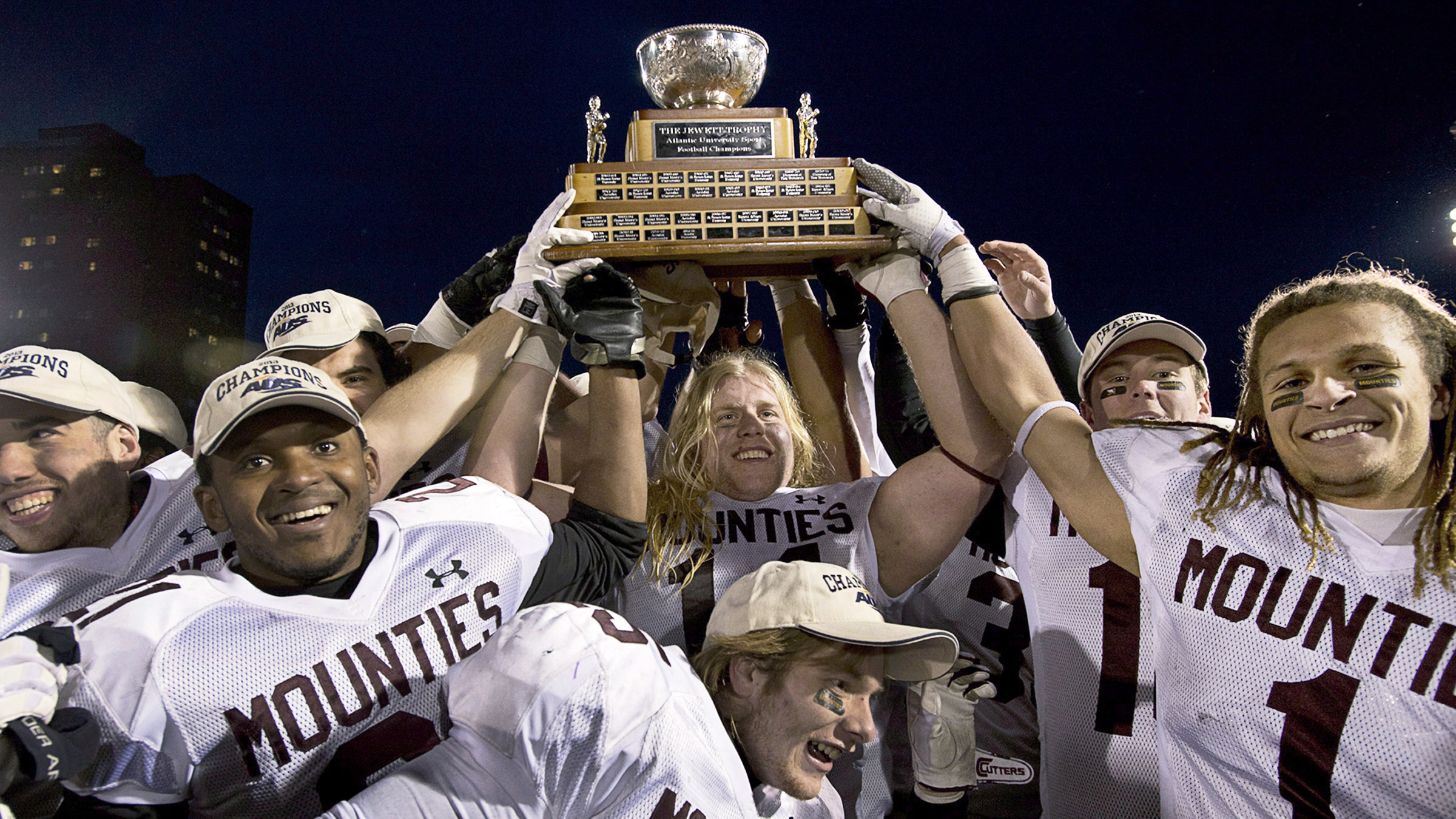
But there’s hope, after all it’s been a miracle season in Sackville. They started 1-4 before reeling off five straight wins including a come-from-behind victory for their first AUS championship since in 1997 in front of a partisan crowd in Halifax last Saturday.
By a stroke of luck or fate this year marks the first year that the Uteck Bowl is being held at the site of the winning school; its permanent home was previously in Halifax. Suddenly Laval will be heading not only out East, but to Sackville, a frozen-in-time kind of place where university sport—even at the highest levels—is still charmingly ad-hoc.
There will be a pep rally in the quad Friday night. The town’s limited hotel stock is sold out. Temporary bleachers are rapidly being constructed and there will be crowds on the roof of the dining hall that overlooks the field and there will be fans standing five deep around the end zone and covering every inch of the hillside surrounding the field. The last time crowds like that were seen in Sackville, Lapointe was churning out an AUS-record 4,666 rushing yards through the muck churned up after a season of intramurals and late fall rains. There will be a home-field advantage.
“Laval has the money behind them, they’re dominant,” says Keyes. “But in football anyone can be beaten on any day. It’s a game of emotions and the Mounties are riding a wave right now.”
Looking back, it’s clear the first ripples of that wave began in the program’s deepest, darkest days. Following the three-year winless streak, a commitment was made, and stable—if limited—funding was found. More coaches were hired and more scholarship money committed, but the Mounties were still the Mounties; they weren’t going to be able to bash down the front door.
“We’ve kind of said: ‘We are who we are; we’re not going to be able to take the New York Yankees’ model,’” says Arsenault. “We had to be efficient in our recruiting and we really focus on things we can control with physical preparation in the off-season and the summer so unheralded players become good, dependable players in our league.”
Some of them are more than dependable. Some of them are outstanding. The honourary chairman of the Uteck Bowl is Gary Ross. He arrived in Sackville from Windsor, Ont., with a wife and two young children and had another when he was there from 2006–10. In his five seasons Ross gained 7,053 all-purpose yards, believed to be the most in CIS history, and the team won only nine games. It was difficult, but part of the motivation was building something better in a place he’d grown to love.
“The losing wore on me,” says Ross, who is now in graduate school, studying dentistry. “You questioned yourself, you questioned the program, you questioned everything. But you have that ego, you believe that you can be one of the guys who turn things around.”
In 2010, Ross’s senior season, the Mounties went 4-4, signaling they could compete again. The core of the team that will be playing Saturday are from the recruiting class that came on the heels of that group.
In some ways the heroes of this sudden resurgence of football at Mount A and the rebirth of Mountie Pride are guys like Ross and others who held the flag high when the situation was bleakest.
Keyes says he expects 10 or 15 of his former teammates to fly in from all over North America for the game. Social networks have been on fire.
“It’s been fun to see all the old players change their Facebook profiles to pictures of themselves in their uniforms,” he says.
His own Flying A tattoo will always be close to his heart, but for the first time in a long time his chest is bursting with pride.