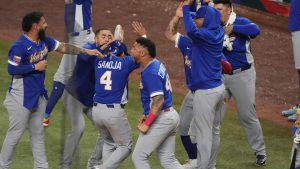
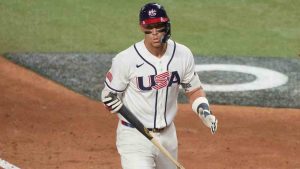
HOUSTON — The United States stole hockey from Canada at the Olympics and try as they did, the Canadians couldn’t in return steal baseball from the Americans at the World Baseball Classic.
An inspired run to the quarterfinals after winning Pool A, two firsts for the national team in six trips to the event, ended Friday night with a 5-3 loss in which there was both plenty to be proud of, along with plenty to lament.
The Canadians fell behind early, partly by their own doing, rallied in the middle when Bo Naylor’s two-run shot in the sixth inning dialled up the stress on an American team that continues to acquit itself poorly, and then let opportunity slip away late.
So close, so far and now the wait until next time, whenever that might be.
“I’ll be reflecting on this for probably a couple of months,” said manager Ernie Whitt. “You gather your thoughts and what if and what if and what if, but if you continue to do that, you'll drive yourself crazy.
“I thought we represented the country well and I don't think we have anything to hang our heads about,” he added. “I told the boys to walk proudly.”
In the bowels of Daikin Park having packed up before parting ways, they did just that, balanced against the regret that it’s the Americans, who only advanced out of pool play with the help of the Italian team that went 4-0 in Pool B, are off to Sunday’s semifinal in Miami rather than them.
Vladimir Guerrero Jr. and the Dominican Republic, who mercy-ruled South Korea 10-0 in Friday’s other quarterfinal, await the U.S. while Puerto Rico meets Italy and Venezuela takes on Japan on Saturday to decide the other side of the bracket.
“It hurts,” said Michael Soroka, who allowed three runs, two earned in 2.2 innings but pitched better than the line suggests. “A lot of people looked at us and thought we were not necessarily even expected to get our pool, for whatever reason. We expected to do that. We knew we were going to put up a good fight today and we did. But that's baseball. Things could have easily went another way and we gave them a good run for it. So it hurts and a lot of guys are excited to get back out there when we're able to do this again.”
Added Tyler O’Neill: “I really wish that we could play a lot longer, it's just such a fun group to be around. It just sucks that we came up short again.”
Soroka got bled for three runs, two of them scoring in the third when Abraham Toro airmailed a relay to first on an Alex Bregman infield single that could have been the inning’s final out, while consecutive RBI singles in the sixth by Brice Turang and Pete Crow-Armstrong, set up when no one covered first on Roman Anthony’s infield single to start the inning, opened things up.
Logan Webb, meanwhile, threw 4.2 shutout innings and the Canadian offence didn’t get on track until the sixth, when Tyler Black ripped an RBI single off Brad Keller before Bo Naylor crushed a Gabe Speier slider 404 feet to right field, cutting the U.S. lead to 5-3.
“Huge homer,” said O’Neill. “We were right back in that ball game and the boys had a lot of belief all throughout the game, even when we were down. We knew we had the strength to come back and make ourselves known.”
They nearly did in the seventh when Edouard Julien and Otto Lopez opened the inning with singles and advanced on a Cal Raleigh passed ball. But David Bednar rallied as Josh Naylor popped a middle-middle 96.8 m.p.h. heater to third, O’Neill struck out on a chase curveball while Owen Caissie lost a tenacious nine-pitch duel by swinging through a split.
The Canadians didn’t get another chance to score as Garrett Whitlock worked a clean eighth before Mason Miller closed things out in the ninth as a crowd of 38,054 celebrated.
“The real special part was that this team did not cave,” said Soroka. “Bo came up clutch with that big homer and you could feel the tension over there, you could feel the tension in the crowd. In the seventh inning we had them right there and it's just so close. They've got one of the best bullpens baseball's ever seen, so credit to them for continuing to pitch out of jams. It was very, very close.”
It was, but instead of a flight to Miami to ready for an even tougher challenge against a stacked Dominican Republic team that looks like the clear tournament favourite, the Canadians were instead left to assess the way they raised the bar for themselves.
"We did something that a Canadian team has never done, hopefully inspired the next generation and we all look forward to the next one, really,” said Josh Naylor, who wasn’t the same after being hit by Jose De Leon on the right elbow Tuesday against Puerto Rico and didn’t push back on the idea he was banged up. “This is a big stepping stone for Canadian baseball. We'll look to push it on a little bit further next time and maybe at some point quick, we'll win this thing.”
Worth noting is that they showed well even in a tournament structured around the U.S. team, a reality underlined by the way this quarterfinal, originally scheduled for Saturday, was moved to Friday so the Americans remained in the broadcast slot envisioned for them.
Playing a day earlier had little impact on the U.S., but gave the Canadians less time to recover from their 7-2 win over Cuba on Wednesday and the subsequent flight from San Juan to Houston.
Combine that with the restrictions on player usage the Canadians had to face — a reality for all Classic teams but more damaging to countries with shallower talent pools — and there were limits on how creative they could get, even as they got deeper into the event.
Once you consider some of the prominent names that for different reasons didn’t play — Nick Pivetta, Cade Smith, Matt Brash, Jordan Romano, Jonah Tong — and it’s clear the Canadians did a good job of piecing a plan together.
The hope is the next time there’s a World Baseball Classic, in 2029 or 2030 depending on what happens with the next collective bargaining agreement, even more of the country’s best players join the current core.
“It's a stepping stone,” said Whitt. “Hopefully other Canadian ballplayers see it, the excitement that there is, we had a full house out there today cheering. That's fun.
“That's the way baseball is supposed to be played. Not everyone can be happy, though. There's always a winner and loser. When you get into this format, someone's got to win and someone's got to lose. On this side, it's hard to take.”
As it should be, marking an important sign of growth.
O’Neill debuted at the Classic in 2017, when Canada went 0-3 in its worst showing at the event, when he was pushing for the majors in the way Caissie, a force over the five games, was this time. At the 2023 tournament, the Canadians improved to 2-2 and lost a win-and-in game to Mexico and this time, featuring a lineup full of big-leaguers, they went 3-2 and legitimately could be 5-0 with cleaner play.
“Most of that group from '23 has carried over here to '26,” said O’Neill. “We know each other even better now, chemistry is only getting better and there's a lot of future talent here, a lot of future winning and opportunity in this group.”
They showed that in the chaos of Hiram Bithorn Stadium in San Juan and again at Daikin Park in Houston, where they pushed a powerhouse American team to the brink. For now, it will have to be enough, but next time, the goal will be even more, rightfully so.

 6:32
6:32