
TORONTO – Reality check time as spring training continues to kick off around the big-leagues – pretty much every team has at least a flaw or two, if not several glaring holes.
There is no uber-team in the majors, although the Los Angeles Dodgers and Washington Nationals are taking a pretty good run at it, and that appears to hold especially true in the American League East, which is something Toronto Blue Jays fans should keep in mind during the weeks ahead.
Yes, second base remains a mixed bag of scraps with fingers crossed that the surgically repaired left knee of 34-year-old Maicer Izturis holds up. And centre field is uncertain with the young but supremely talented Dalton Pompey in the driver’s seat. And there are no blatantly obvious configurations that hint at a dominant bullpen. And while the rotation may be loaded with upside, old reliables Mark Buehrle and R.A. Dickey are the only two starters you can comfortably count on.
Truth is, the Blue Jays became a better club over the winter in a most unorthodox fashion, improving not by directly addressing their clear needs, but by upgrading their overall talent base and strengthening their general core. In a division that by no means ran away from them over the winter – the Boston Red Sox made plenty of moves, but also have the most ground to make up, while the defending champion Baltimore Orioles probably came back to the pack – that may be enough.
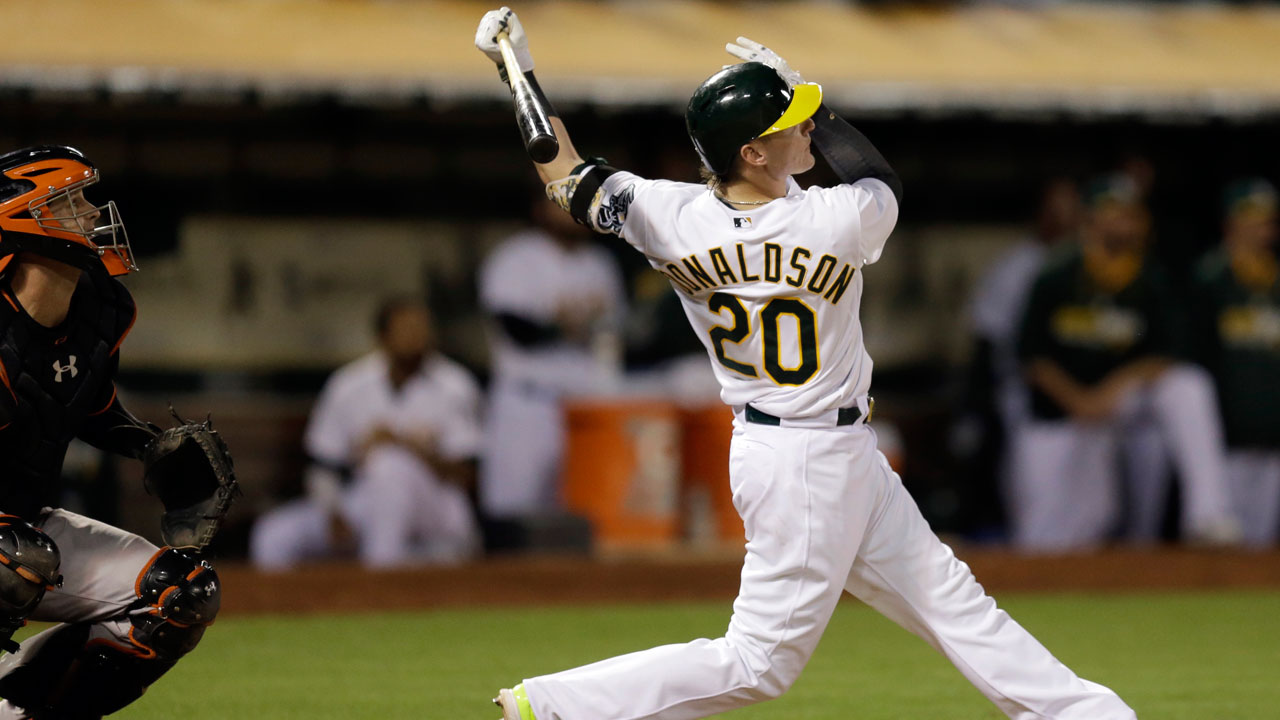
Russ Martin and Josh Donaldson are key to the endeavour, both in the short-term and in the bigger picture, which will evolve substantially over the coming months based on the results on the field.
The durable Donaldson, under club control through 2018, gives the Blue Jays another budget-friendly middle-of-the-order cornerstone, and provides the front office with some protection and flexibility with Jose Bautista and Edwin Encarnacion headed toward club options for the 2016 season.
Meanwhile, Martin’s production at the plate will be needed to cover Melky Cabrera’s lost offence, but more pivotal will be his work maximizing the bevy of cost-effective young arms that must carry the load if the Blue Jays are to remain contenders in the coming years.
Inexpensive pitching, after all, is going to be the lifeline for this team moving forward.
The Blue Jays’ payroll this year is expected to land in the $135 million range, and as things stand, they have $117.725 million guaranteed to 16 players (including Ricky Romero) and $5.6 million in buyouts that must be budgeted for, bringing them to $124 million. Add another $6 million for the 10 players with 0-3 years of service time that will be needed to fill out the roster plus another $5 million or so to cover recalls when players hit the disabled list, and the Blue Jays seem to be near their limit.
While it’s possible general manager Alex Anthopoulos has a couple million more in the kitty, he may be saving any money that might be left for a more decisive move later on, rather than taking a chance on the free-agent flotsam remaining.
Given all that, imagine for a second if the Blue Jays didn’t have Drew Hutchison, Marcus Stroman and Aaron Sanchez making the league minimum, or close to it. This team would really be in trouble without them.
That’s why that trio, plus Daniel Norris, Roberto Osuna, Miguel Castro and Jeff Hoffman – the next wave of young arms – are so pivotal.
If the Blue Jays exercise their options on Bautista, Encarnacion and Dickey for 2016, they would have $73 million committed to five players with Donaldson probably headed to the $8 million range in arbitration on top of that.
Such a top-heavy set-up can only work with a strong cast of 0-3 players to fill out the rest of the roster, and that’s before the fading Canadian dollar or the plans of the replacement for president and CEO Paul Beeston enters the mix.
Noteworthy here is what team owner Rogers Communications Inc., said when it reported its third quarter earnings back in October. The company’s release pointed out that “higher revenue associated with the Toronto Blue Jays” helped keep the Media division’s operating revenue unchanged in the quarter, but also that “higher player salaries of approximately $10 million this quarter and $20 million year to date at the Toronto Blue Jays,” helped increase operating expenses eight per cent.
Specifics weren’t given, but if the loonie keeps falling versus the American dollar and team revenues don’t compensate in a meaningful way (the first ticket-price increase since 2010 should help), you’d think something will have to give.
Beeston’s successor will likely have to figure that out, but a successful season on the field that ends with the club’s first post-season berth since 1993 can sure simplify the process.
After all, a common saying in sports is that winning cures all, and with a GM and president both on expiring contracts, a manager and players preparing for a tipping-point season, and significant long-term issues hanging in the balance, that certainly holds true for the Blue Jays.
Could a winning year happen?
Absolutely, as Hutchison, Stroman and Sanchez very well may take off and lead the rotation, the bullpen might sort itself out and be effective, the offence should improve substantially and the defence, bolstered by Martin, Donaldson, Michael Saunders and Justin Smoak should tighten noticeably.
All of that is very realistic, and would make them awfully tough to beat.
You see, while the Blue Jays have flaws, they also have promise, arguably more than most others. And just as promise isn’t always met, flaws aren’t always fatal, either, and only the grind to come can truly sort that out.