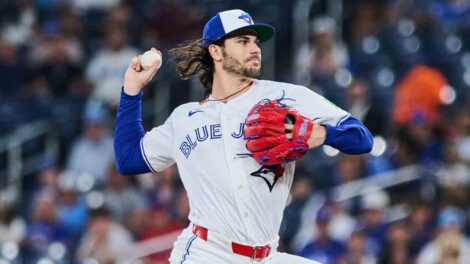
Earlier this month Sportsnet’s Shi Davidi sat down for a lengthy interview with former Toronto Blue Jay Travis Snider. Over the course of 90 minutes, the 24-year-old opened up for the first time on what he believes went wrong during his once promising, yet ultimately turbulent time in Toronto.
In Part 2 of this three-part series, Snider reveals how a change in GM and manager had him feeling good about his future with the Blue Jays before a broken promise left him confused and distracted.
 Tuesday, Sept. 25: Part I: Clashes with Cito
Thursday, Sept. 27: Part III: A ‘burden’ is lifted
—
Read @shidavidi Travis Snider exclusive bit.ly/QRDlQf and then tell us why YOU think he didn’t pan out with #bluejays @ #SniderSaga
— Sportsnet (@Sportsnet) September 25, 2012
—
PITTSBURGH – An important belief within the Toronto Blue Jays front office is that young players aren’t hurt by being moved through the farm system slowly, but that they certainly can be harmed from getting rushed up too quickly.
In many ways, Travis Snider can be used as Exhibit A on that front. The one-time franchise cornerstone in waiting was promoted to the majors at age 20 with a mere 1,138 minor-league at-bats under his belt. His flaws weren’t exposed until he was playing on baseball’s grandest stages. "When I look back," says Blue Jays GM Alex Anthopoulos, "it would have been nice to let him stay in one place a year at a time to develop. That’s the only thing I can look back and say, ‘Why not get more at-bats at each level.’ The end result may have been the same, but I think at 24 it’s too early to make any determinations on his career."
It is, but maybe things turn out differently off the bat if he grooms in the minors longer, or if his first touches with former manager Cito Gaston and hitting coach Gene Tenace went better. They foresaw some of his struggles, but the three were never able to get on the same page. "We were giving him information to try and help him, not to try to hurt him," says Tenace. "That was our whole criteria, was try and help him survive. He didn’t look at it that way, apparently."
Adds Gaston: "With Geno there was no messing around. That’s the way Geno is. But he’s a guy that has four World Series rings from playing, and two World Series rings from being a coach. So I think I might want to listen to him a little bit."
There are so many ifs surrounding how Snider’s time in Toronto played out.
Here’s the next installment of how things went so wrong.
***
Heading into the 2011 season, Snider felt pretty good about where things stood.
John Farrell replaced Gaston as manager of the Blue Jays, and the two had several positive conversations, Snider eating up info from the new boss on how the Boston Red Sox exploited his weaknesses.
Other discussions went even better, Anthopoulos praising him for the way he handed his second stint in the majors at the end of 2010 and for owning up to his mistakes. Snider felt a trust developing atypical for a player so young and an executive, and he was over the moon when Anthopoulos raised the topic of a long-term contract extension.
"It was something for me, man, this is what I’ve dreamed of," he remembers. "I wanted to be a part of this organization as a long-term guy."
Anthopoulos told Snider they would get to it, and with an off-season that included a remaking of the bullpen, the trading of Vernon Wells and, eventually, the signing of Jose Bautista to a US$65-million, five-year deal early in spring training, their talks slipped down the priority list.
Already dealing with an intercostal injury suffered while golfing at the beginning of camp, the lack of contact from the Blue Jays unwisely got into his head, but he was relieved when Anthopoulos called him into his office once Snider returned to action, and told him, "We’re going to send something over to you guys. We want you to take a look at it, and let us know what you think."
Snider remembers another week or so passing with no offer, and by then the wheels really started to turn.
"For me at this point, there are a lot of distractions going on mentally instead of focusing on just the game of baseball and preparing for a long season," he says.
The offer eventually came, Snider recalls it arriving with four or five days before the season’s start, Anthopoulos adamant it was extended with at least a week to go, but either way the window to hammer things was short because they had agreed not to drag things on into the year. Snider, trying to educate himself on the matter while making arrangements to pack up his spring home, find a place in Toronto and coping with a back injury he suffered trying to break up a double play in an exhibition game, started to stress.
"For everything that was told to me up to that point, I felt like is this how you handle it?" he says. "I was kind of put with my back up against the wall."
Neither he nor Anthopoulos would divulge terms of the deal, although Snider described the contract’s structure and details as "very club favourable."
Snider’s camp felt there wasn’t enough time to bridge the gap between them based on "our beliefs in what kind of player I believe I can be, versus what they’re comparing me to," so they told Anthopoulos. "This is something we need to revisit at another time, right now we’re not close in our thought process."
A counter-offer was never made.
@mikecormack Hopefully the BlueJays have learned that the way they treated Snider is not a successful way to treat prospects #SniderSaga
— K Kennedy (@KennedyMLB) September 25, 2012
Back in Toronto for the season’s start, Anthopoulos again called Snider into his office, during the workout day ahead of the curtain-raiser according to the GM, a few hours before the opener, according to the player, to discuss the contract one last time.
Anthopoulos describes it as a no-hard-feelings talk, urging Snider to go out and have a huge year, telling him the team would be happy to give him a huge raise in arbitration if that were the case.
Snider recollects it differently.
"There was some pressure put on me: ‘Are you really in this, are you really about what we’re trying to do here,’" he says. "And I said, ‘Listen, yes, that the thought process has not changed and again I’m honoured that you would even come to me and think of me as someone you would like to lock up.’ And that’s something that I will forever be grateful to Alex for, whether we were close or not.
"That was an exciting time for me, but also very confusing when it’s opening day and I’m in there talking about a contract situation that was supposed to be between agent and GM."
Though Snider says he doesn’t regret the decision to turn down the extension, at the time it weighed on him heavily. Instead of being focused on his swing in the batting cage, his mind would drift to whether he’d made a mistake or not, question why things unfolded as they did and wonder if he had done something to make the Blue Jays question his worth.
"I wasn’t in a consistent rhythm in terms of a work routine and things like that," he says. "I bought into that thought process of I’m panicking, trying to do this and do that instead of slowing down."
It’s precisely what Anthopoulos didn’t want to happen and why he doesn’t like negotiations dragging into the season.
"I always make sure to ask the player if this is going to be a distraction for him," he explains. "You don’t want to do anything to affect the player, first and foremost."
Yet that’s what ended up happening, Snider playing catch-up all of April because of the time he missed in spring training that should have been used to hone his swing, the hole in it on the inside of the plate – the one Gaston and Tenace saw – the size of a canyon the way opposing pitchers exploited it.
Snider batted .184/.276/.264 in 25 games during April, with an alarming 23 strikeouts and an even more concerning lack of pop. The more the Blue Jays looked it, the more they felt that this was more than a simple slump, and that his swing was too flawed for a quick fix. They decided his entire swing had to be rebuilt, and on April 28 he was optioned to triple-A Las Vegas.
Considering that four weeks earlier he’d been discussing a long-term contract, Snider felt like he’d been hit by truck.
"Obviously they have every reason to be frustrated with me because of the injuries I’m dealing with, especially the one that happened off the field, but I’m being told directly from our general manager that I’m getting six months sink or swim, we believe in you as a player and as a person, that you can get through a slow start in April," says Snider. "After I got optioned we had a conversation to follow up, and I said, ‘Alex, you can’t make a promise to somebody that you know you can’t keep. If you’re going to tell me that I’m going to get six months, sink or swim, give me six months or don’t tell me that.’"
Anthopoulos says he would never promise a player 600 at-bats, but he did draw a lesson from how things with Snider were handled.
"What that opened my eyes to is I really have to spell it out," he explains. "I told Travis that what I would have added to the conversation is, and I tell players this now, obviously if you hit .100 or have an 8.00 ERA during the season, we have a right to change our minds. But to start the season, this is the position you’re going to be in."
None of that impacted the need for Snider to take a timeout and get his swing right. And while the Blue Jays did kick around letting him stay, Anthopoulos says, "if you know the swing isn’t going to work, and you know the swing needs to be changed, why let him sit here and fail?
"Edwin Encarnacion didn’t need to make swing changes, we just needed to stick with him long enough for it to come. At the time of Travis’ option, we had to make a mechanical change."
Eventually Snider would come to accept and understand the decision.
"I know what was going on wasn’t right, I wasn’t locked in, I wasn’t driving the ball," he says – but not before a rethink of how he looked at the game, and his relationships in it. At the big-league level decisions can’t be taken personally, it’s all business, and Snider knew then he had to wrap his mind around that. Until that happened though, he went through a "trying time" in Vegas.
"I had to grow up at that point and say, ‘if this is what I want to do, I have to learn how to deal with this stuff because this is real life," he explains. "As comfortable as I was in the organization until that point, that was a turning point for me, when I realized I’ve got to get it right and get going, instead of ‘I’m going to sit here and look back on 2009 and 2010 and even 2011. I had almost a rebirth mentally.’"
Snider went at the swing changes with a fierce determination; working relentlessly in the cage with 51’s hitting coach Chad Mottola, his progress briefly derailed by a concussion after he was hit by a pitch on the bill of his helmet. He went from a closed stance in which he often pulled off the ball to one that started more open before closing in on the pitch, helping his plate coverage.
My heart is breaking all over again reading the @shidavidi piece on @lunchboxhero45 #SniderSaga #missyou
— Jon Copeland (@j_copeland_) September 25, 2012
In 49 games with Vegas, he batted .333 with 21 doubles, two triples and two home runs, earning a recall July 4 in Boston, when he went 3-for-5 with three doubles and two RBIs in a 9-7 win over the Red Sox. Over his next 10 games, he added six more doubles, a homer and 10 RBIs, batting at a .391 clip, but then his performance collapsed, batting .148 over the next 13 contests with only a double and a homer.
On Aug. 5, he was blindsided a second time when he was optioned back to Vegas to clear space for Brett Lawrie, losing out to Eric Thames.
"I had a lot of respect for Eric and got along with him and (we) never had any animosity even though we competed for the same job," says Snider, "(but) it was another blow to the confidence of this buildup of this our core group. I was like, ‘man, that’s a short leash, I don’t feel like I was given a shot, that’s what I communicated to (Anthopoulos and Farrell)."
Says Anthopoulos: "If you looked at the body of work between (Snider and Thames), Eric had a better body of work so it felt like the right thing to do. I think that was fair. They were both hitting .200 at the time – just play better than the other guy."
Either way, Snider decided to try and make the most of his reunion with Mottola, focused on further developing the mechanical changes to his swing and enjoy playing the game.
He remembers a road trip to Nashville and Memphis where he felt the power come back to his swing – "last year was an ego check for me as a home run guy," he points out, adding he felt like he started seeing some light at the end of the tunnel before tendonitis in his right wrist shut him down for the year on Aug. 21.
The Blue Jays told him not play through it, to simply go home, get healthy and be ready to compete for a job the next spring.
"Not you have a job, not you’re getting 600 at-bats, just an honest communication. Great," says Snider, who proceeded to "spend time with close friends and family, started to get into reading and meditation and different things that I felt were important for me moving forward in my career and my life, to be a balanced person, and somebody who is able to live their life each and every day to their fullest instead of carrying the burdens of what had happened to me in baseball like a chip on my shoulder.
"As much as I want to go out there and prove myself as an everyday player in this league, I had gotten to a point where I needed to work on myself as a person and my mindset."
During the off-season, Snider did exactly that, and the new version of himself would be tested in entirely new ways in the year ahead.
Tuesday, Sept. 25: Part I: Clashes with Cito
Thursday, Sept. 27: Part III: A ‘burden’ is lifted