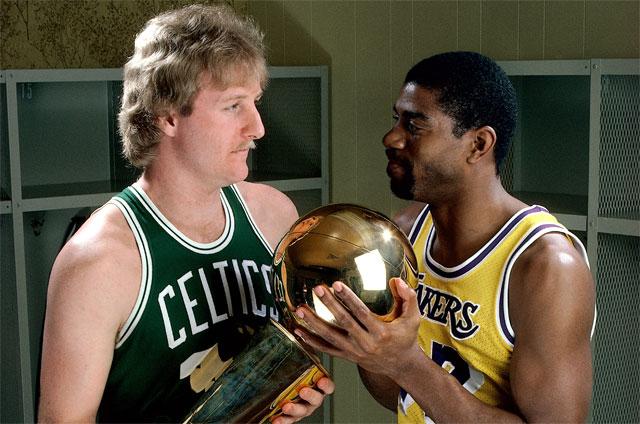

The best rivalries aren’t about hate. The best rivalries are about respect. And the very best end up being about something much more.
Larry Bird and Earvin “Magic” Johnson never really hated each other. The first time they met they couldn’t stop talking about each other. It was the summer of 1978, and the pair were benchwarmers on a team of college all-stars, playing in an event called the World Invitational Tournament. There is no videotape; no gushing “we have seen the future” newspaper headlines or Twitter hashtags or YouTube clips. It was a moment that came and went largely unremarked upon, except by the two men themselves. “I’ve just seen the best player in college basketball,” Bird told his brother Mark. “It’s Magic Johnson.” Meanwhile, Johnson was left with the task of explaining to his friends back home in East Lansing, Mich., that the best player he’d seen was a white guy. “A lot of black guys always ask me, ‘Did Larry Bird really play that good?’” Johnson said years later. “I said, ‘Larry Bird is so good it’s frightening.’”
Bird and Magic led their teams to the NCAA final the following spring—with Magic’s team edging Bird’s—a game watched by 35 million, college basketball’s biggest audience to date. The world was introduced to the storylines that would surround their on-court brilliance: Bird, the stoic small-town kid from the cradle of Midwestern, rural basketball; Magic, the effervescent one from the industrial heartland, not exactly from the streets, but a player whose game had more than enough flash to represent the urban side of the sport.
Johnson was the consensus first choice in the 1979 NBA draft, a pick held by the mighty Los Angeles Lakers. Bird was already property of the Boston Celtics because of the “junior eligible” rule. They got a boost by becoming embedded within Lakers-Celtics, an NBA feud that had been burning since 1962, when Elgin Baylor and Bill Russell were the faces of the respective franchises. But it was the excellence of the two players that made Bird-Magic basketball’s defining rivalry.
Bird was the NBA’s Rookie of the Year in 1980; Magic forced his way into NBA lore when he scored 42 points and grabbed 15 rebounds in game six of the 1980 NBA Finals to help L.A. past Julius Erving’s Philadelphia 76ers for the NBA title. A year later, Bird led Boston to the first of three titles the team won during his 12-year career. A decade-long game of “Can you top this?”—during which they met three times in the NBA Finals—had begun.
Bird: “The first thing I would do every morning during the season was look at the box scores to see what Magic did. I didn’t care about anything else.”
Johnson: “During the season I’d check out Larry’s line first thing. If he had a triple-double, I knew what I’d want that night.”
It wasn’t until Bird’s mother served them lunch in his hometown of French Lick, Ind., where they were shooting a commercial for Converse in 1985, that they became friendly. But it was as their careers were winding down that their relationship truly took hold, and respect gave way to something more. When Johnson was diagnosed with HIV in 1991, one of his first calls was to Bird, who pledged whatever help Johnson needed. “The best feeling is when a friend supports you,” Johnson said after the announcement. “And this young man came and supported me. Forget the sports, forget the championships, forget the MVP. He came to my side and supported me and I’ll never forget that.”
Bird and Magic; Magic and Bird. No one will ever forget any of it.