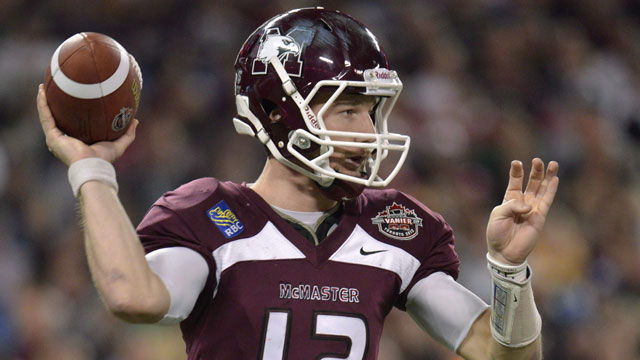
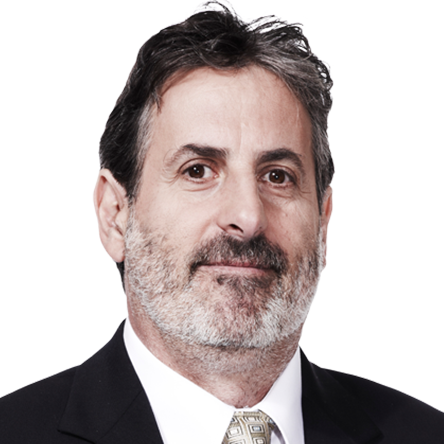
If he was anything but a Canadian quarterback trying to play in the Canadian Football League, Kyle Quinlan’s decision to retire before his pro career began would hardly generate the amount of discussion that it has.
It is only because Quinlan is the latest star pivot produced at a Canadian school that his decision to spurn a contract offer with the Montreal Alouettes in order to accept a part-time coaching position with McMaster University has become a talking point with CFL teams set to begin full training camps on Sunday.
Quinlan, voted the Hec Crighton Award winner as the top player in Canadian university football last year, had been instrumental in his school’s rise to prominence. Two years ago, Mac won the Vanier Cup – the Canadian universities’ championship game – for the first time in school history in a game for the ages; and last year it lost in the championship game.
So now imagine what it would have been like for Quinlan, who had played at the top level in university, to essentially begin an apprentice program at the professional level in an organization which would have given him every opportunity to crack the starting roster, but which has had the same starting quarterback since 2002.
Yes, Anthony Calvillo will turn 41 in August and is coming off surgery in his non-throwing shoulder in December and didn’t begin throwing until a month or so.
Yes, the Als didn’t want to put added physical stress on Calvillo, even with a new head coach in place, because he is a savvy enough veteran to understand himself and the new offensive playbook that he and his teammates will have to learn. There really isn’t anything he needs to do at this point of his career to physically participate in training camp because he’ll be able to mentally grasp what is needed while giving his shoulder the proper rehab needed for the start of the season.
Yes, Quinlan would have been given ample reps and also would have come into this camp with a greater understanding of the professional game having had a taste of it last year with the Als, who signed him as a free agent. Last year, he came to training camp knowing he would be going back to school to play out his final year of university eligibility. The circumstances are quite different this year.
Quinlan had done all he could in university in a high-level program which fosters success and now faced the prospect of a potential career at the professional level, but with no certainty he would ever play. While it may have provided him with a regular paycheque, it wouldn’t necessarily translate to anything meaningful as a player or any certainty he would crack the starting roster. There are no guarantees in professional football, more so for inexperienced quarterbacks, in particular for those born and developed in Canada.
At best Quinlan may have become the Als’ third-string quarterback, who receives only a few reps in practice. For the most part, he operates the scout team that is comprised mainly of backups who run opposing team’s plays in practice to help the defence prepare for the next game. It is an honourable job, but it takes an injury for the top two quarterbacks on the depth chart for the third-stringer to move up. Occasionally, the top two quarterbacks will suffer injuries during the game that will require the third-stringer to take the starting snaps, but for the most part, the third-string quarterback stands on the sidelines and holds a clipboard, writing down the plays the offence runs. He will have spent considerable time leading up to the game in quarterback meetings preparing as if he is going to play, but knowing the likelihood is it won’t happen.
The CFL has truly done some things in recent years to give Canadian quarterbacks a chance to play, but it hasn’t made it a requirement to legislate each team to carry at least one on the starting roster – they can be of any nationality. This has always been a bone of contention among some people who can’t comprehend why a Canadian league isn’t making a Canadian quarterback a priority when there are rules that require each team to start at least seven Canadian players and comprise half of the 42-man roster with non-imports.
The reality is there aren’t enough Canadian quarterbacks produced on an annual level relative to the other positions on the team to properly stock a CFL team with at least one. Moreover, the time it takes to develop a player in positions other than quarterback is not nearly as intensive. It is one thing for a player to learn his own position and possibly know others similar to what he does; it is quite another to be the quarterback who is required to know what every player does on offence. It is a learning process that takes time, regardless of whether the player has been developed in the U.S. or Canada – although the argument has always been the Americans are further ahead because of the greater financial commitment to minor-league football.
Quinlan’s decision could be seen as a blow to young Canadian quarterbacks who might look at what he has done and wonder about their own long-term future. Some Canadian university quarterbacks undoubtedly play the position knowing the likelihood is slim they will be able to purse a professional career, and even if they do want to play at the pro level, they will have to consider switching to another position.
Consider the case of Brad Sinopoli, who goes into the Calgary Stampeders’ training camp this year trying to crack the roster as a receiver after two years at quarterback, albeit with no statistics. Sinopoli played for the Ottawa Gee-Gees in university and was voted the Hec Crighton Award winner in 2010. The Stamps drafted him in the fourth round, 29th overall, in 2011 with the full intention of giving him a shot to play quarterback. He made good by cracking the starting roster for every one of the Stamps’ games in 2011, although his role became the holder for field goals and converts. The Stamps dropped him prior to the start of the 2012 season, but re-signed him because of an injury to starter Drew Tate in the second game.
Sinopoli knew his chances were slim of pursuing his career further at quarterback, so he made the decision to switch. He played the position a bit in university and took some reps doing it last year in practice.
Mathieu Bertrand, who retired earlier this year, had a successful career at the pro level playing fullback for the Edmonton Eskimos for nine seasons. He did well playing at the University of Laval, but opted to switch to another position feeling he had the athletic talent to make the adjustment.
These are two examples of players who came to the conclusion that they could put behind them the dream of playing professionally at the position in which they excelled at university as they did what various other Canadian QBs did. It is not to say they made the right or wrong decision, only that it was their choice.
The plight of the Canadian quarterback in the CFL has been going on for decades; Quinlan is only the latest example of one who decided to end his pro career just as it was beginning. Quinlan cannot be faulted for making a decision that in his heart he felt compelled to make; in his head he knew he could probably play the position, but he followed his heart.
We’ll never know if he had reported to camp whether or not he’d have survived the final cuts or made it to the starting roster. But history suggests the odds were not in his favour and he leaves knowing that he made the decision on his career rather than having someone do it for him.