
For this, Tim Leiweke can feel some measure of satisfaction: He lasted nearly a full year on the job before having a full-blown crisis on his hands at Maple Leaf Sports and Entertainment.
But now it’s here. This is his welcome to Toronto moment.
Splurging on international soccer stars that only fans of European soccer would necessarily know for TFC is one thing.
The Toronto Raptors accidental playoff run? Hey, enjoy it while it lasts and hope it was worth missing out on the draft lottery. Only time will tell.
But MLSE isn’t named after TFC or the Raptors. The $2-billion empire Leiweke arrived from Los Angeles to steer is named for its hockey team, and after flirting with statistical disaster most of the year the Leafs are suddenly a late-season sinkhole swallowing cars, baby carriages and very likely some careers.
So how will Leiweke respond when the storm clouds roll in? We asked him, but he deferred comment, which makes good sense – the chief surgeon can’t perform an autopsy while the patient is still breathing. That’s called murder.
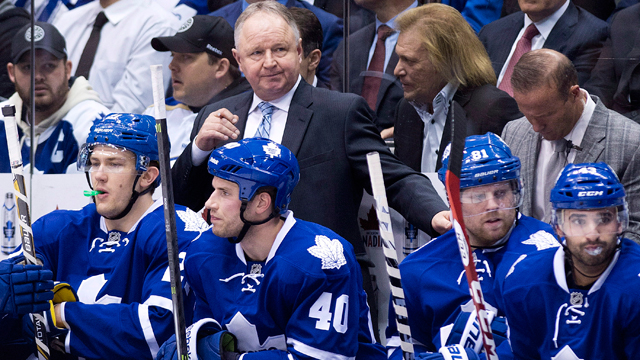
But after losing eight straight games in regulation the Leafs have once again burst through the guardrail and cartwheeled into oblivion.
When Leiweke arrived almost exactly a year ago, he had his priorities. The Raptors were a mess, so he pushed aside then general manager Bryan Colangelo. Even worse off was TFC, so he fired president Kevin Payne.
But Leiweke felt like his hockey team was on the right track. He figured the Leafs were his ace-in-the-hole. He was going to be here when the Stanley Cup finally arrived, and his legacy in sports would be that much grander for it.
"What intrigued me about [joining MLSE] is that the Maple Leafs now are headed for a long run where they are going to be a good competitive team," Leiweke said last April after he was announced as the incoming MLSE president and chief executive officer. "And I think about winning the Stanley Cup in Toronto would mean for the sports, for the city, for the organization, and I can’t think of anything I would want to build that would be better than that."
Leiweke backed up his talk with some hefty commitments.
He didn’t blink when general manager Dave Nonis bought out Mikhail Grabovski for $14.3-million and then used the cap space to invest $36.75-million and seven years in David Clarkson. Leiweke rewarded his general manager for that $51-million transaction with a five-year contract extension barely a week later. Emboldened , Nonis locked up Tyler Bozak for five-years and $21-million, Phil Kessel for eight years and $64-million and Dion Phaneuf for seven years and $49-million.
Throw in Joffery Lupul’s five-year, $26.25-million deal – Nonis’ first significant signing after he took over from Brian Burke last January — and the Leaf core seemed set, which at the moment seems terrifying, given this group collapsed similarly in 2011-12 and showed all the same traits in blowing Game 7 against Boston up three goals with 10 minutes to play.
So now the question for Leiweke, who spent days last summer walking the streets of his new city plotting a new Stanley Cup parade route is something along the lines of: What the hell have you’ve gotten yourself into?
You could understand why he arrived talking championships and banners. That’s what leadership sounds like. You raise the tent and do what it takes to get everyone to gather under it and leave with the same vision.
But aiming for a championship in a league with a hard salary cap like the NHL is like plotting a moon shot – miscalculate your trajectory by just a little bit at the beginning and you can go miles off target spinning off into orbit, never to return.
If Leiweke came to Toronto because he thought the Leafs were poised for a long run as an Eastern Conference contender he might have been misinformed or simply thought he knew better.
Just a few months ago when the Leafs engine light first came on after they went 13-16-5 after their 10-4 start in October, Leiweke seemed unbothered.
"What they need to do is take a deep breathe, relax a little bit and stop clenching their sticks so tight," he said. "I don’t think October was a fluke."
Except even as those in his front office were spending millions to commit to a core of dubious credentials, a small platoon of data adept Leaf fans were – for the grand price of nothing – producing a steady stream of advanced statistical analysis that argued that the Leafs penchant for being badly outshot and being overly reliant on outstanding goaltending meant their success was actually very fluky.
And now the luck has run out.
So now what? Does Leiweke pull the rug out on the same crew who effectively sold him a bill of goods regarding the competitiveness of the Leafs a year ago and then continued to double-down with long-term, cap clogging deals?
Or does he look at a roster that is going to collapse for the third straight season, clearly lacks the quality at centre ice and the blueline that corresponds with winning teams and trust Nonis to fix it?
It’s been a year since Leiweke took Toronto by storm, rolling in like a saviour. Now we’ll get the measure of the man.