Sunday, the Toronto Blue Jays made history. Thanks to a weather postponement in New York on Wednesday, followed by a doubleheader at Yankee Stadium Thursday, a weather-shortened game the following night in Cleveland that probably should have been postponed, and another weather postponement Saturday, the club became the first team in MLB history to play five consecutive games of fewer than nine innings.
That Toronto’s opponent, Cleveland, was likely to become the second a day later thanks to back-to-back doubleheaders of their own says something about the realities of pandemic baseball, open-air stadiums in the Northeast, and shifting climate patterns. But that’s neither here nor there. Because for the Blue Jays, scrambling to cover innings amidst a stretch of 29 games in 31 days, while constantly shuffling roster puzzle pieces with three pitchers on 10-day IL and a half-dozen others on 60-day, this once-in-a-century phenomenon couldn’t have come at a better time.
The same can be said of Ross Stripling’s resurgence, as the Blue Jays starter continued to thrive with overhauled mechanics in the first half of Sunday’s doubleheader, holding Cleveland to a run on two hits over five innings in a 4-1 Blue Jays win. Run support came from the big bats of Teoscar Hernandez and Rowdy Tellez, who each hit solo shots in the fourth, while Marcus Semien continued his bid for player of the month with a three-hit performance, including a pair of doubles and a walk.
[snippet id=4722869]
“I think that today was a good sign because, for one, I didn’t have the full arsenal working with the breaking stuff and even the changeup,” Stripling said. “But I think where my hands are shows that my timing is better, that I’m a little bit more deceptive than I was the first couple starts of the year.
“When I missed my spots, I’d still feel like I had guys off balance. Versus in the past, if I missed spots, they were getting punished. So, I think that’s a good step in that direction even when I may not have my best stuff — that I’m able to keep guys off balance with some deception that maybe I didn’t have before.”
Outside of a Josh Naylor solo shot in the fifth, Stripling dealt for a second-straight outing, looking much more like the guy who pitched to a 3.68 ERA over five seasons with the Los Angeles Dodgers than the one who carried a 5.85 ERA through a dozen outings with the Blue Jays into Sunday’s start. A recent series of mechanical adjustments have paid immediate dividends for Stripling, as has a tweaked approach that saw him pounding the zone with fastballs the first time Cleveland hitters saw him, before leaning heavily on changeups and curveballs during their second plate appearances.
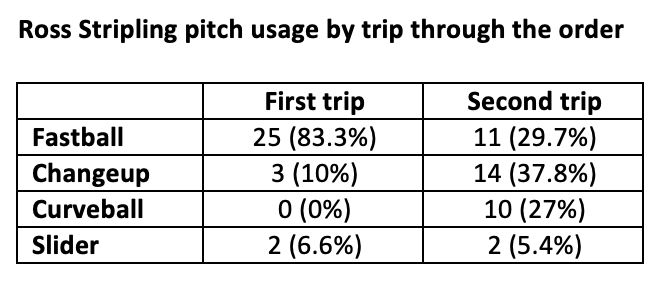
The disparity Sunday was remarkable. His first trip through Cleveland’s order, Stripling threw 30 pitches — 25 of them fastballs. His second trip was 37 pitches — only 11 of them fastballs. The final batter Stripling faced in his first trip, Austin Hedges, saw six fastballs in a seven-pitch plate appearance. The first two batters of his second trip, Cesar Hernadez and Amed Roasio, saw nothing but changeups and curveballs.
Stripling’s day ended after that second trip, as Blue Jays manager Charlie Montoyo turned to a bullpen that’s taken advantage of Toronto’s lessened schedule to get as much rest as it’s had since the beginning of the season. That’s been the true benefit of all these seven-inning games. Montoyo’s no longer looking for pitchers to get in games; he’s looking for game time to get his pitchers. And with two quick, scoreless innings from Rafael Dolis and Jordan Romano, the bullpen secured Stripling his first victory in a Blue Jays uniform.
Steven Matz was cruising right along to a victory of his own in game 2, facing the minimum through five near-perfect innings. But Santiago Espinal booted a routine grounder to begin the sixth, which set off a series of unfortunate events. There was a double to the wall, a groundball single to left, and another single off Matz’s glove, which ultimately chased him from the game. Then Tyler Chatwood took over and gave up a single of his own, before Cleveland’s game-tying fourth run of the inning scored on a double play.
“My stuff felt good today. I was cruising. A couple hits here and there, and kind of got snake bitten right there,” Matz said. “So, that’s definitely frustrating.”
Fortunately, the Carolina Reaper-hot Semien was due up in the top half of the seventh. And after Jonathan Davis reached with a lead-off walk and moved to second on a Danny Jansen sacrifice bunt, Semien rifled a 99-m.p.h. first-pitch cutter from erratic Cleveland reliever Emmanuel Clase right back up the middle to cash the go-ahead run.
MarCLUTCH Semien does it againpic.twitter.com/8OYX159m4U
— Toronto Blue Jays (@BlueJays) May 30, 2021
“He throws a 100-mph cutter — so, the ball needs to start a little bit closer to you to end up in the box. So, that’s what I was looking for,” Semien said. “I got one that was probably middle-away. But in my mind it looked like it started middle-in and just cut out over the plate. So, I got a pitch I could handle. He throws a lot of those pitches. He probably throws about 75 per cent fastballs. So, I was ready to hit it.”
Interestingly, despite having several rested relievers and an off-day Monday, Montoyo sent Chatwood back out for the seventh — with no one warming in the bullpen behind him — after his shaky, 11-pitch appearance in the sixth. The results weren’t necessarily surprising. Chatwood got a quick out, but then missed the zone with 16 of his next 19 pitches, walking four consecutively to cough up another lead.
That forced Montoyo to make a move, summoning Anthony Castro into the toughest spot a pitcher can enter — bases loaded, tie game, sudden death inning. Tough to blame him, then, for allowing the walk-off sacrifice fly that handed the Blue Jays a 5-4 defeat in a game they really ought to have won.
It’s fair to wonder, considering Chatwood’s long history of command trouble and struggles to find the strike zone in recent outings, why Montoyo didn’t have someone warming behind him to be called upon in case of trouble. Asked that very question after the game, the Blue Jays manager said he was showing faith in a pitcher who successfully got him through several high-leverage spots earlier in the season.
“For us to be good, Chatwood needs to do the job. He needs to be the reliever that he has been,” Montoyo said. “So, you’ve got to give him a chance to regroup and do the job. Get a double play ball or something. He just couldn’t do it. That’s two straight bad outings. But we need him. That’s a fact. He was our best reliever for the first two months. And he just needs to get it back.
“He’s been lights out,” Montoyo continued. “You know, the funny thing about it — we’re talking about just the one game. We took two out of three from the Yankees; two out of three from [Cleveland.] And we’re talking about one bad inning. You know what I’m saying?
“Yeah, maybe we could have taken him out. Yeah, all that stuff. But he’s one of our best relievers. You’ve got to trust somebody one time and let them get out of trouble.”
If there’s a foremost example of the toll Toronto’s heavy early-season bullpen workload has taken on its relievers, Chatwood’s it. A converted starter who pitched in 12 of Toronto’s 23 games this month leading up to Wednesday’s postponement, Chatwood went from a 12.9 K/9, swing-and-miss machine through his first 13 appearances of the season, to a guy with more walks than strikeouts and no swinging strikes in four of his last five. Sunday, he registered only one swinging strike and walked five without a strikeout.
“He’s just not throwing strikes. That’s just what it is,” Montoyo said. “We need him. That’s a fact. And he needs to get it back. And you’ve got to give the guy a chance because he was that good the first two months — he was our best reliever the first two months. Just because of two outings, you’re not going to put the guy to side. We need him to get back to where he was.”
Wednesday’s postponement in New York, which began this odd-yet-well-timed stretch, came just as the Blue Jays were beginning the back-half of a 13-day run without an off day, and at a point when the club’s bullpen was stretched to its seams. The only somewhat well-rested reliever Montoyo had at the time was A.J. Cole, who’d been down for three days and was almost assuredly pitching Wednesday one way or another. Everyone else was up against it.
[snippet id=3305549]
Romano had entered late-game spots on four of the ensuing six days, throwing 56 pitches in all. Chatwood had it even worse, pitching on four of six himself while totalling 71 pitches, no fewer than 15 in any of his appearances. Plus, Tim Mayza had appeared in three of five and was difficult to trust in leverage after allowing multiple runs five of his last seven times on the mound.
Meanwhile, Castro, having just returned from a forearm strain, had been used in two of four, logging extended outings of 17 and 26 pitches. And Trent Thornton had carried a huge load, throwing 25 pitches in a Saturday night relief appearance against the Tampa Bay Rays and then 32 pitches in a Monday afternoon opening outing less than 48 hours later. In the span of a week, Thornton had thrown 94 pitches over 4.1 innings in three separate appearances.
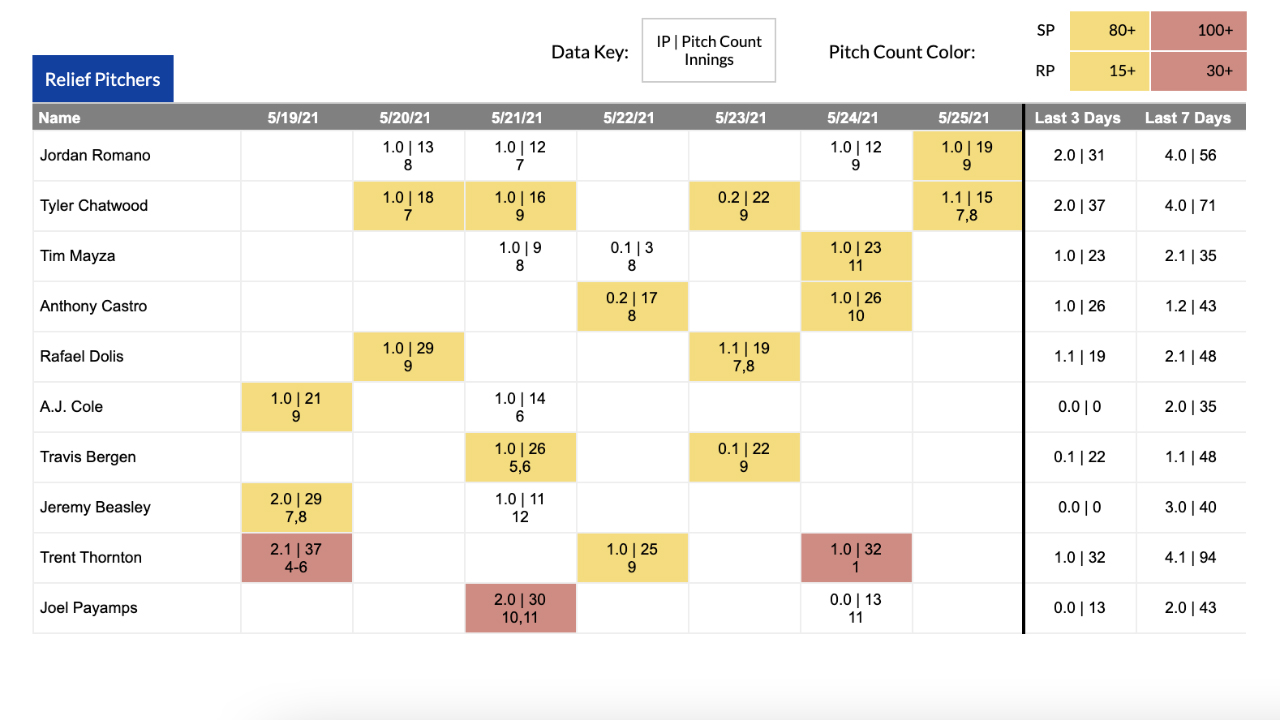
How the Blue Jays have used their relievers over the seven days prior to this stretch of five straight seven-inning games
Montoyo and his coaching staff had done their best to manage workloads, nudging starters deeper into games and running a frequent shuttle between the majors and triple-A — but the situation was proving untenable. Blue Jays relievers had pitched to a 4.53 ERA in May after posting a 2.52 mark in April, the third-best bullpen ERA in the league. MLB’s relentless schedule was just too much for a group dealing with numerous injuries and covering for at least one spot in Toronto’s rotation each turn it took — sometimes two.
Which is what made this week’s slight reprieve so welcome. Seven innings are much simpler to cover than nine, particularly when starters are chewing up outs and getting deep into games, as Toronto’s have been lately. Entering Sunday, only Romano had made multiple appearances out of the Blue Jays bullpen over the preceding five days. Chatwood had received a much-needed, four-day breather. And guys like Castro, Mayza, Dolis, and Joel Payamps hadn’t pitched at all.
The Blue Jays also added a reinforcement Sunday in veteran right-hander Carl Edwards Jr., who was selected to the active roster with Ty Tice designated for assignment to make room. Edwards was once a lynchpin in the Chicago Cubs bullpen, pitching to a 141 ERA+ over 154.1 innings from 2016 through ’18 with 12.4 K/9. But injuries and spotty command have held him to only 28 big-league appearances since as he’s bounced between four different organizations.
Toronto’s hoping Edwards can right the ship in their bullpen, carrying forward momentum from the four scoreless innings he threw for the triple-A Buffalo Bisons prior to being called up. And if he does recapture something close to his Cubs form, the Blue Jays stand to benefit even beyond this season, as Edwards is still arbitration eligible this winter.
[relatedlinks]
 2:55


 2:06