
On May 1, Toronto Blue Jays fans had to look up in the standings to find the Boston Red Sox and New York Yankees ahead in their own division, not to mention two other teams with better records elsewhere, and the Cleveland Indians comfortably ahead in the AL Central.
In other words, if Thanos descended from the heavens and decided to screw with baseball by ending the regular season now instead of collecting shiny gems, the Jays would miss the playoffs for a second straight season.
That’s the bad news.
The good news is that the Jays ended April with a solid 16-12 record, scoring 29 more runs than they allowed to claim the fourth-best run differential in the American League. For a team coming off an 86-loss season, that’ll play.
Which Jays players led the charge in April? Which ones didn’t pull their weight? Let’s take a look.
[snippet id=3918627]
Infield
C Russell Martin, D-
He batted .156/.299/.328 through the end of April, while making $20 million. Though Martin continues to walk at an elite rate, he’s making more weak outs than just about any other hitter in the game: Only three AL hitters have beaten the ball into the ground more often, and only one has cracked line drives less frequently.
Martin gets high marks for his experience and game-calling skill behind the plate, but no amount of catching know-how can make up for hitting like a pitcher.
1B Justin Smoak, B-
This all comes down to perspective. Compared to everything Smoak did before last season, a .255/.355/.441 line at the end of April looks terrific. Compared to the .270/.355/.529, 38-homer joy-ride he went on in 2017, it’s a power-starved disappointment. We’re more or less splitting the difference here.
2B Devon Travis, F
Another Toronto hitter who punished the infield turf, Travis’s lack of hard contact in the air got so bad, he got sent to the minors.
It might be time to accept that Travis more closely resembles the fringe prospect/13th-round draft pick he was six years ago than the player who hit .301 in the first 163 games of his major-league career.
SS Troy Tulowitzki, F
The Jays need to make alternate plans, assuming that Tulo won’t ever again be a significant contributor in Toronto. Matter of fact they’ve already done so, which is why Aledmys Diaz, Yangervis Solarte, and Lourdes Gurriel are already on the major-league roster. Injuries suck.
3B Josh Donaldson, D+
A shoulder injury cut his month short, and a .239/.352/.457 batting line falls well short of his production from the past three seasons.
Because of Donaldson’s injuries this year and last, here’s where we’re at: If the Jays dangle Donaldson to other teams at the trade deadline, they’ll fetch a lot less in return than they would have had Donaldson played through the past season-and-change at full health. And if they try to sign him to an extension, he’ll cost a lot less than he would have with the tailwinds of health and full-season numbers behind him.
UT Yangervis Solarte, A+
If we’re going to open the doors to sports betting with platforms like daily fantasy, we should be able to push this a lot further. Wouldn’t it be great to be able to make hyper-specific bets on your favourite team? Like, say, that Yangervis Solarte would not only lead his team in home runs through the end of April, but that no one would be any closer than three long balls away from his total?
Acquiring Solarte from the San Diego Padres last winter in exchange for B-level prospects looks like a colossal steal at this stage, with Solarte about to take his suddenly powerful bat from third base (where he’s covered for Donaldson during the latter’s DL stint) to second (with Travis now plying his trade in Buffalo).
UT Lourdes Gurriel, C-
We could also call this an incomplete grade, since Gurriel played in just nine games after his call to the Show. The bigger question is whether he is, or will become, a major-league calibre hitter.
Gurriel struggled badly at both single-A Dunedin and double-A New Hampshire last season, before riding a fluky .364 batting average on balls in play to some gaudy double-A numbers over 12 games. If we include his ‘0-fers’ in the first two games of May, Gurriel’s batting an ugly .211/.231/.289.
Not all prospects are created equal, and Bo Bichette is a likelier candidate to be starting for the Jays a year from now than Gurriel is.
[snippet id=3966765]
Outfield
OF Teoscar Hernandez, A+
Can we give out a higher grade than A+?
The Jays made a reasonable gamble when they bought low on Randal Grichuk over the winter, hoping to find a cheap power source to revive a moribund offence. As it turns out, however, they had a cheap power source right under their nose all along.
Hernandez absolutely raked in April, batting .306/.377/.677 with 13 extra-base hits in 15 games. Management has grappled with the dilemma of how to make 2017’s oldest AL team younger while also contending and filling the ballpark in the here and now. If Hernandez keeps making good on his potential, GM Ross Atkins and Co. will have one position well filled and one piece of their dilemma solved.
Some time next decade, the Jays might look back on getting six years of Hernandez in exchange for two months of Francisco Liriano as one of the greatest trades in franchise history.
OF Curtis Granderson, A
He and Solarte have been the co-captains of the Jays’ bargain brigade, providing huge production at rock-bottom prices.
Yes, Granderson is just a platoon player at this stage of his career, and yes, he’s a power-and-walks corner outfielder at age 37, instead of the five-tool centre-fielder that he was in his prime. Big whoop. Playing almost exclusively against right-handed pitchers, the Grandy Man hit .306/.434/.548 in April, has been an invaluable part of Toronto’s early-season success, and costs the team just $5 million in 2018.
OF Randal Grichuk, F
Remember that one player who’s managed fewer line drives than poor Martin this year? That would be Grichuk, whose recent trip the DL might’ve clinched Hernandez Wally Pipp-ing him out of a job.
OF Kevin Pillar, A
Pillar is a reliable source of speed and elite defence every year, with the caveat that he’s never hit much. Actually that’s not quite true.
Pillar looked great at the plate for the first few weeks of 2017, before batting a brutal .233/.275/.363 from May 17 on. So while Pillar’s offensive explosion to start this season looks exciting, keep in mind that we’ve been here before, and that a .368 batting average on balls in play has no shot of lasting.
The Gold Glove defence and impressive speed will still be there in June, July and August; the rest probably won’t.
[snippet id=3305549]
Pitchers
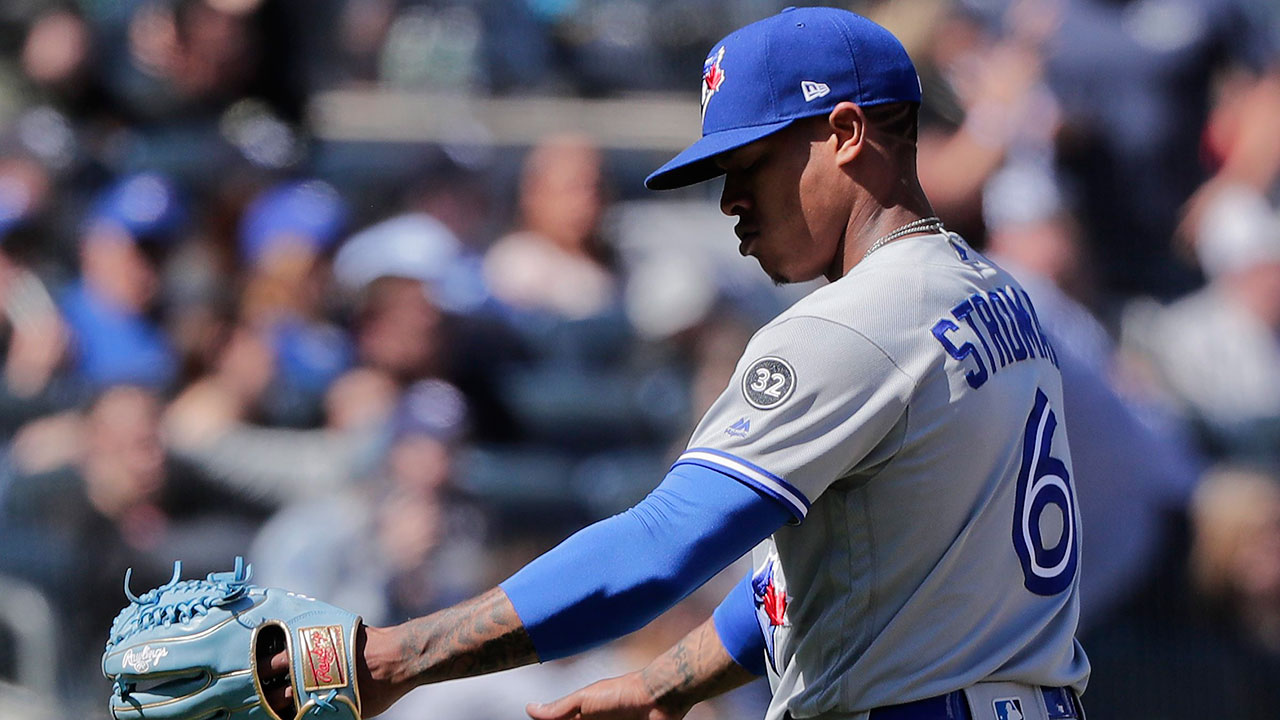
SP Marcus Stroman, F
There’s no dressing up an 8.88 ERA. Stroman ended April rocking the fifth-highest walk rate in the league, with the worst first-strike percentage of his career, and a terrifying 47.6 per cent hard-hit rate by opposing batters.
Let’s hope that Wednesday’s seven innings of two-run, six-strikeout ball mark the first step on his road to redemption. Stroman maintained the highest groundball rate in the majors even as rivals teed off on him.
If he can get his command in order, he could make April’s woes a distant memory.
SP Aaron Sanchez, C
Far too many walks, a career-low strikeout rate, and an average fastball velocity that’s more than one m.p.h. lower than his previous career-worst mark.
Sanchez is healthy, and he’s giving his team a chance to win by averaging more than six innings per start, but he’s still got a long way to go if he hopes to recapture the 2016 form that made him the AL’s ERA champ.
SP J.A. Happ, A-
The resurrection of Happ began in the summer of 2015, when the excellent Pirates pitching coach Ray Searage encouraged the lefty to stop nibbling and start attacking the strike zone with high fastballs.
After two straight successful seasons, Happ’s taken that high-fastball tack to a new level this year, becoming a strikeout machine with 50 whiffs (and just seven walks) in 36 innings.
Stroman and Sanchez are the home-grown products who were expected to leap to stardom, but it’s the 35-year-old journeyman who’s become the clear ace of this staff.
SP Marco Estrada, D-
Estrada has been tempting fate for a few years now, challenging hitters with high fastballs of his own, while relying on heavy spin to overcome his subpar high-80s velocity. That approach has failed badly this year, with Estrada serving up seven home runs in his five April starts, then another two gopher-balls against Minnesota on Tuesday.
Estrada turns 35 in July, and already dances on a razor’s edge with his lack of traditional stuff. The Jays might need to hunt for better options if these long-ball struggles continue.
SP Jaime Garcia, D
Garcia looks like a completely different pitcher this year. Good: an unprecedented strike rate, with 28 punchouts in 26.2 innings. Bad: a huge drop in his groundball rate, down around 42 percent compared to his career rate of 56 per cent. Just plain weird: Despite that huge spike in K rate, Garcia’s swinging-strike rate has plummeted to 8.7 per cent this year, down from his 11.1 per cent mark in 2017.
A larger sample size should iron out some of these discrepancies. The Jays better hope it irons out his 5.40 ERA too.
RP Roberto Osuna, B
Remember last season, when Osuna’s overall numbers looked great, but the flame-throwing closer still managed to blow 10 save chances? He’s converted eight of nine save chances this year.
Some minor red flags to watch: A steep early drop in his K rate, plus a surge in both line drives and hard contact allowed.
Rest of the bullpen, A-
We covered this last week: They have been really good.
[relatedlinks]