For baseball fans who don’t frequent stats-based websites, the sport can be hard to follow at times. Analytics have gained a profound foothold in the game, making it easier for the casual observer to fall behind.
That’s part of the reason Keith Law penned his recently published book Smart Baseball, which breaks down some of the myths surrounding archaic stats while helping readers digest some of the new ones that have gained prominence.
Law, a senior writer and analyst for ESPN, is deeply familiar with the subject, having worked in the Toronto Blue Jays front office where he was responsible for statistical analysis for four-and-a-half years.
He also has scouting experience and writes one of the most respected prospect lists in baseball for ESPN.
We caught up with Law to discuss a wide range of subjects, including his book, his battle with anxiety and the state of the Blue Jays as they approach the July trade deadline, as well as the organization’s top prospects.
SN: What spurred you to write this book?
Law: It was largely inbound requests from readers for recommendations on a book that would allow them to get up to speed on the state of sabermetrics, whether it was understanding individual stats, or to follow arguments why certain stats aren’t good, or just to be able to keep up with what their favourite teams were doing.
There wasn’t anything I could recommend that was written for the lay audience. Everything was too [technical], or just didn’t get the job done at all, and so I thought there was an opportunity, but also it felt like, ‘Hey this is something I can contribute. I think I can write this because I’m not going to write the overly technical book, but I can explain some higher concepts maybe in plain language that make them accessible to everybody.’
SN: What was the writing process like?
Law: I did it on the side, which is always tricky. It’s not like I left my full-time job to be able to do this. Along those lines it was difficult just to find the time, but because it’s a subject that I’ve been dealing with for 15-plus years now, a lot of it came right out of my head. I was able to sit down and write 2,000 words in an afternoon without too much trouble. I treated it like I was giving a talk. Just sit down and it’s like somebody said, ‘Hey, take an hour and explain to us why RBIs are bad.’ That was relatively easy to do compared to what had to go into the Statcast chapter or what had to go in to the final chapter where I interviewed a bunch of executives and asked them open-ended questions about what they thought about the future of analytics in baseball.
SN: Speaking of RBIs, in the book you mention that it was former Blue Jay Joe Carter who first opened your mind to the idea that it’s a dishonest stat. Can you tell me about that revelation?
Law: At the time I was a fan playing fantasy baseball with friends and recognized this guy who consistently had fairly high RBI totals. [In the book] I highlight the 1990 season with San Diego when Carter was hitting .232 and not getting on base at an acceptable clip, let alone a high clip, and that it was a function of what the hitters ahead of him in the lineup were doing. Roberto Alomar and Tony Gwynn were on base for him all the time and so of course he had a high RBI total. A player who is seen as a good player, weighs well in this particular category, but overall is not actually that productive a hitter. That conflict of recognizing here’s this disconnect between the way we talk about a player and what the player actually is.

SN: What are the most overvalued stats by fans today?
Law: I still hear them from readers and occasionally see them from writers: Batting average, RBIs, wins, saves. People still throw fielding percentage around like it means something. I’ve had people throw minor league error totals at me to argue for a player being or not being a good defensive player. In the minors, the state of the fields, in and of itself is not the same as it is in the big leagues, to say nothing of who’s actually doing the scoring.
These all still exist and they’re still huge because they exist. It’s the anchoring effect: People see a number and immediately assume that the number is meaningful. I could certainly throw numbers out there, even sabermetric numbers that are not meaningful.
SN: What do you make of the new speed data that’s just been made available by Statcast and MLB?
[sidebar]
Law: I’ve seen it, but haven’t spent any time looking into it. I think everything with Statcast is all about offering us more precision, more granularity than we ever had before and in many cases, it allows us to truly quantify things we had a hard time quantifying, like the spin on a breaking ball. Because we’ve only got about two-and-a-half seasons of Statcast data, we don’t have a great handle on the predicted value of many of these things or their correlation to actual production. In other words, are the fastest guys actually turning into either the best defenders or the most valuable baserunners? We still don’t know. We probably need more years of data before we get to that point. But that doesn’t mean it’s not valuable, it just means we don’t know … I think there’s a tendency to try to use these stats before we really know what their importance is.
SN: Roberto Osuna is top of mind here. You’ve been open about your own battles with anxiety. How did you deal with that?
Law: My story is that there’s a long portion of my life where I wasn’t dealing with it at all. And I was not even diagnosed until I was 39, at which point I began both therapy and medication. [It gave me] so many explanations for how I felt and how I would behave in the past. I don’t think anything has helped as much as medication has, but exercising more regularly is huge for people with depression and anxiety, and other lifestyle changes as well. I’ve begun some meditation. All of these things are part of a comprehensive regime to treat the condition.
I don’t want to give anyone the impression that I have solved it. It still exists, it’s always going to be there. The perfect combination of remedies is an ongoing process. I’m in a better place now than I was five or six years ago and I hope that a year from now, I’ll be in an even better place.
SN: You worked with the Blue Jays in the early 2000s. How did front offices in baseball treat mental health back then, versus how they treat it now?
Law: Back then there was very little understanding of mental health issues. That was seen as bad makeup or mental unfitness. That’s no longer the case. I think the fact that you have seen a big turnover in who’s running baseball operations departments is probably a big help. There’s this greater societal recognition that mental illness is an illness. This is not ‘You’re crazy.’ These are medical conditions that require medical treatment and can and need to be addressed just as how you would deal with an employee who got sick, who got a diabetes diagnosis.
These can be chronic conditions, but most of them can be managed. The programs to manage them need to be highly individual. We’re seeing more of that in baseball and in sports in general. We’re seeing more players who are comfortable coming out and saying, ‘Here’s what I have.’ We’re seeing more teams come out as well. You try to work with the player. With sports teams, obviously your goal is to get your player back on the field, but you also want him back on the field in a position to perform at his best. You wouldn’t send a pitcher out there if his arm was sore. Would you send a pitcher out there who is dealing with the real consequences of depression or anxiety? I think 10-15 years ago it was, ‘Go pitch through it.’
Today it’s, “No, how do we work with this.”
I have a sense that there are more resources available today to a player. I can only speak to the fact that when I was with the Blue Jays, there was one person in the entire organization [who dealt with mental health]. That’s not enough, obviously. You need many and I don’t know exactly how much better that’s gotten.
SN: Regarding today’s Blue Jays, what do you think the team should do as it approaches the trade deadline? They’re treading below the .500 mark and can’t seem to get above it.
Law: It depends on what happens to them in the next 20 days. If they rattle off enough wins and suddenly end up in a playoff position, the answer is going to be very different. I don’t think that’s likely. I don’t want to make it sound like it’s impossible — this team could easily win 12 out of 15 and then the conversation changes. Let’s say they stay around where they are, we get to July 20 and they’re still a .500 team, given the competitive landscape of both the division and the league, I think it would make more sense for them to sell than buy. The worst thing they can do, is to do nothing. Their schedule is going to be tough because the division has no pushovers. You’ll be playing in the division a lot towards the end of the season. The teams in the Central and the West, you’re competing against them in the Wild Card, and they have an advantage. Their divisional schedules are easier.
Also, the Blue Jays farm system is down at this point. They traded a lot of prospects to fuel the playoff runs of the last few years, which was great. It’s what you use prospects for. But now they’re light and I think even making two or three smart trades at the deadline could really help speed up restocking the farm system. Doesn’t necessarily have to be a complete teardown. But, at the same time, I think if they’re not firmly in a playoff position by the end of July, it doesn’t make sense to try to buy.

SN: What could those “smart trades” look like?
Law: It’s going to largely depend on what the rest of the market is looking for. I don’t know what the market for starting pitchers is going to look like and will there even be a market for a Marco Estrada? He’s been terrible this year, after being surprisingly good last year. My instinct is there are always teams looking for starting pitching. J.A. Happ is pitching well, when healthy. Is there a market for him? I think what you do in the front office’s position is figure out anyone who’s a free agent after this season or after next season, you put them out there and you see where you get what you consider an adequate return. But it’s entirely possible they put someone out there, like Jose Bautista, and the market says, ‘We’re not giving you anything for him and that’s that.’
SN: We saw the New York Yankees rebuild on the fly the past two years, turning things in overdrive at the July trade deadline in 2016. Does this Blue Jays club have the ability to do the same?
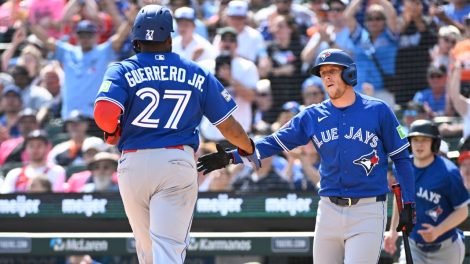
Law: That’s probably a question without a yes or no answer. They don’t have Andrew Miller to go out and swing a trade to get two guys who ended up on my top 100 prospects list. Last year, in the Miller and [Aroldis] Chapman trades, they added three top 100 prospects and then drafted another one in the first round in Blake Rutherford. I don’t think the Blue Jays are quite in that position. At the same time, I thought they did very well in the draft this year. Better than they had the year before. I think the emergence this year of Bo Bichette and Vladimir Guerrero Jr. helps. They’re expected to sign the top pitcher in the July 2 class this weekend. A Brazilian pitcher named Eric Pardinho. That helps.
[pullquote]”He should be in the big leagues before he’s 21.”[/pullquote]Keith Law on Vladimir Guerrero Jr.
I have a feeling when we get to January, let’s say they do make two trades at the [July] deadline this year to sell and and get prospects, I’m going to end up ranking them quite a bit higher than I did last off-season because I think most indicators are pointing up. I would say Rowdy Tellez, who I was never high on anyways, is the only guy I can think of in their system who has really taken a step back this year.
SN: I remember reading that you weren’t high on Tellez going into this season. Can you explain that and what you make of his struggles this season?
Law: I’ve seen a lot of Tellez since he was in high school. He doesn’t hit good velocity. Last time I got an extended look at him was in Fall League in 2015 and he was just destroyed by velocity up [in the strike zone]. He just couldn’t connect with it. Would continually swing under it. He’s also a below-average athlete who doesn’t have a position. The standard for those guys is extremely high. Look at Dan Vogelbach [of the Seattle Mariners] who’s a better hitter and has as much raw power as Tellez, but is struggling to find a role in big leagues because he has no position. If you’re a DH only as a kid, you’ve got to really rake. Preferably rake and rake with power. And I think that Tellez would need that combination of offensive skills to be able to overcome the fact that he’s either a DH or a bad first baseman.
His struggles this year are kind of what I expected. He moved up a level, he’s facing better pitching. The word gets around very quickly that here’s how you get this guy out. This is what I thought he was. Now it’s on him to see if he can make pretty substantial adjustments at the plate to at least be able to find himself a big-league role.
SN: How quickly can we realistically expect Guerrero Jr. in the big leagues, and do you see him staying at third base when he gets there?
Law: He’s 18 now. He should be in the big leagues before he’s 21. He’s an advanced hitter. He may end up spending the rest of this year in the Midwest League. I don’t think [the Blue Jays] have committed one way or another whether to promote him to the Florida State League or not. He’d be fine if they did. Given what he’s doing at his age as one of the youngest players in his league, playing extremely well at the plate, it is realistic to think that he’ll get through the next three levels of the minors in two years. That’s absolutely, I wouldn’t even say possible, I’d say probable given how advanced he is.
I haven’t seen him live yet, I will next week. My understanding is he can play third base. He may not be great, but he can certainly play third base. But we don’t know what his body’s going to look like in a couple of years. He’s still a child; he’s the age of a kid coming out of high school. He may just grow off the position too. But I tend to believe players who are at least athletic enough and have the footwork to stay at third, usually end up staying there. Good athletes can end up moving off the position because they don’t have the footwork, whereas guys like [Boston Red Sox prospect] Rafael Devers, who is a big third baseman, but there’s no doubt in my mind he can play third base because he’s got the footwork, the hands and a crazy arm. If you have those three things, you can play third base and I believe [the Blue Jays] are going to leave Vlad at third base as long as they possibly can. Because once you move him off, he’s going to the outfield and you lose value. And that’s silly. Let him play third base until it just gets to a point where you really think he can’t do it and I have not heard anything to this point that makes me think he can’t.
SN: Lastly, what are your thoughts on Bichette?
Law: He’s outstanding. He’s just got incredible hand-eye coordination. I thought they had a bad draft in 2016 and yet they got him in the second round and that’s gonna end up being the pick that salvages the draft class for them. He’s a pretty special offensive talent. I don’t think he stays at shortstop, but if he goes to second base he’s going to hit more than enough to be a very good second baseman, maybe an all-star.
Those two guys, if they are your top two offensive prospects, teenagers destroying full-season ball, it’s a pretty good start.
[relatedlinks]