It was a heavyweight tilt between two of the best Canadian men’s curling teams on Wednesday at the Co-op Invitational in Victoria B.C.
Not only was it Team Brad Jacobs, the defending Olympic gold medallists, facing off against the newly formed Team Brendan Bottcher, it was also Bottcher playing against Marc Kennedy, Brett Gallant and Ben Hebert — the three that left him for Jacobs before going on the Olympic run.
For a first-year team in Bottcher seeing where they stack up against Canada’s best, it was a close battle until one key moment in the sixth end.
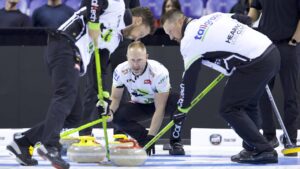
Jacobs, without hammer and already sitting one, decided to draw through the port and try to reach the button to make Bottcher’s last shot nearly impossible. Well, it took all of what Gallant and Hebert had to get the rock there after needing to sweep the distance of the ice, but he made the perfect shot.
Bottcher only had a 30-foot angled runback that he missed, giving up a steal of two. It was the difference in the 6-3 victory for Team Jacobs.
It wasn’t that Jacobs played better than Bottcher throughout the game, it was just the timely shots of which Jacobs always makes that propels him to be the best. Their performances showed that. Jacobs had an ace percentage of 75 while Bottcher was 70. In terms of field percentage, Jacobs was at 71 and Bottcher at 70.
The ace percentage is how well a curler is performing during the match — each shot is graded out of five and only fours and fives are considered made. Field percentage takes into account what every player from the GSOC tour would shoot on average with the same type of shots.
The edge stat shows how much better or worse a curler is performing against the field. So, Jacobs was plus-four while Bottcher was even.
This is a new way to track stats throughout the entire Grand Slam season that was created by The Curling Group’s Scott Cooke.
Considering it was only a measuring-stick game for Bottcher’s new Alberta rink compared to Jacobs’ team, now in their third season together, the gap between the two is smaller than expected.
Wednesday’s results: (Full scores and standings)
Draw 5
Hardie 6, Epping 5 (SO)
Casper 9, Maeda 3
Kang 10, Fujisawa 5
X. Schwaller 10, Dupont 7
Draw 6
Hoesli 5, Waddell 4
Paetz 8, Zardini Lacedelli 3
Ueno 9, Einarson 4
Ramsfjell 7, Mouat 2
Draw 7
Y. Schwaller 8, Koe 2
Carson 7, Eriksson 6
Jacobs 6, Bottcher 3
Dunstone 7, Yamaguchi 4
Draw 8
Gim 6, MacMillan 4
Hasselborg 7, Reese-Hansen 6 (SO)
Wrana 9, Miura 5
Homan 8, Nihira 7 (SO)
The growing pains of a new team
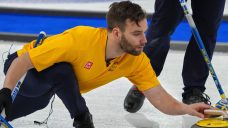
It was no secret when Grant Hardie left Bruce Mouat’s team after last season to join Ross Whyte’s squad as the new skip throwing third stones, they would be one of the best teams in the world immediately.
So far this season, they’re proving that to be the case. However, there is one thing that is noticeable through the first couple of games of the new Slam season that Team Hardie will want to improve.
Line calls.
Not necessarily for the whole team, but more so Whyte and Hardie in particular. In both of their games against Canadian Teams Kevin Koe and John Epping, where they picked up wins, there were a couple of times where Hardie or Whyte either missed the sweeping or the line call on each other's shots.
This is going to be a part of the growing pains with a new team. Everyone has different releases and for Hardie and Whyte, calling line for each other just hasn’t become natural yet.
Once it does, though, watch out.
Paetz still learning what her team wants to be
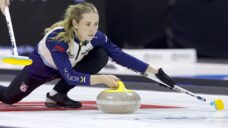
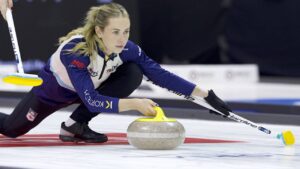
Of all the top women’s teams in the world, Alina Paetz’s Switzerland squad is definitely the one that saw the most change in the off-season. Silvana Tirinzoni, Paetz’s skip for eight seasons, retired from the sport after last season, leaving a hole in the roster.
With Tirinzoni as the skip and Paetz the fourth stone thrower, they won four-straight women’s world championships (excluding the 2020 season) and six Grand Slam titles. Then, Carole Howald, who was also on Team Tirinzoni, decided to step away from women’s fours and focus on Rock League and mixed doubles, leaving two holes.
So, Paetz moved back to the skip position, where she played before joining forces with Tirinzoni, and picked up Renee Frigo and Stefanie Berset to play lead and second. Selina Witschonke, who played lead for Team Tirinzoni, stayed with Paetz but changed positions from lead to third.
Paetz knows the team identity they had in the past won’t be the same moving forward.
“I think as a team, you have to find your own team strategy, what kind of style you want to play and I think we're still finding out what team we want to be,” Paetz said in an interview on The Just-In Sports Show. “We’re still having those strategy discussions, like some basic strategy discussions after the game.”
That’s a perfect way to sum up Team Paetz’s first two games of the Slam.
In the team's opening-day upset against the hometown favourite Taylor Reese-Hansen, it felt like Paetz was a little in-between on strategy calls for how they would play. But against Zardini Lacedelli, Paetz and the rest of her lineup were more decisive with their shots.
It led to Paetz producing a multi-score end in three of the four ends that they had the hammer. For the Swiss squad — who came into the Slam with three titles on the season already— this week, and season, will all be about figuring out how exactly they want to attack each game.
Reese-Hansen has their 'Welcome to the Slams' moment
When Reese-Hansen is asked a couple years down the road to recall her 'Welcome to the Slams moment,' she will probably say this game against Anna Hasselborg.
After a massive four-spot in the third end, Reese-Hansen’s Victoria-based squad looked like they were going to blow the defending Olympic champions out of the building. They were the better team, and controlled the flow of the game.
But after going up 6-2 with three ends left, everything fell apart. The mental cracks of the rookie squad started to break through and they just lost focus. Next thing Reese-Hansen and her teammates knew, they were going to a shootout tied 6-6 after giving up a steal for the second end in a row.
The hometown team couldn’t out draw Hasselborg in the draw to the button, losing 7-6, and blowing the big lead.
Obviously, there are so many positives from this game for Reese-Hansen and her teammates, who are now 1-1 and still have a good chance to make the playoffs. But the biggest takeaway they probably will learn after this game is to never take your foot off the gas.
The Co-op Invitational will be available on Sportsnet and Sportsnet+ Wednesday starting with Draw 6 at 2:30 p.m. ET / 11:30 a.m. PT. Sportsnet will air three draws per day through Friday. Sportsnet+ and CBC will carry the Saturday quarterfinals, while CBC will air the semifinals on Saturday evening. Championship Sunday will be on Sportsnet.


 0:58
0:58