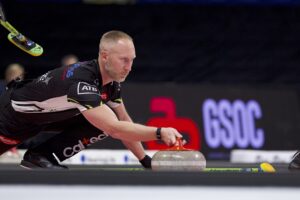
Canada’s Team Brad Jacobs did a lot of things at the HearingLife National in Sydney, N.S.
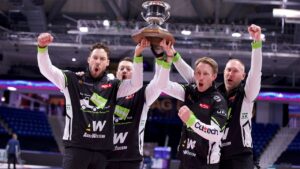
He won his first Slam title since forming a team with third Marc Kennedy, second Brett Gallant and lead Ben Hebert before the 2024-25 season. Jacobs also personally won his first Grand Slam since the 2019-20 season, when he won three of the four played that year before COVID-19 shut everything down.
The now eight-time Slam champion also stirred the pot against Sweden’s Team Oskar Eriksson during their semifinal match on Saturday, reminding everyone that what happened at the 2026 Olympics still hasn't been forgotten by either team.
It was only the second time since the double touch controversy that took over the Olympic Games, where Jacobs won the gold medal, that the two teams met. The first was at the Co-op Invitational, the first Slam of this season.
The game was, honestly, just a normal curling match. Sure, it definitely meant more to both teams, especially Team Jacobs, which won, but no there was no drama.
During the pre-game practice of the semifinal on Saturday night, though, Jacobs and Eriksson got into an argument over where stones were being thrown. The two got into a heated conversation for several minutes before finally letting it go.
However, throughout the entire game, we didn’t hear a word from either skip directed at the other. It’s probably safe to say, unless it's jawing back-and-forth, that will be the case for a long time.
“There’s still some tension there and some high emotion. Both want to do well… I think it’s going to be that way against those guys for a while, but hey, still a great team,” Kennedy said in an interview with The Curling Group after playing Eriksson in the semifinal.
It was just one of the many things we learned from this week's HearingLife National.
Ice conditions and rocks were strange
Let's be clear about one thing. The ice and stones at the Grand Slam of Curling are really good. It’s only on this type of ice with these rocks that the curlers can make the kind of shots they do. That being said, during this entire event, it had teams fooled.
First let's talk about the rocks.
Of course, you’re going to see the occasional cutter — which means the rock curls more than all the other stones — or a rock that runs straighter than normal. We see that at every event, not just Slams, and the HearingLife National was no different.
However, what was a little bit different about the National was the amount of drag the rocks had.
What is better known as the “drag effect” in curling happens when two stones are connected or within an inch and a team hits the top rock. This will either pull or send the back stone in a different direction depending on where the team hits the first rock.
Multiple times throughout the week, with a variety of teams, they attempted a hit in a certain spot on the top stone where they anticipated the drag would work a certain way.
However, the drag they expected to happen never came.
One example was during Canada’s Team Matt Dunstone’s game against USA’s Team Danny Casper.
It was Dunstone’s first rock in the eighth end, and he thought if he hit Casper’s stone that was frozen on top of his own in a certain spot, it would create drag into another stone in the back of the house.
The reigning Brier champion hit the stone where he wanted, but didn’t get any drag, and the rock went straight back.
“That didn’t drag it at all," Dunstone said on mics picked up on the GSOC broadcast.
Dunstone’s running mate Colton Lott was just as shocked.
“I’m very surprised, they were frozen. I thought it was going to pull (in a different direction),” Lott said.
Still astonished, Dunstone turned around to his coach Caleb Flaxey and said, “How did that not drag that at all?”
While it’s hard to officially say the reason as to why rocks didn’t drag the way Dunstone or any of the curlers thought they would, a likely reason would be the striking bands.
On the bottom of each stone there is a striking band that goes around the entire rock. Usually wider and more rough bands will create more grip and drag, and probably would’ve given Dunstone the result he was looking for.
However, stones with narrow and smoother striking bands don’t usually create that much drag.
The ice plays a factor as well. Which is the second thing we need to talk about.
As mentioned above, the ice conditions were good all week, but they were also strange. There were many instances of inside-out hits where the team took a normal amount of ice and threw it the way they wanted to, but it still overcurled.
This led to teams such as Switzerland’s Team Alina Paetz in the final against Japan’s Team Miku Nihira thinking she needed to take way more ice and getting tricked.
It wasn’t just hits, though. A lot of draws and guards were also off the mark during the entire event. Sure, the curlers should be able to adjust, and some did at the National, but it’s a matter of being able to trust what you're seeing.
If the curlers couldn’t trust to put the broom further out than normal on a hit during the week — not as far as what Paetz did on the shot above — they weren’t going to make the shot. Even when the ice, although different than normal, was telling them it’s the right thing to do. It’s all mindset.
A lot of Blowouts
The previous section is directly correlated with this one.
We saw a lot of blowouts over the course of the week at the HearingLife National. In 41 of the 64 round-robin games, teams won by three or more points. Not really the results anyone is hoping for from an entertainment standpoint.
For the most part, it’s the same teams competing in the Grand Slams and we didn’t see these types of results during the first two events. So, it’s not that a couple teams magically became way better or vice versa, it’s all about the point above.
One prime example is Canada’s Team Brendan Bottcher. In the first two Slams, his team qualified for the playoffs. But at the National, they started the week 0-3, losing by three points or more in all three defeats.
Sure Bottcher’s team can have an off week, any top team could, but considering the margin of defeat, this strikes as something to do with ice, more than their overall game.
The next stop on the Slam Tour is the GSOC Open, happening Dec. 1-6 in Thunder Bay, Ont.



 1:49
 1:18