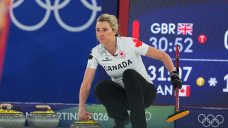
With a new quadrennial set to begin, one of many things on Curling Canada's to-do list is tackling a glaring inequality with its Olympic teams in 2026.
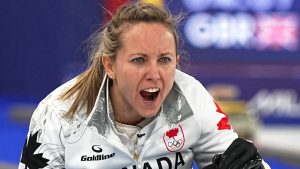
Rachel Homan's team was unable to defend its Scotties Tournament of Hearts title in Mississauga, Ont., last season and also missed out on a chance to go for back-to-back world titles. The Jan. 23-Feb. 1 Canadian playdowns were tight against the Milan-Cortina Olympics.
Women's round-robin play started Feb. 12 at the Games. The national women's championship is traditionally played in mid-February.
Curling Canada required Homan, the Trials winner, to be in Italy for a training camp ahead of Olympic competition. Her team went on to win a bronze medal in Cortina.
Brad Jacobs and teammates competed in the Montana's Brier less than a week after capturing Olympic gold, and thus had the opportunity to win a second straight national men's title and berth in the world championship.
In an appearance on The Broom Brothers podcast in March, Homan's second Emma Miskew said that "it's always this scheduling conflict reason, but no one has ever made any effort to change the schedule so it doesn't only affect the women."
Miskew pointed out the $300,000 prize purse at the Hearts is substantial for a team.
Jacobs, who admitted he was exhausted in St. John's, N.L., bowed out in the Brier semifinal to eventual winner Matt Dunstone.
Curling Canada chief executive officer Nolan Thiessen said the imbalance will be addressed.
"We can't fix what happened in 2026 here, but we have already started the conversation with our athlete council, and from a high-performance perspective, should both be allowed to play in the nationals in the same season or should both just concentrate on the Olympics?" he said.
An already-crowded curling calendar with provincial and national championships, tour events, Grand Slams, mixed doubles and the new Rock League, becomes even more compressed in an Olympic season because of Pre-Trials and Trials.
And the 2030 Winter Games in the French Alps will do Canada's curling calendar no favours with a start date of Feb. 1.
"World Curling is not changing when their world championships are. We're not going to put our Scotties versus the Olympics, so we do have to find an avenue for that," Thiessen said.
"It's not as easy as saying "move it to here". There's a lot of knock-on effects. The calendar is just too tight and just becoming logistically impossible for everybody to play in everything."
Four sure
Teams showing up to a national championship with a three-person team instead of four is on Curling Canada's radar.
Prince Edward Island's Tyler Smith won a provincial title with a three-man team and stayed a three-player side for the Brier.
The team's regular second, Chris Gallant, was unable to compete in either event because of work commitments. Smith went 3-5 in St. John's, N.L.
Injury or illness to one of the Smith team members would have required either coach Paul Flemming to draw in, or forfeiture.
Curling Canada rules state "a team shall include a minimum of two players from the original team and a substitute player(s)."
World Curling requires teams to start a competition with four players, although in "extenuating circumstances, and with approval from a panel of three persons" a team could start with three.
Thiessen, who sits on World Curling's competition rules commission, said domestic rules need a rethink.
"We're looking for ways to write the rule so that you're not hurting the team that has a real injury or sickness, but ensuring that we are a four-person game. We are a four-person game and we need to be a four-person game," he said.
The Curling Canada CEO said the end of an Olympic quadrennial is a good time to align domestic rules with international rules.
"We're looking at probably trying to less and less have a Curling Canada rule book and a World Curling rule book, and use a World Curling book as much as we can," Thiessen said.
"Our last rule book was 2022 to 2026. We're looking to try to have more and more alignment in the next quad."