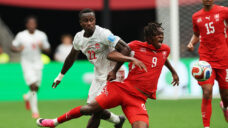
One door was slammed shut, but another one has opened for the Canadian men’s team at the FIFA World Cup.
Wednesday’s 2-1 loss to Switzerland at BC Place meant Canada finished second in Group B and lost homefield advantage for the rest of the tournament, as it must now play all of its matches in the United States. Had the Canadians earned a draw, they would have pipped the Swiss for first place and stayed in Vancouver for the round of 32 (and possibly for the round of 16).
At the same time, 30th-ranked Canada has a favourable matchup for its first-ever knockout game. The Canadians avoided No. 25 South Korea and instead will take on No. 60 South Africa, which upset the Koreans to finish runners-up in Group A.
Goals have been hard to come by for the South Africans at the World Cup — Teboho Mokoena and Thapelo Maseko have each found the back of the net once. At the same time, they've only conceded three times and have one clean sheet.
Nineteen members of their 26-man squad play their club football in South Africa's modest domestic league — the most notable exception is forward Lyle Foster (Burnley). So, in terms of overall player quality and depth, Canada heads into this match as the decided favourite. But South Africa, nicknamed Bafana Bafana, should not be taken lightly, as South Korea discovered to its peril.
“I think that we're expecting South Africa to be very intensive, to have a fast start, to be excited and spirited for this match. It's a big moment for their federation and for their team. Coach Hugo Broos has done a really good job of preparing them and getting them ready to be at their best, especially after the first match, where they picked up two reds against Mexico and stayed strong in the tournament and found a way to get better as they've gone on,” Canadian coach Jesse Marsch said on Saturday.
“So, we are very clear on the qualities that they have, we are very clear on what to expect, and it's also a moment for us where we want to be at our best, and we talked a lot about from a physical perspective getting stronger as the tournament was going to go on.”
Here are three things to look for in Sunday’s round of 32 match between Canada and Switzerland at SoFi Stadium in Los Angeles.
What roles will Alphonso Davies and Stephen Eustáquio play?
Canadian captain Alphonso Davies has yet to play a single minute at this World Cup as he’s been working his way back to full fitness while dealing with a long-term hamstring injury.
“Decoy-gate,” which was Jesse Marsch’s attempt to throw off the Swiss in their preparation for the Group B finale, only served to muddy the waters, confusing reporters and fans alike about the true nature of Davies’ condition and whether he’ll be ready to feature for his country this weekend.
On Saturday, Marsch stated that Davies is “back and healthy and ready to perform” and that he’s available to play against South Africa. But he refused to confirm whether he would start, come off the bench or how many minutes he might see on Sunday.
“He's a big X-factor for us, because he's such a big talent. He's very explosive in transition moments. … There's a lot of dynamic qualities that he brings to the team that make us even better. But even more so, what I've said to him is the effect that he will have on the team, being on the pitch, the belief they have in him, the belief he has in himself, I think, changes the possibility of what the potential of our team is, and what we can do in this tournament,” Marsch stated.
While that’s true, it’s important to remember that Davies, 25, hasn't played for Canada since March 2025, when he tore an ACL in the Concacaf Nations League finals. He missed a fair chunk of the recent Bundesliga season with Bayern Munich and hasn’t laced up since suffering an injury setback in the second leg of the UEFA Champions League semifinals vs. Paris Saint-Germain on May 6.
When he’s healthy, Davies is one of Canada’s most important and impactful players. But after Davies has spent so much time watching games from the sideline, questions have to be asked about what kind of contribution he can reasonably be expected to make against South Africa.
Not being involved for Canada up to this point has been tough on Davies, who tried to convince Marsch he was ready to play against Switzerland, but was told by the Canadian coach that they didn’t want to risk it.
“The first game, watching it, I was eager to get on the pitch. Second game, even more so. And, obviously, the third game, I went to him before the game, I asked him, 'Do you think I can get a couple minutes?' He could have said yeah … but he cares about me and the team and as human beings as well. So, he sat me down and said, ‘You haven't gone through your progressions to get back on the pitch and in game.’ So, I thought about it and (he was) right,” Davies said.
And what about Stephen Eustáquio?
The influential midfielder played every minute of Canada’s opening two games of the World Cup but was left out of the starting 11 against Switzerland, as it’s believed he was dealing with a muscle injury.
Canada missed his presence as his replacement, Mathieu Choinière, looked tentative and lacked a distinct desire to counterpress Switzerland out of fear of leaving gaps in midfield. Marsch pulled him from the game after 58 minutes and was replaced by Eustáquio.
Eustáquio’s introduction into the match helped turn things in Canada’s favour, instantly bringing a sense of calm for the home side. The Canadians were seeing a lot more of the ball, and more times than not, it was Eustáquio pulling the creative strings.
But it was Eustáquio who told Marsch beforehand he wasn’t feeling good enough to start. With such a short turnaround, it’ll be interesting to see if Eustáquio is back to his peak physical levels and will return to the starting lineup vs. South Africa or be brought off the bench again.
Canada needs Tajon Buchanan to step up in a big way
There was no question that Jonathan David was the man of the match in Canada’s 6-0 win over Qatar in the second game of the group stage. But spare a thought for winger Tajon Buchahan, who, if not for David’s hat-trick heroics, might have taken home the honour.
Buchanan was a one-man wrecking crew against Qatar. He was the one who slipped in behind the defence and drew the foul that led to the visitors being reduced to 10 men in the 33rd minute. He also earned an assist on David’s goal to make it 2-0 and had a hand in creating Canada’s fifth goal (an own goal). His speed and probing runs caused problems all night for Qatar’s defenders, who were no doubt relieved when he was replaced in the 83rd minute.
That stellar performance by Buchanan was sandwiched between two rather anonymous displays against Bosnia and Herzegovina and Switzerland, in which he failed to make an impression and was subbed out both times before the 75th minute.
At his best, Buchanan is a dynamic player who unbalances opposing defenders with his combination of pace, deft ball control and acceleration, especially when he peels off the wing. With eight goals and eight assists in 63 games, he’s one of his country’s most dangerous attackers.
But overall, at this World Cup, he has struggled to create scoring chances in the final third for himself and his teammates, completing just three crosses into the box from wide areas. He also hasn’t been involved enough in Canada’s build-up play — 13 of his total 14 touches on the ball in the penalty area across his three appearances came against Qatar.
Now more than ever, Buchanan needs to find his top form and come good for Canada in what is the biggest game in the history of the men’s program on Sunday in Los Angeles.
The good news is that Buchanan isn’t lacking in self-awareness, recognizing that he has to do better and be more consistent.
“I'm very critical of myself. I think I could always improve, but I think I've been able to show my confidence [and] my aggression to make a difference in the final third. It’s just about taking each game one at a time and learning from different situations. And as a player, I think I could always improve, and that's what I strive to do,” Buchanan said.
No more slow starts by the Canadians
Setting aside the anomaly of the Qatar result, Canada looked lacklustre in the first half of its opening 1-1 draw vs. Bosnia and Herzegovina and again in its loss to Switzerland.
Both times the Canadians ended up conceding first, punished for their lack of finishing in front of their opponent’s goal and forced to chase the game. Only after going down in those games did Canada’s attack spring into life and the team began to play with a sense of urgency.
Canada’s passivity was especially noticeable against Switzerland as a distinct lack of courage saw the home side go down 2-0 early in the second half. The aggressive approach that has become the team’s trademark under Jesse Marsch finally came on display when the Canadians were forced to erase the two-goal deficit.
“Everything that we work on and work through is about really being aggressive and using our athleticism and our team speed. The only thing that I feel a little is that when the occasion is momentous, players get a little tighter and then their natural reaction is to hold back a little bit more, instead of going for it more,” Marsch said after the loss.
The stakes are even higher on Sunday. This isn’t the group stage; this is knockout football. There is no margin of error.
Canada needs to start on the front foot against South Africa; it can’t afford to labour its way through another slow start to a match. Otherwise, it runs the risk of exiting the tournament in the round of 32.
“We're in a knockoff phase now, so it's about putting all that in the past aside. Now it's about going out there, competing and having a strong start and a strong game for 90 plus minutes,” Tajon Buchanan offered.
It’s a sentiment echoed by forward Tani Oluwaseyi: “In general, I think it's just being wary of how sometimes we can start games and trying to be more like we were against Qatar and less like we were against [Bosnia and Switzerland].”
Editor’s note
John Molinaro is one of the leading soccer journalists in Canada, having covered the game for over 27 years for several media outlets, including Sportsnet, CBC Sports and Sun Media. He is currently the editor-in-chief of TFC Republic, a website dedicated to in-depth coverage of Toronto FC and Canadian soccer.