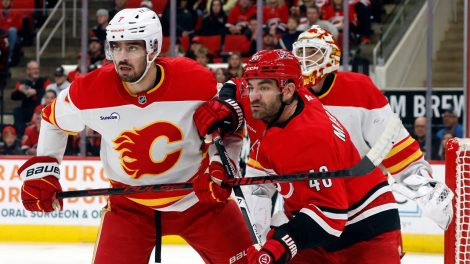
As we get ready for the second half of the NHL season, Andrew Berkshire looks into the recent hot streak by Calgary’s Johnny Gaudreau who is well on his way to a career high in goals. But has anything changed significantly in the way he’s been playing that suggests his overall game is taking another step forward?
Then, Berkshire answers a question about Vladimir Tarasenko‘s ongoing goal scoring troubles and if this is a factor of decline, bad luck, or something else.
Finally, surprise surprise, Erik Karlsson is getting a pile of points again.
[snippet ID=3322139]
SPOTLIGHT PERFORMANCE
Johnny Gaudreau has 32 points in 16 games since Dec. 1, which is more than he had in all of October and November combined. Maybe he really likes Christmas music? Whatever the case, Johnny Hockey has recently torn the hockey world to shreds.
That onslaught of offence is a bit much for anyone not named Connor McDavid to sustain, but Gaudreau has been one of the NHL’s best offensive players for years now. If you go back to 2015 and include this season, only McDavid, Patrick Kane, Nikita Kucherov, Sidney Crosby and Blake Wheeler have more than Gaudreau’s 284 points.
Since 2015-16, Gaudreau has finished 13th, 21st, and 10th in scoring chance generating plays per minute and he’s one of the league’s best transition players as well, so I guess the question is whether he’s taken yet another step forward over this hot streak, or if it’s more of a random burst for a crazy-talented player whose baseline is just over a point per game.
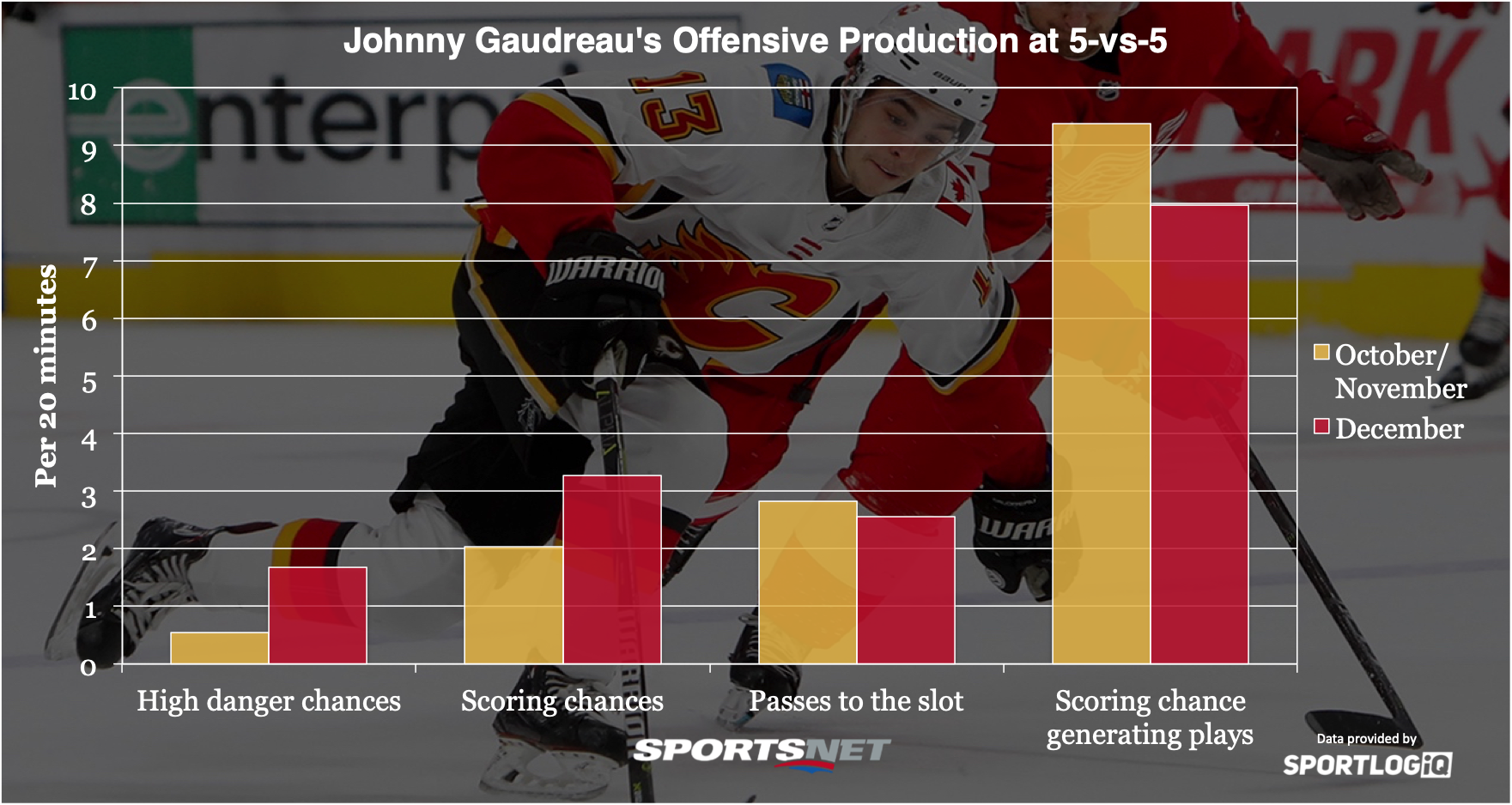
During this hot streak, Gaudreau’s involvement in creating scoring chances for his team has actually gone down slightly, which can happen sometimes. Part of the reason may be that fewer of his scoring chances are being saved, so there are fewer follow up opportunities before he gets off the ice.
That’s speculation on my part, but it would make sense when you look at the vast improvement in Gaudreau’s own shooting over this stretch. He’s seen a 305 per cent increase in high danger chances on a per minute basis, and a 160 per cent increase to his shot attempt numbers from the slot. To put it simply, Gaudreau is shooting significantly more often during his hot streak, and almost all of these extra shots he’s taking are from the most dangerous area of the ice, which is why he’s scored 13 times in 16 games.
The natural result of Gaudreau shooting more is that his playmaking has suffered a bit, but the most important component to his playmaking — the ability to make passes into the slot — hasn’t really changed much.
He is making slightly fewer successful slot passes per minute, but context here is important: he’s gone from making more of these than anyone in the NHL, to making more than anyone except Sidney Crosby. That’s not bad company.
Obviously Gaudreau isn’t going to continue scoring two points per game forever, but this step up in shooting could lead to a career high in goals.
[relatedlinks]
THE QUESTION
After taking a break over the holidays, Steve Dangle and I got back together to figure out a question for this week, and we settled on one that I’m sure is of interest to fans of the St. Louis Blues, and their possible trade partners. Steve asks…
“What is Vladimir Tarasenko doing differently this year, and why isn’t he scoring?”
On pace for just 24 goals after hitting at least 30 in each of the previous four seasons and averaging 38 goals per 82 games in his career, Tarasenko is on his worst scoring pace since he was a rookie in 2012-13.
Interestingly, he’s already equaled his power play production from last season in terms of goal scoring and is on pace for a career high there, so the problem is exclusively at even strength.
From 2014-15 to the end of last season, the only player in the NHL who scored more than Tarasenko’s 149 goals was Alex Ovechkin and no one scored more even strength goals than the Blues sniper. Tarasenko is 27 years old, which seems a little early to be in a steep decline, so let’s look into what’s going wrong for him this year.
Looking at Tarasenko every year for the positional rankings published on Sportsnet in September, I’ve had the chance to watch lots of video on him. I’ve noticed the major keys to his scoring are shot location, shot volume and beating players with dekes to get goalies moving and changing the angle of his shot right before release. He’s brilliant at it, so we’ll focus on what has made him such a fantastic scorer in the past.
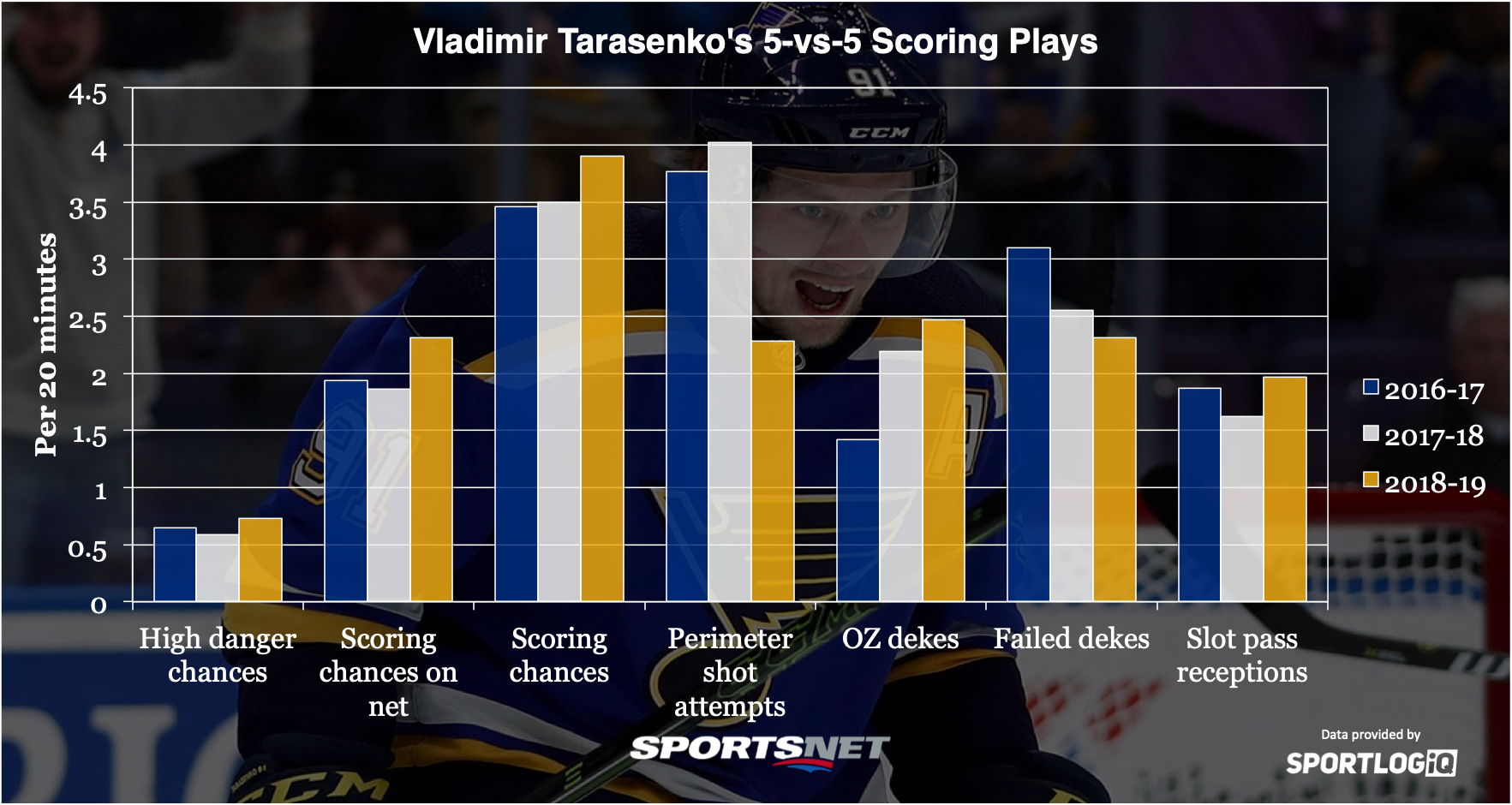
Probably not what you expected, but by every way we measure goal scoring likelihood, Tarasenko is doing all the right things this year. He’s shooting from closer to the net, more often from the slot, he’s deking more, failing on those dekes less often, and receiving passes in the slot with greater regularity.
None of that jives with his shooting percentage dipping from nearly 14 per cent the past four years, to 10.8 per cent last year, and now a career low of just eight per cent this year.[sidebar]
The only area where Tarasenko has seen his performance dip is in his shots from the perimeter, where he’s seeing about half as many opportunities as usual. Those shots have about a four per cent chance of going in for an average player, and just 11 of Tarasenko’s 57 even strength goals have come from outside the slot the past two seasons combined — and four of those were only a hair outside the slot. Nearly 53 per cent of his shot attempts the past two seasons came from the perimeter, though only 19.3 per cent of his goals came from there. Because of that, I’m not buying into the idea fewer perimeter shots has depressed his goal scoring in some way.
The Blues and Tarasenko are clearly under some sort of dark cloud of bad fortune this season, but if St. Louis does panic and decide to trade him, whichever team gets him can expect the vintage version.
This struggle can’t last forever.
BUY OR SELL
• In the first edition of this column, Steve asked if Erik Karlsson was playing poorly and I answered with an emphatic no — his underlying numbers were great and the surface stats would turn around. Lo and behold, Karlsson still isn’t scoring goals, but he’s up to seventh in defence scoring and since November 10, he leads all blueliners in points with 26 in 23 games. By the end of the season his name will be among the Norris candidates, as always.
• Karlsson may not get back to his prime when he was a lock to shoot around seven per cent, but 2.2 per cent this year is absurd. Even if his shooting has taken a hit after a few injuries, scoring on five per cent of his shots this year would net him an extra four goals and have him on pace for 76 points. And he’d still be getting unlucky compared to his career average.
• Speaking of defencemen who are playing great and not getting enough recognition, Jeff Petry has arguably been the best player on the Montreal Canadiens this year and last, admirably eating up Shea Weber’s minutes for a year, and now thriving in a second pairing role. He leads the team in scoring since Weber returned to the lineup, tied with Phillip Danault.
• At this point last season, only five players were on pace for 100-point seasons, and one of them was Josh Bailey, who went on to get just 21 points in the second half. This season, 15 players are on pace to hit 100. How many will actually get there is anyone’s guess, but I can’t be the only one loving the NHL’s new normal of goal scoring.