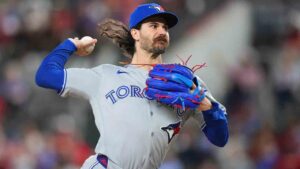
As soon as the Toronto Blue Jays acquired José Soriano, one of the biggest questions about the move was whether the team had any ideas about altering his plan of attack.
Soriano has been successful in recent years, posting a 3.73 ERA and 6.8 fWAR since the beginning of 2024, but the Los Angeles Angels have a poor track record with pitching development — and Toronto has done excellent work with veteran pitchers from outside the organization lately. Dylan Cease’s work with the team is a good example, but there are other notable success stories like Robbie Ray, Steven Matz, and Yusei Kikuchi.
After Soriano's Blue Jays debut on Friday against the Philadelphia Phillies (6:40 p.m. ET / 3:40 p.m. PT, Sportsnet, Sportsnet+), there might be a hint of tweaks the team has in mind. But even if their vision for the starter is for him to do exactly what he’s done lately as an Angel, there’s reason to believe he’ll be better off in Toronto because of the difference in the defence he’ll be working with. The Blue Jays have not been as good defensively in 2026 as they were in previous years, but Soriano is still in for a major upgrade behind him:

The difference between the two squads is even more notable when examining the defence that is most relevant to the way Soriano pitches. When Toronto has encountered defensive issues this season, they’ve normally come in the outfield, but their new starter’s 51.9-per-cent groundball rate is the fourth-highest among qualified pitchers. Between 2024 and 2025, he didn’t log enough innings to earn ‘qualified’ status but ranked first in groundball rate among starters with 200-plus innings pitched.
For Soriano to perform at his best, infield defence and framing behind the plate are more important than what happens in the outfield, and he’s likely to enjoy better support in both these areas with the Blue Jays.
Infield defence
To compare the Blue Jays and Angels’ infield defence, we’ll use the same metrics as those used above to check out the team’s total defensive metrics to zoom in on their total output at first base, second base, third base, and shortstop, as well as the players who man those positions the most. For the Blue Jays, that’s Vladimir Guerrero Jr. (1B), Ernie Clement (2B), Kazuma Okamoto (3B) and Andrés Giménez (SS). For the Angels, it’s Nolan Schanuel (1B), Oswald Peraza (2B), Denzer Guzman (3B) and Zach Neto (SS). Here’s the breakdown by position this season:
First base
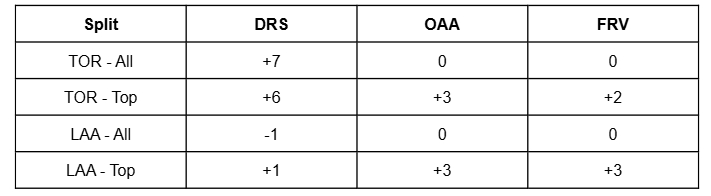
In both cases, the starter has been significantly better than any part-time options, but Guerrero seems like an upgrade on Schanuel. His defensive metrics have been divisive and scattershot over the years, but he’s been solid in 2026 and has a Gold Glove on his mantle.
Second base
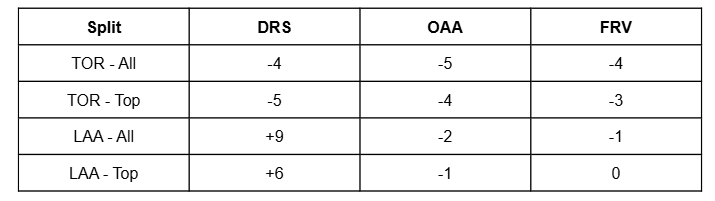
This doesn't look like a step up for Soriano, but Clement is also an accomplished defender capable of improving on his iffy numbers in 2026 while the hodgepodge of Angels have produced some ambiguous defensive metrics.
Third base
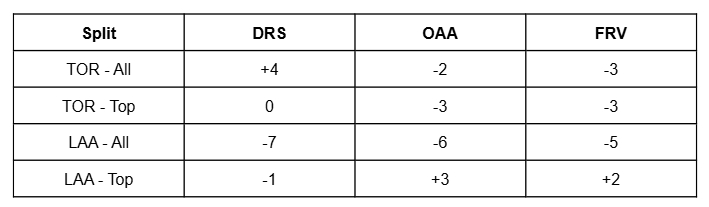
Guzman has graded well in limited action, but the Angels have used many players at the position, and it’s been a mess. Okamoto may be slightly below average at the hot corner, but he’s relatively sturdy. Clement is an excellent option at the position when the rookie slugger moves around or has a day off.
Shortstop
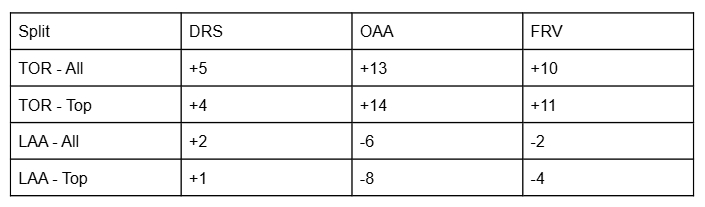
This is where the difference is profound. Giménez is one of the best defenders in baseball and Neto consistently grades as one of the worst at his position. Since Neto became a full-time starter in 2024, his range has never rated above the 10th percentile by OAA. Meanwhile, Giménez has never fallen below the 97th percentile. The way Blue Jays pitchers felt when they started pitching in front of Troy Tulowitzki in 2015, instead of a declining José Reyes, is approximately what Soriano will get going from Neto to Giménez.
Framing
Coming to the Blue Jays figures to be a major quality-of-life upgrade for Soriano in terms of framing. Over the last three seasons, he’s worked with a group of catchers that ranked 28th among all teams in framing runs (-22.5), largely due to Logan O’Hoppe’s poor performance in that area (-15.4).
In Toronto, he’ll work with a battery that includes the current MLB leader in framing runs, Brandon Valenzuela (+8), and Alejandro Kirk, who has been hurt for much of 2026 but ranked second between 2023 and 2025 (+36). Kirk may be an especially good fit for Soriano as he’s always excelled at stealing low strikes, ranking first at bottom-of-the-zone framing (+23 runs) in that time period. That should mesh well with Soriano’s inclination to throw sinkers and secondary stuff low, seldom working above the zone.
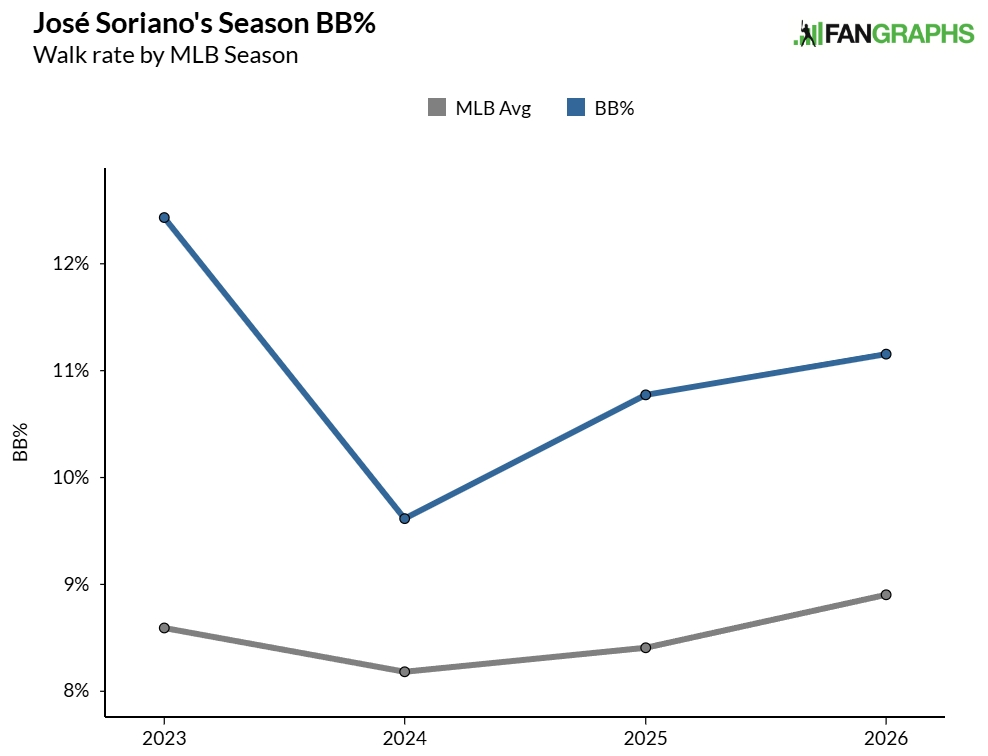
Improved framing should not be considered a cure-all for a pitcher who has consistently walked more hitters than average.
At the same time, it could get Soriano in more favourable counts, helping him in a variety of ways. It’s also notable that his percentage of pitches in the ‘shadow zone’, where framing comes into play the most (44.5 per cent), ranks 11th among 87 pitchers who’ve logged 100 or more innings this season. He’s the type of pitcher likely to disproportionately benefit from a framing boost, and there’s no doubt he’s getting one.
It’s impossible to know precisely what effect coming to the Blue Jays will have on Soriano’s career. His chapter in Toronto could be better, worse, or more of the same depending on all sorts of factors. What is clear is that he will benefit from much-improved defensive infrastructure in the areas most important to his pitching style.