TORONTO — While John Schneider grew up in New Jersey as a fan of the New York Yankees, he remembers feeling appreciation for the championship club North of the border.
“They were a bunch of dudes,” Schneider said in his office on Saturday morning. “It was a legit team and lineup that was just coming after you.”
Long before he became a catcher in the Toronto Blue Jays’ organization, then eventually the major-league manager, Schneider was a pre-teen who was pulling for Toronto to capture its second straight World Series title.
“Just because I thought they were a cool team,” he said. “I thought the SkyDome was awesome, I thought like the turf was awesome, I thought the players were awesome.
“They were a really likeable team for a baseball fan.”
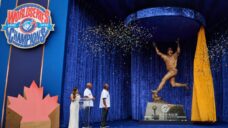
Schneider was among the many who revelled in nostalgia on Saturday at Rogers Centre during an impressive celebration of the Blue Jays’ 1992 and 1993 World Series championship teams and the unveiling of a statue of Joe Carter, a central figure among those dudes.
The pre-game ceremony included video tributes to the ’92 and ’93 squads and alumni riding around the field in a cavalcade of white pickup trucks before heading outside for the grand reveal. The bronze statue of Carter, leaping in the air with his hands raised to celebrate his walk-off homer that clinched the ’93 Fall Classic, is located between Gates 5 and 6.
It took 15 months to complete and stands at 15-feet tall and 6,200 lbs. While it depicts Carter, the organization is calling it the Back-to-Back World Series Statue and it features the names of every player on those Blue Jays rosters.
On Saturday, a total of 28 players, coaches and front office members from the ’92 and ’93 teams were in attendance, a list that included former president Paul Beeston, general manager Pat Gillick, manager Cito Gaston and former players Pat Borders, Juan Guzman, Pat Hentgen, Paul Molitor, Jack Morris, John Olerud, Ed Sprague, Dave Stewart, Dave Stieb and Devon White, among others.
When the collective headed back inside the stadium, they were cheered by the 41,775 in attendance as Carter was handed the mic.
“I’m proud to have been there,” Carter told the crowd. “This is not about me, it is about all of us because we all did it together.”
The 66-year-old then proceeded to toss the ceremonial first pitch to George Springer before Vladimir Guerrero Jr. presented him with a custom home run jacket featuring an image of Carter on the back with the words “Touch ’em All Joe.”
Later, Carter conceded that “this is basically getting your flowers while you're still alive, so I'm very grateful for that,” before further deflecting to his former teammates.
“I was just one guy,” said Carter. “It happened to be my time to come to the plate. And it's sports — when you come through for your teammates, it's a great feeling. So, I'm very happy I was able to come through for my teammates because they've come through for me a lot.”
There was no question, though, that if there was one person from the Blue Jays’ glory days who deserved the recognition of a statue, it was always going to be the slugger.
“That is the iconic play,” Olerud said. “So, it makes all the sense in the world.”
Added Molitor: “The right guy is going to be immortalized forever in Joe. If you hit a home run to end the World Series, you deserve a statue. I mean, that's all there is to it.”
Carter’s iconic homer is only the second ever to end a World Series, with Bill Mazeroski’s Game 7 blast in 1960 being the other. It’s the among the most important moments in Canadian sports history and while such gravitas has elevated Carter’s status in the country, those who were around him during his playing days are quick to note that it doesn’t necessarily define him.
Carter established a reputation as a premier run producer in the mid-to-late 1980s and in December of 1990, Gillick acquired him, along with second baseman Roberto Alomar, in a blockbuster trade that sent Tony Fernandez and Fred McGriff to the San Diego Padres. After years of falling short, the Blue Jays were in need of a shakeup and that deal eventually put the club over the championship hump.
The first baseman and outfielder was a fixture in the lineup but also a pillar in the clubhouse. Molitor calls Carter a “glue guy,” while Olerud says he was a “leader who was always in good spirits” and was inclusive to all teammates.
“We did a lot of background work on him,” said Gillick, the Blue Jays’ GM from 1978 to 1994. “We knew what kind of a competitor, what kind of a person Joe was before we got him. So, you know, we were right for once.”
Gaston pointed to Carter’s penchant for driving in runs — he collected 100 RBIs in six of his seven seasons in Toronto — and also lauded Carter’s durability.
“Joe used to suffer migraine headaches,” Gaston said. “He’d come in and say ‘Skip, have you put the lineup out yet?’ And I'd go, ‘No.’ He’d say, ‘Give me a minute.’ We had a sauna back in those days and he'd go in the sauna, get in the dark, get rid of it, and he always came out and played. He played every day and he wanted to play every day. He led by example.”
Of course, there were plenty of great players on those Blue Jays rosters that brimmed with talent, experience and even featured several future Hall of Famers. “Dudes” is one simple descriptor and Carter laughed when told of Schneider’s remarks.
“It was a very unselfish ball club,” said Carter. “We never worried about stats. We never worried about how much money we were making. What we worried about was doing our job.
“We did whatever it took to win the ball game, regardless of individual statistics,” he added. “We never worried about that because we knew if we did everything that we were capable of doing, we were world champions and no one can take that away from us.”




 3:26
3:26