MILWAUKEE, Wisc. — Toronto Blue Jays manager John Schneider wrote out his 16th different batting order in the club’s first 17 games on Wednesday, leading off Nathan Lukes, bumping Ernie Clement down to No. 5 and inching Andres Gimenez up a spot to make room at No. 8 for Lenyn Sosa’s first start with his new team.
Such is reality right now for a team missing four players — Anthony Santander, George Springer, Alejandro Kirk and Addison Barger — who were expected to be lineup regulars this season. Toronto’s batting order will resemble a slot machine over the next stretch, as players cycle through the eight spots on either side of Vladimir Guerrero Jr. batting third.
If the Blue Jays are going to withstand these absences, they’ll need to play a 13-player game, optimizing batting orders to match up against opposition starters while preserving the right bench options to pinch-hit against specific relievers later in games.
That’s why Lukes, who entered the game mired in a 2-for-28 slump to begin the season, led off. Brewers starter Chad Patrick has struck out less than a quarter of the batters he’s faced in a brief MLB career and carries a whiff rate ranking within the league’s bottom-third. He allows plenty of contact, most of it in the air. That’s a good matchup for Lukes, who could’ve used one to help snap his funk.
“Just trying to get him going, really,” Schneider said prior to the game. “Not being married to one person in the leadoff spot. Looking at the profile of Patrick — there's a lot of stuff in the zone, a lot of contact. We’ll try to get (Lukes) going and try to get some traffic on for Vlad and Sanch and Kaz. And try to be a little bit creative if we can.”
A decent enough concept — but execution was lacking. Lukes indeed put three balls in play against the Brewers starter, yet none went for hits. Guerrero, Jesus Sanchez, and Kazuma Okamoto had only two plate appearances combined with runners on. The Blue Jays made plenty of contact over Patrick’s 6.2 innings, striking out just twice. But only came away with three hits and a run for their efforts.
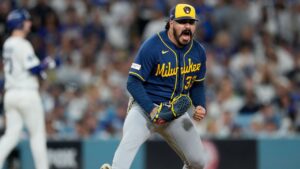
There aren’t many nights in this league when that little offence will be enough. And this wasn’t one of them, as Dylan Cease’s ace-calibre performance went to waste when Tyler Rogers coughed up a pair in a nightmare eighth to let the Brewers come back and drop the Blue Jays, 2-1.
“When you boil it down,” Schneider said, “you’ve got to score more than one run.”
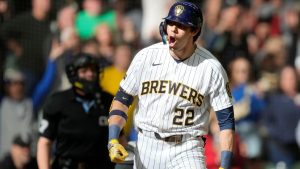
Rogers’ trouble began with two balls that didn’t even make it back to the pitcher’s mound. First, Rogers whiffed attempting to gather a David Hamilton dribbler towards third base. Then, Brandon Valenzuela hesitated to field a Sal Frelick bouncer right in front of the plate before bobbling a last-second attempt at the out. That put two runners on for William Contreras, who grounded the first pitch he saw into right field, tying the game.
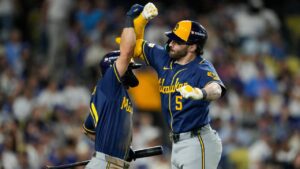
Moments later, Brice Turang chopped another grounder over the pitcher’s mound that left Sosa with only one out to get at first as the go-ahead run scored. And thanks to Toronto’s lack of jump offensively, that was all it took.
"Those innings are going to happen with (Rogers)," Schneider said. "Swinging bunt, swinging bunt. It's almost like you just have to get your outs with him because you know he's going to throw strikes, he's going to be in the zone. I think if we could do anything over, (Valenzuela) would just get the out there on Frelick's ball in front of the plate. It's a young guy, and it's a learning play for him."
The Blue Jays scratched their lone run across in the first, as Daulton Varsho drew a walk, went first-to-third aggressively on a Guerrero single, and scored on Sanchez’s sacrifice fly. But only one more baserunner reached through the end of the fourth — Valenzuela’s lead-off single in the third was erased by a Lukes double play — as Patrick settled into his rhythm.
In the end, the Blue Jays mustered only five hits against Brewers pitching — none of them for extra bases. Only two plate appearances were taken with runners in scoring position. Just five balls were put in play at 100+ m.p.h. — four of them going for outs. And 13 of Toronto’s 20 outs against Patrick came on three pitches or fewer.
MLB on Sportsnet
Watch the Toronto Blue Jays, Blue Jays Central pre-game, marquee MLB matchups, Jays in 30, original documentaries, the wild card, divisional series, championship series and entire World Series on Sportsnet and Sportsnet+.
Broadcast schedule
"I think we were quick, to be honest with you," Schneider said. "Guys are in the big leagues for a reason. You can't take anything for granted. And I think that there's going to be other pitchers like that that are going to use aggressiveness against us and know that we're going to put the ball in play.
“I thought there were really quick outs in the middle innings. Really quick innings. And then that puts a lot of pressure on Dylan to go back out and throw a zero. So, we kind of lost the time of possession game a little bit. And I think we could have been a lot more patient, knowing that it's OK to hit with one or even two strikes against a starter like that. So, we've got to make that adjustment going forward.
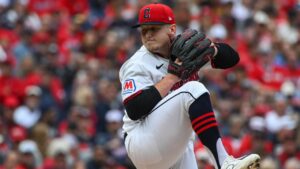
Meanwhile, Cease was spectacular, becoming the first Blue Jays starter to complete six innings since Kevin Gausman did it against the Rockies on the first day of this month.
Averaging 98-m.p.h. with his fastball and 89-m.p.h. with his slider, Cease worked in to lefties and away from righties, carrying his velocity and stuff right through to his final pitch, a 99-m.p.h. fastball that struck out Gary Sanchez and allowed Valenzuela to get off an 80-m.p.h. throw of his own to gun down Brice Turang trying to steal second.
Cease allowed only three balls in play with an exit velocity of 100-m.p.h. or higher — a forceout, a groundout and an inconsequential groundball single. When Brewers hitters weren’t swinging through pitches, they were beating them into the grass, as Cease earned 9 groundball outs.
“I feel like every time out I’ve given us a chance to win,” Cease said. “That’s probably the biggest thing.”
It was one of those nights when Cease’s stuff was electric enough to pitch into late innings. But walking three while landing only 44 per cent of your pitches in the zone tends to get in the way of that.
For Cease to get even more out of nights like these, it’ll start with working ahead. He entered the outing with a 53.7 first-pitch strike percentage, which ranked within the bottom 15 per cent of MLB pitchers to throw at least 10 innings this season. And against the Brewers, he threw first-pitch strikes to half of the 22 batters he faced.
Handing over count leverage that often is no way to live as a starting pitcher trying to get deep into ballgames. There’s a reason why hitters have been swinging at the first pitch of their plate appearances vs. Cease only a third of the time since the beginning of 2025. If he can find a way to nudge that first-pitch strike rate up closer to last year’s 62.6 per cent average for MLB starters, he’ll be getting through six innings on 85 or 90 pitches rather than the 106 it took him Wednesday.
But that’s a focus for another day. On this one, Toronto’s lack of offence was the culprit as a winnable game slipped from their grasp, an ace-calibre performance was wasted and Schneider went back to the lab to devise his next lineup.