
KANSAS CITY — Baseball doesn’t work like this, but if you add up the results of every starting pitcher in the league over the last 12 months — April 21, 2023 through April 21, 2024 — Yusei Kikuchi ranks among the top-40 starters across MLB:
Yusei Kikuchi since April 21, 2023
(MLB rank among 163 starters with minimum 60 IP)
IP — 174.0 (28th)
ERA — 3.57 (40th)
FIP — 3.73 (38th)
K-BB% — 19.3 (29th)
Kikuchi’s earned-run average over that span ranks ahead of Luis Castillo, Zach Eflin, Pablo Lopez, George Kirby, and Framber Valdez, who finished fifth through ninth in American League Cy Young award balloting last year. As a guy earning $10-million this season while residing fourth on Toronto’s rotation depth chart, and only two years removed from a calamitous 2022 he finished working low leverage out of the Blue Jays bullpen, we don’t talk about Kikuchi as one of the 40 best MLB starters. But that’s what he’s been for a year now.
There are a myriad of reasons Kikuchi is pitching as well as he is. Some obvious, such as repeatable mechanics and command of the strike zone. Some more subtle, such as his confidence and tempo between pitches. This is why teams are loath to give up on struggling pitchers with obvious ability who could be only a couple tweaks or a run of good health away from putting it all together. (Is now a good time to mention Julian Merryweather, pitching leverage relief for the Chicago Cubs, has a 3.29 ERA and 32 per cent strikeout rate over 73 outings since the beginning of 2023?)
Still, a huge difference-maker has been the addition of a curveball that Kikuchi designed last spring while working with Blue Jays pitching strategist David Howell. Funny story: Kikuchi wasn’t intending to feature a curveball at all in 2023. He spent his winter working to develop a sweeper, inspired by teammate Chris Bassitt to add an early-count breaking weapon he could use to steal strikes.
But in order to generate that sweeper action, Kikuchi needed to adjust his arm slot — and the Blue Jays have done a lot of work with him on finding a consistent arm path and release point, which has been a huge factor helping his command since his erratic 2022. No one wanted to sacrifice that. So, Kikuchi and the club shelved the sweeper idea.
In its place, Kikuchi began working on a curveball. He uses the same grip as his slider — he just throws it slower from a different arm angle. Kikuchi still wasn’t totally comfortable with it to begin the season, which is why he rarely threw it last April. But his confidence in the pitch grew progressively as time wore on. By September, he was using it more than his slider — nearly 30 per cent of the time:
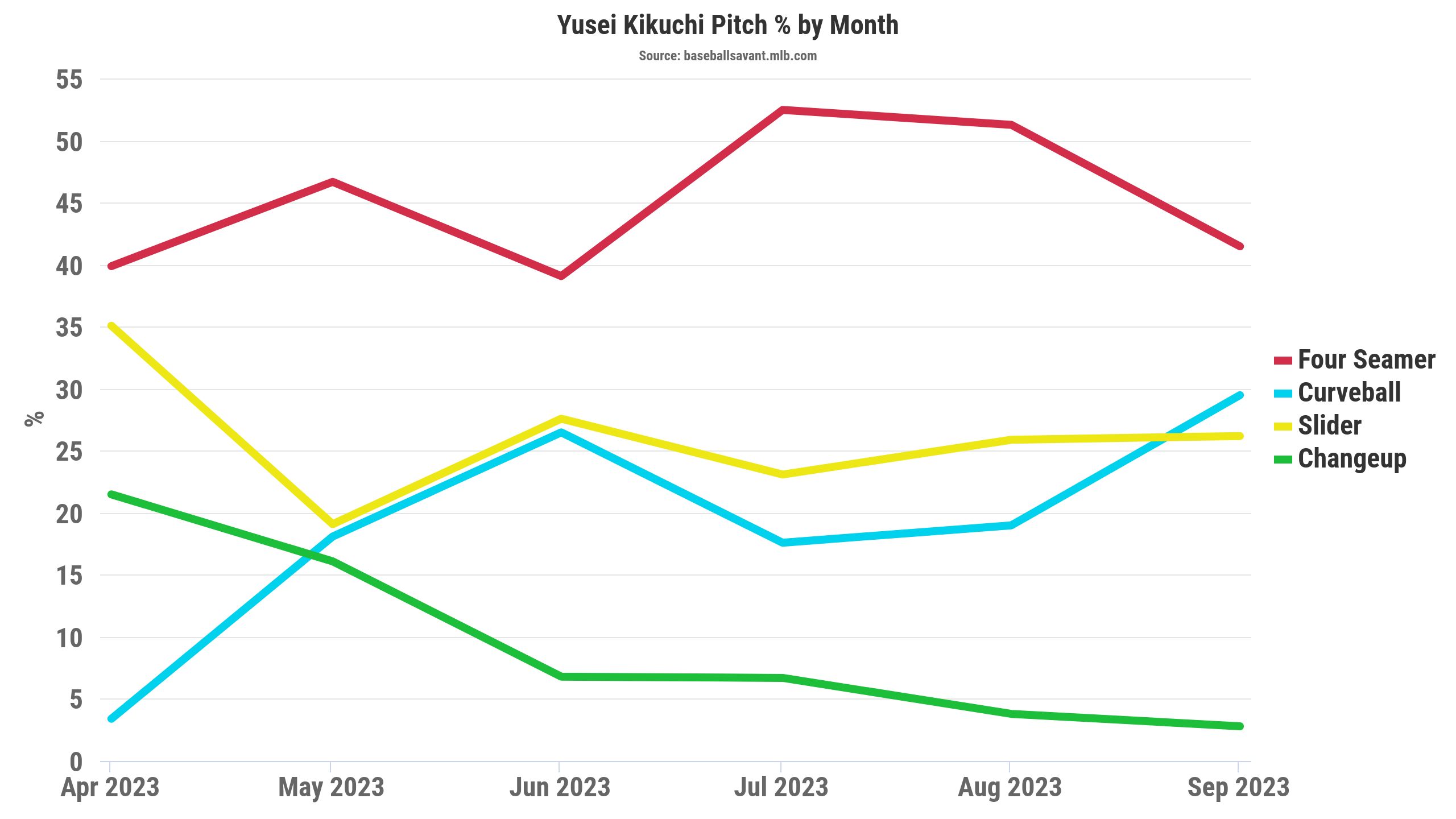
This season, it’s his second-most used pitch and by far his most effective, ranking first among all MLB curveballs with a +3.2 run value. Kikuchi has thrown it 95 times this season, allowing only two hits while generating a whiff nearly a third of the time batters offer at it. You know he’s confident in his command of it because it’s his most used pitch in 1-0 counts and his second-most used pitch any time he falls behind. When Kikuchi needs a strike, he’s using his curveball to get it — to both righties and lefties.
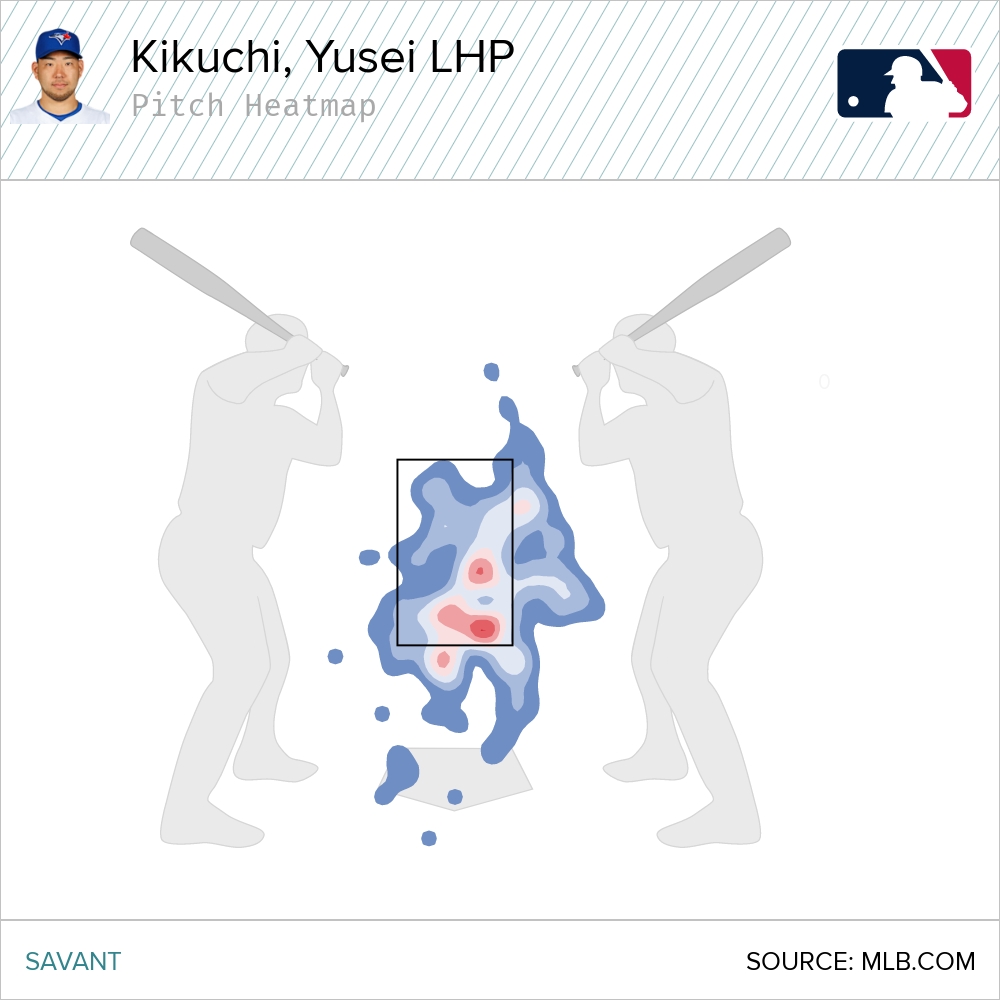
Kikuchi’s curveball heat map only reinforces that confidence. He’s frequently locating it down-and-away from right-handed hitters, and down-and-in to lefties:
Of course, everything Kikuchi is throwing has been located towards the bottom of the zone. He’s averaging the lowest overall pitch height of his career this season, a radical departure from 2023 when he averaged his highest:
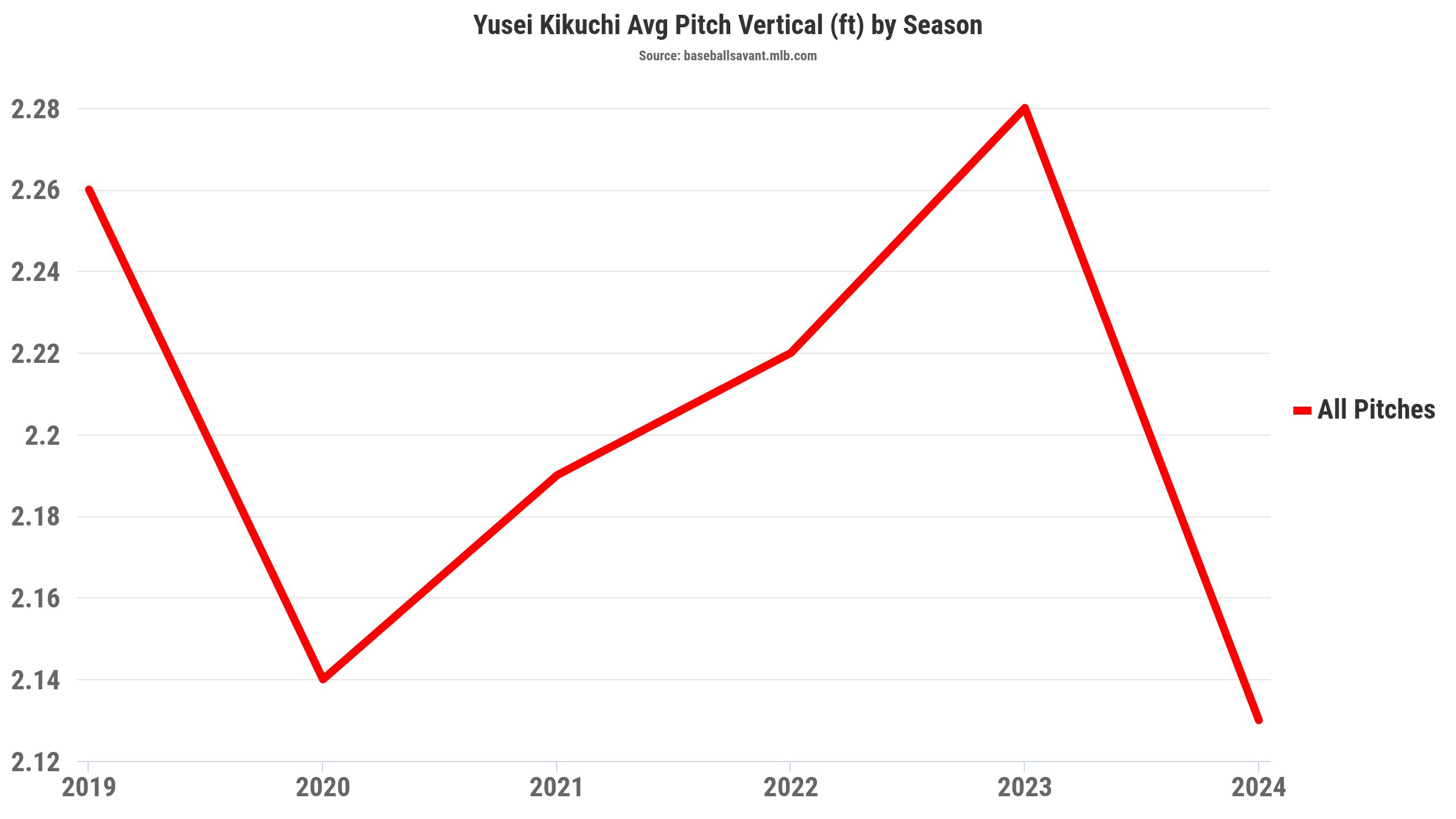
If you’re wondering why Kikuchi’s groundball rate is up over 50 per cent this season, you can start there. Add it to the pile of reasons why Kikuchi’s been a top-40 MLB starter for a year and counting.
Yariel Rodriguez’s many fastballs
The Blue Jays are always on the hunt for pitchers with unique fastballs. Downhill sinkers thrown from unusually high angles. Gravity-fighting four-seamers riding off back-spin. Cutters that approach the plate on weird planes, confusing the eyes of hitters in the two-tenths of a second they have to make a swing decision. That can be enough to move pitches off barrels and soften the high exit velocities that create damage.
And Yariel Rodriguez’s unconventional heater certainly qualifies. Through his first two outings we’ve seen Rodriguez throw his fastball anywhere from 91-98 m.p.h., with anything from four inches of glove-side cut to 16 inches of arm-side run, from both vertical and horizontal release points that have varied by over a foot. Rodriguez’s fastball is technically one pitch — but his ability to manipulate its action helps it play like many more than that.
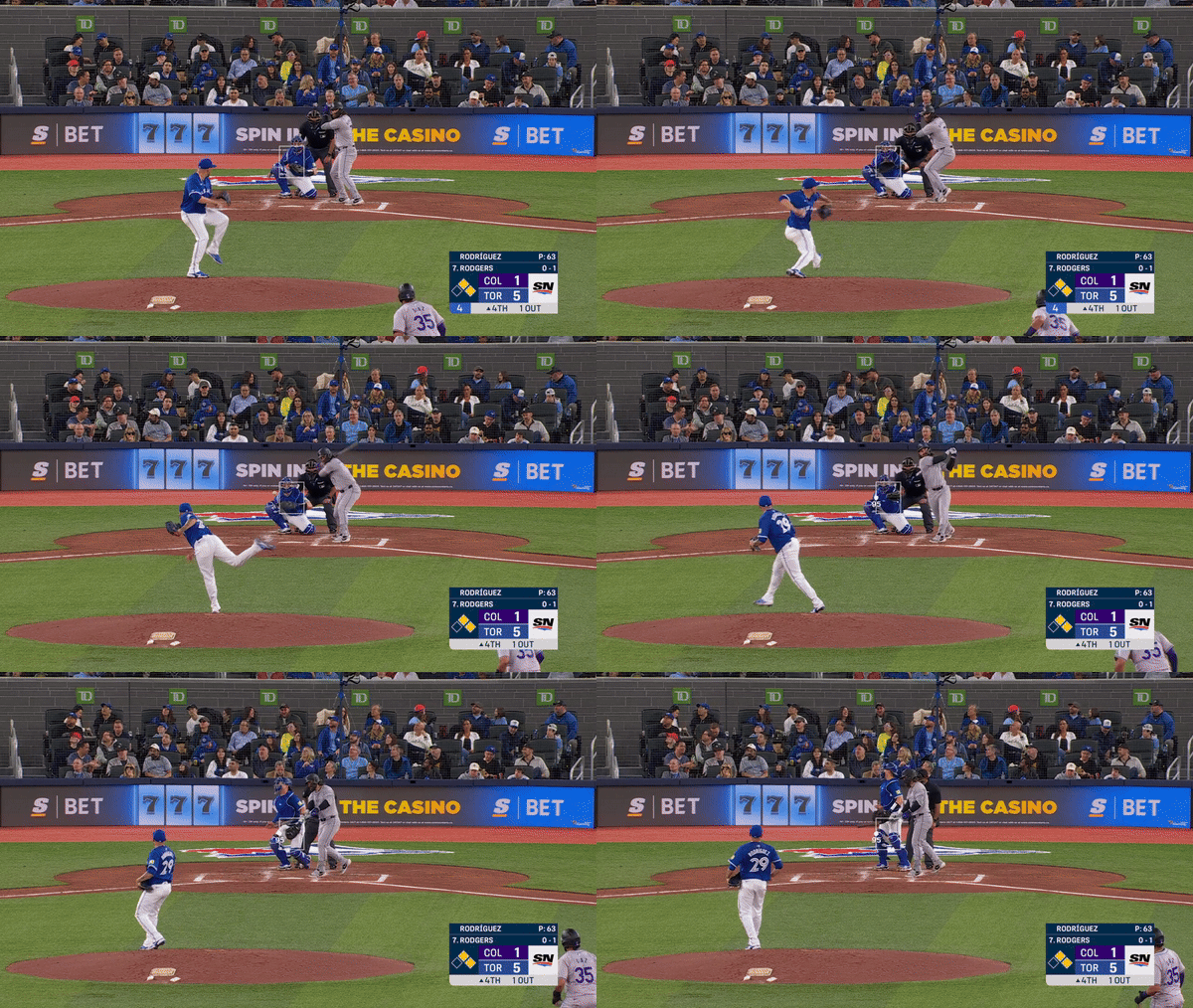
To wit: here's a first-pitch heater cutting away from the Rockies' Brendan Rodgers in the fourth inning of Rodriguez’s debut last week:
Here’s the next pitch Rodriguez threw — a straighter, harder, back-spinning four-seamer that dropped two inches less than the prior one and created the illusion of rising as it neared the plate:
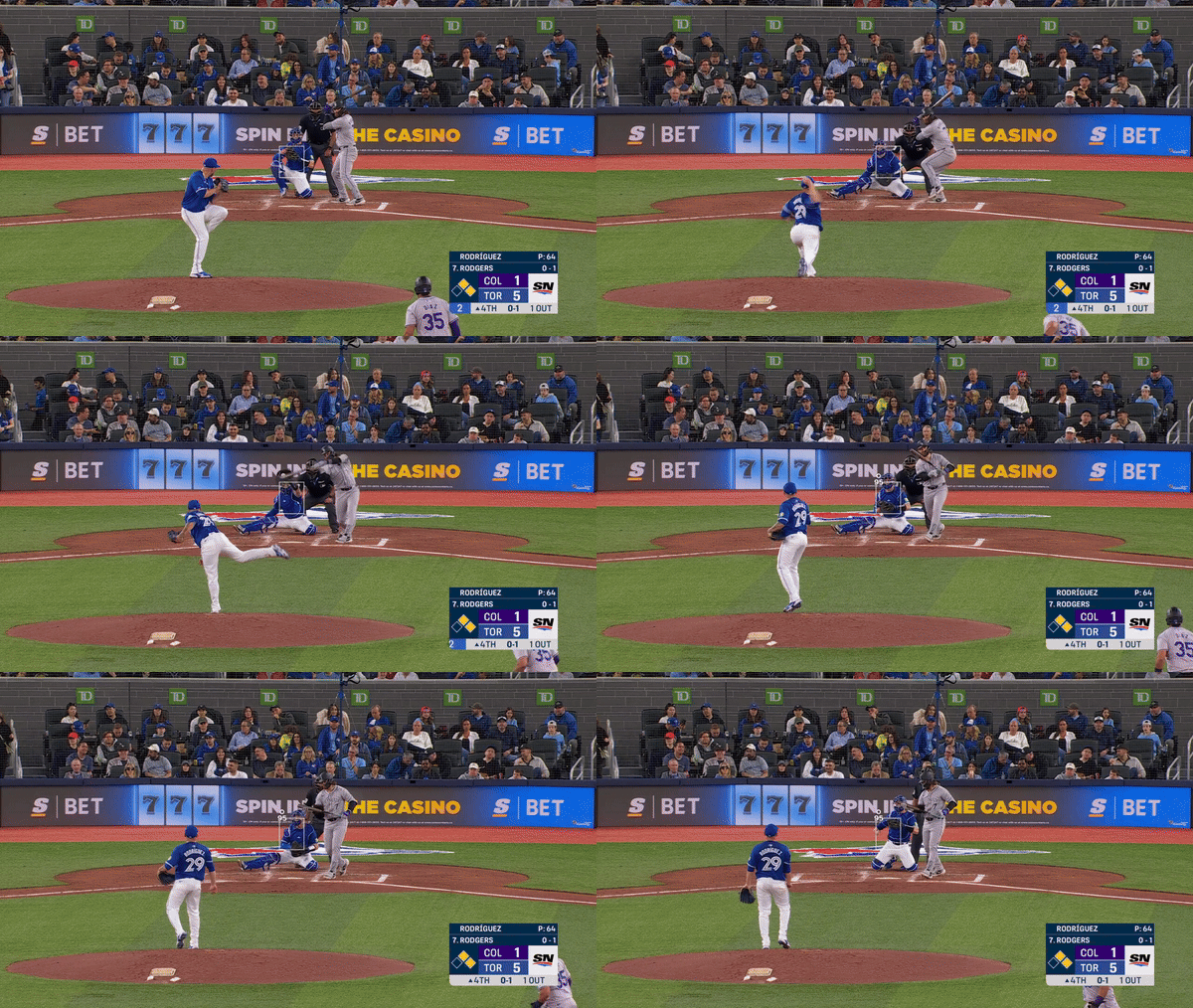
And here’s a final fastball two pitches later, which Rodriguez runs 15 inches to his arm-side for a called third strike:
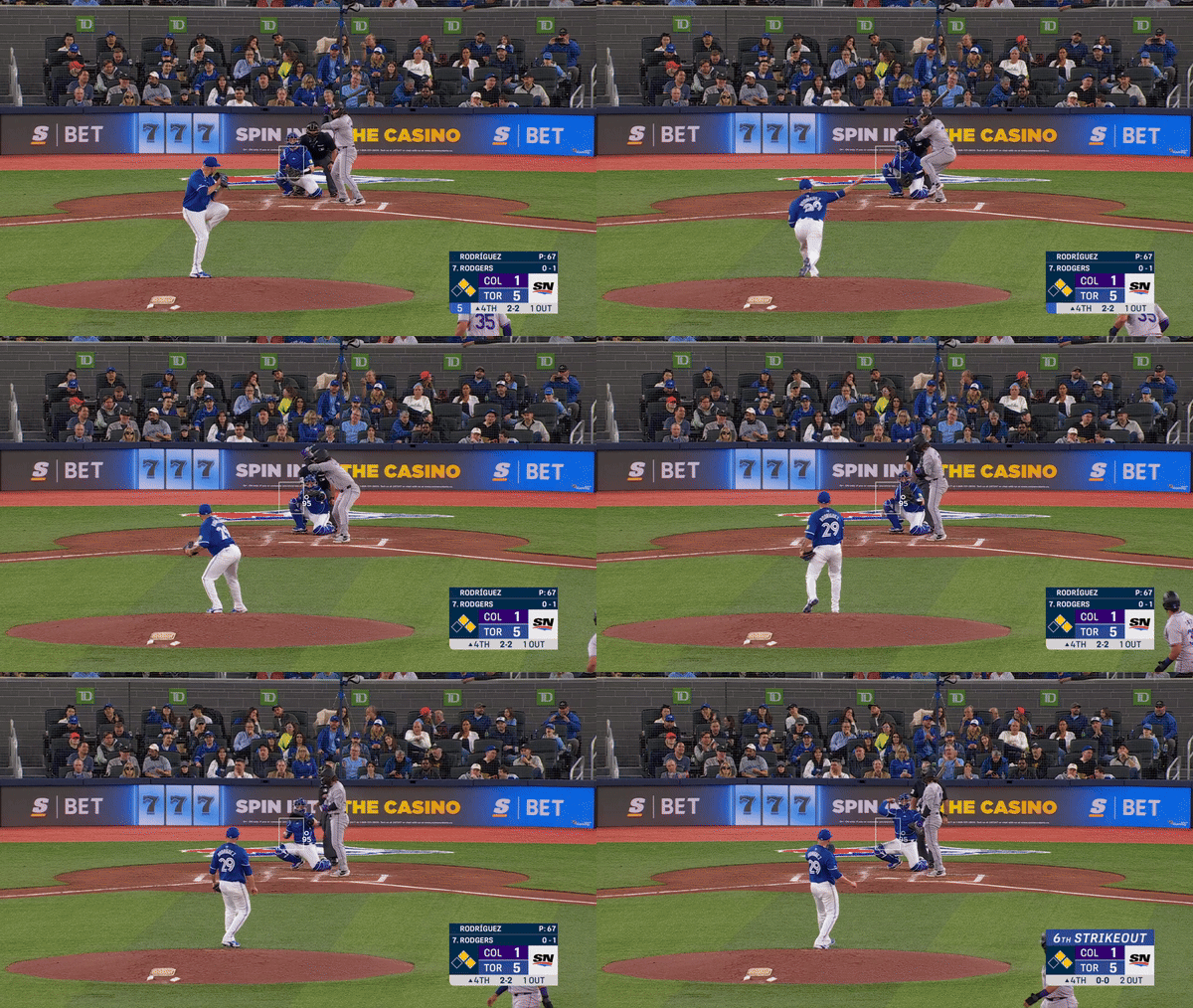
So, that’s three 95-m.p.h. fastballs — one cutting away to the outside edge of the plate, one riding up at the height of the zone, and one running in towards Rodgers’ hands. A hitter simply can’t guard against it all. Which is what leads to the awkward half-swing and uncomfortable take you saw from Rodgers on those final two pitches.
Maybe as we gain more data on Rodriguez pitch trackers will begin separating these out into an isolated cutter, four-seamer, and sinker. And maybe hitters will identify one that matches up particularly well with their swing plane and sit on it. That will only work if Rodriguez gives them what they’re looking for. If he can consistently command his fastballs to the edges as well as he did in that Rodgers plate appearance, he’s going to generate a bunch of defensive swings, broken bats, and quick outs.
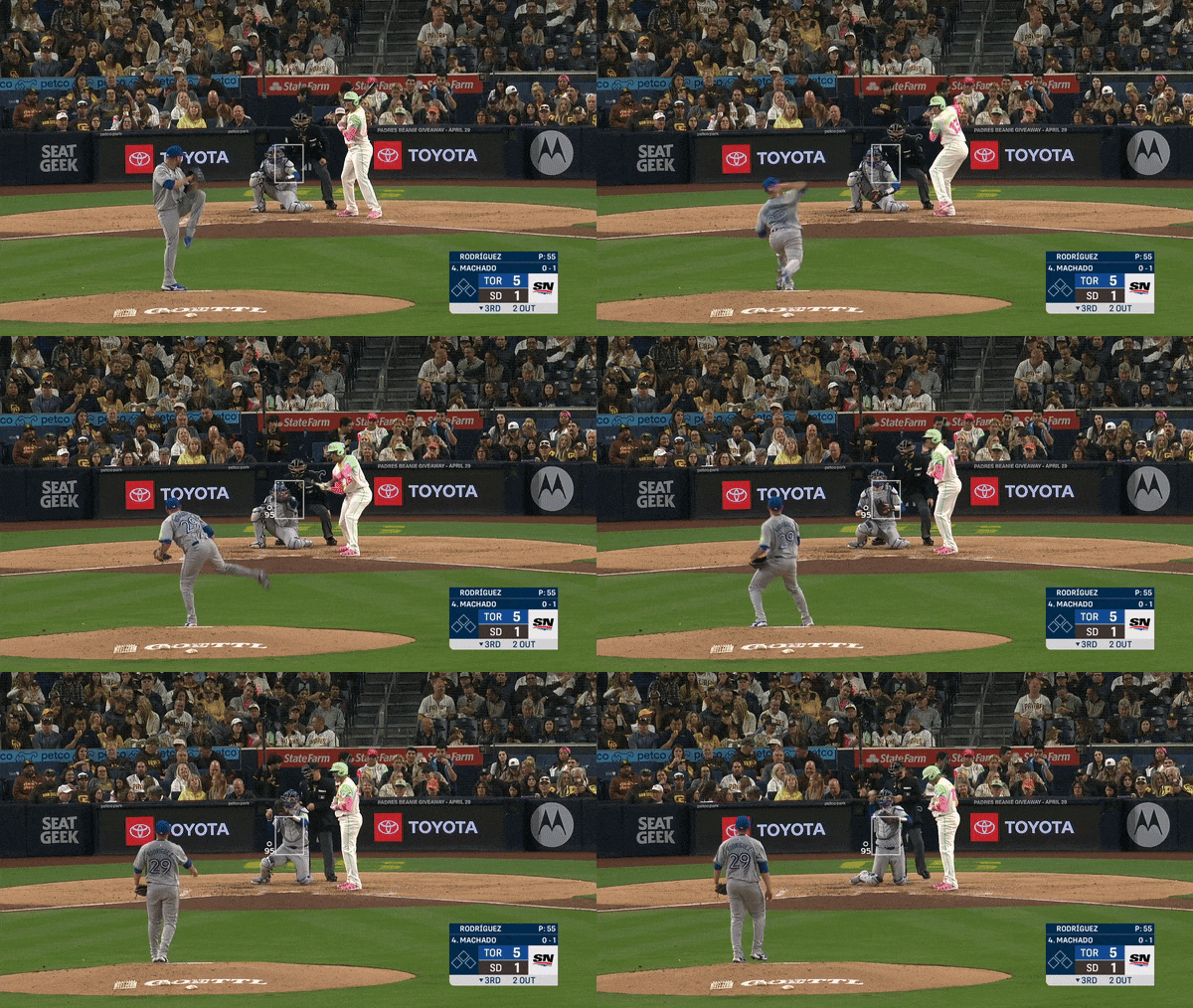
Rodriguez has also been altering his arm slot when throwing fastballs throughout his starts, which only adds to the uniqueness of each one he throws. Here’s a first-pitch heater to Manny Machado in the third inning of Rodriguez’s Saturday start against the Padres:
And here’s the very next pitch Rodriguez threw:
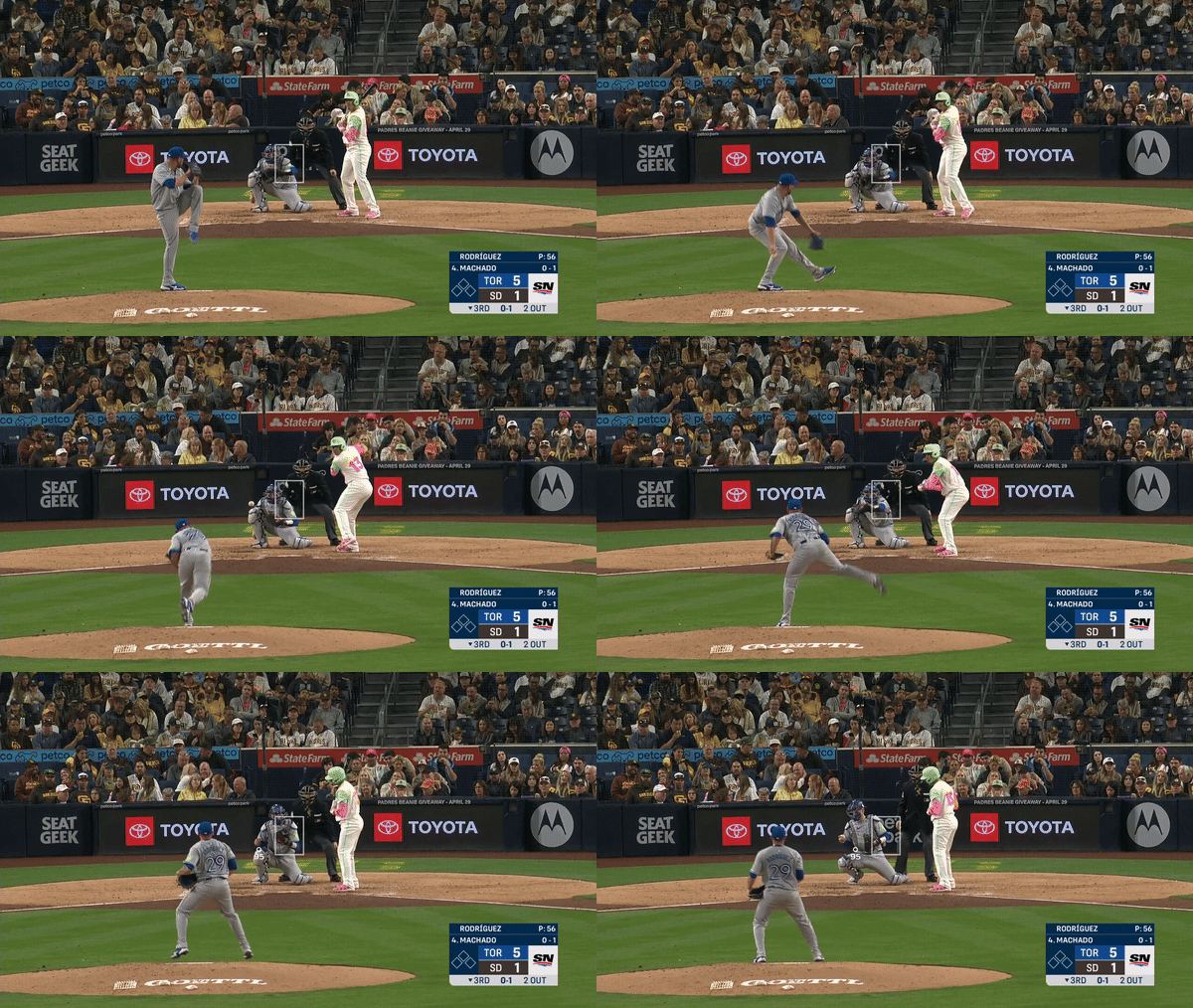
Same velocity, same lane, but nearly a foot of discrepancy in both vertical and horizontal release point. Here’s what that looks like side-by-side:
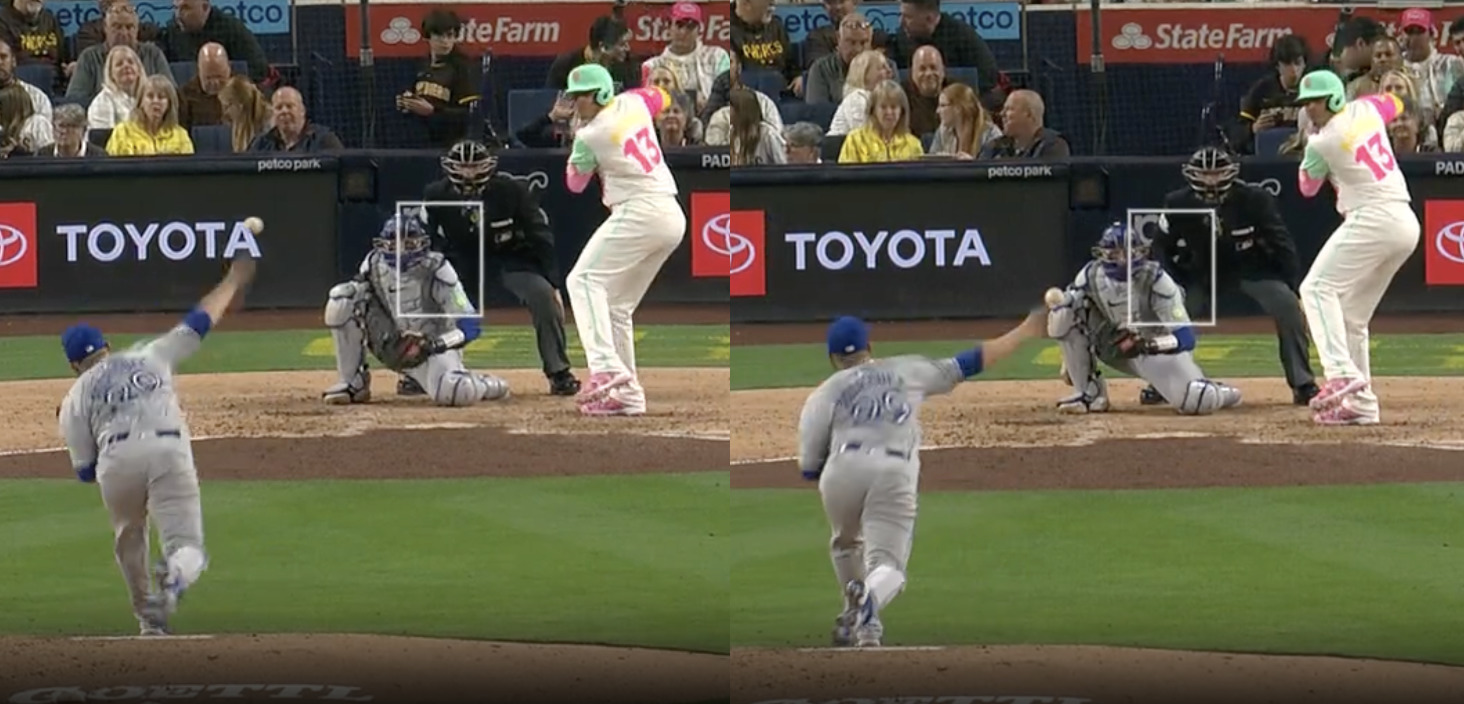
There doesn’t seem to be much rhyme or reason to when Rodriguez drops down into a nearly three-quarters slot vs. when he reaches up to release over the top. One thing we can be sure of is opponents are carefully tracking it regardless, looking for tells and tendencies in various counts that can help their hitters discern what’s coming. But if Rodriguez can avoid falling into patterns, it’s going to be difficult for hitters to reliably pick up his pitches when he’s releasing fastballs and sliders anywhere from below five feet to above six feet from the ground:
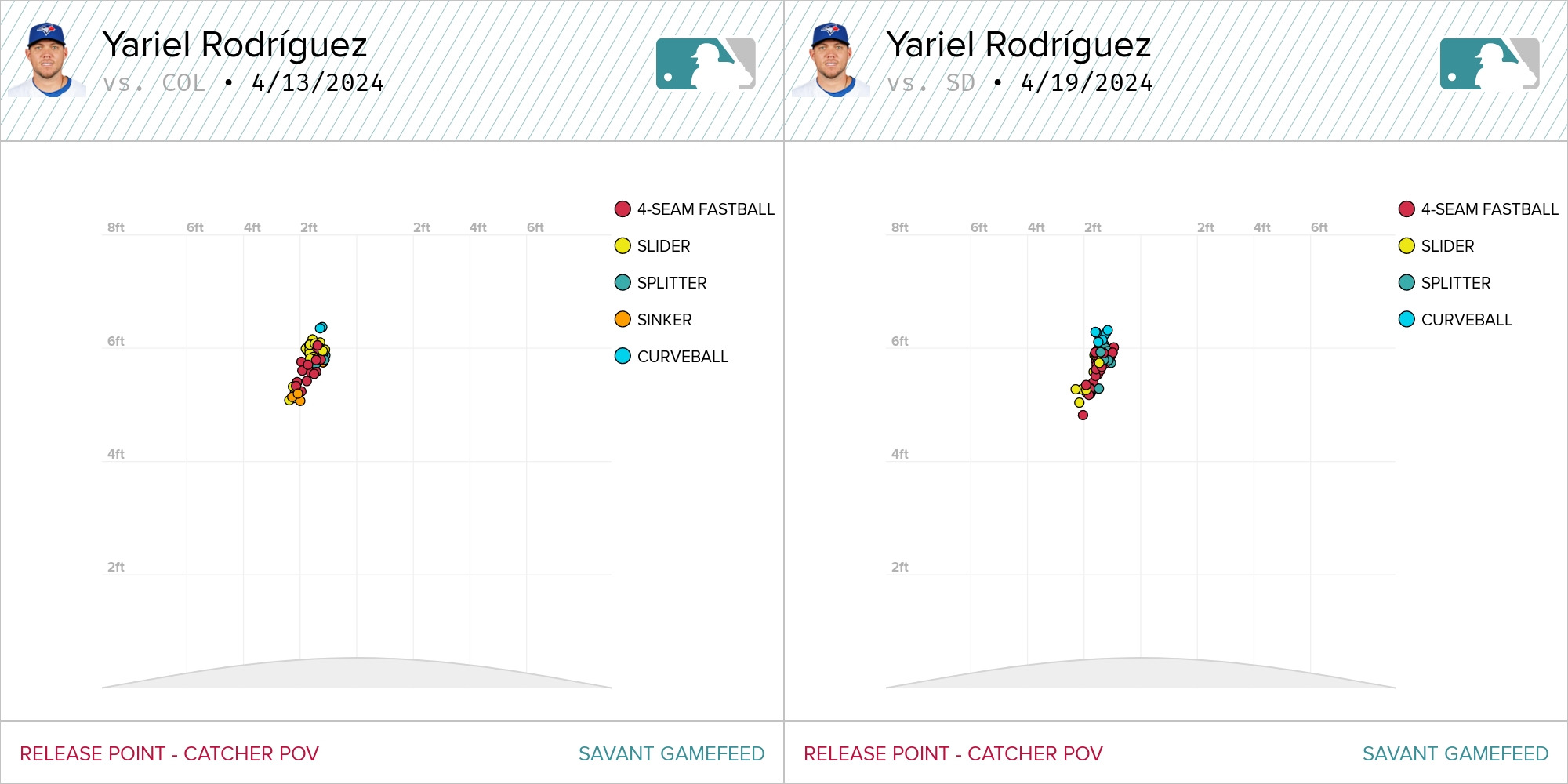
Plots like those are typically a red flag for pitching coaches. Guys that inconsistent with their release are often spraying pitches all over the place. But Rodriguez has walked only three over his first 7.2 big-league innings, while locating over half his pitches in the zone. And 73 per cent of his pitches have landed either in the box or within the shadow zone a ball-width off the plate.
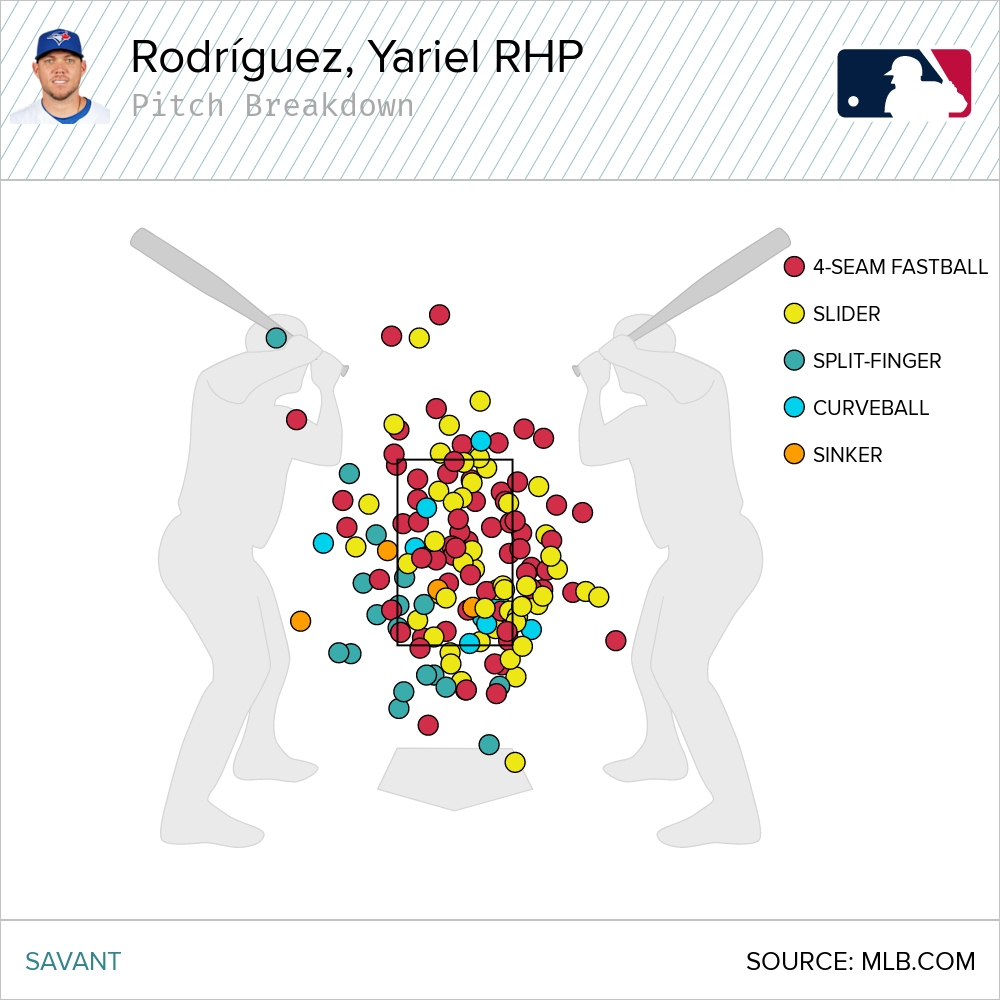
That’s pretty clean living. If anything, Rodriguez has been a little too comfortable on the plate, leaving nearly a quarter of his pitches in what Statcast classifies as the heart of the zone.
With unfamiliarity on his side, Rodriguez has been able to out-stuff hitters with those fat pitches so far. But big-leaguers are big-leaguers for a reason. So, the next advancement for him is likely to start attacking the edges more consistently. The good news is he doesn’t lack the fastball — really, fastballs — to do it.