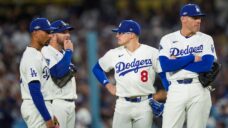
Despite the Los Angeles Dodgers’ enviable talent and recent playoff success, it shouldn’t be a shock to see them where they are now — eliminated from the 2026 MLB Postseason.
While the team’s World Series odds briefly peaked above 50 per cent after it dispatched the Atlanta Braves in the National League Division Series, the Dodgers generally lived between 20 and 30 per cent for most of 2026. With the randomness inherent in short-series baseball, it’s tough to get much higher than that until late in a post-season run, and the team was never close to inevitable. Los Angeles’s current predicament shouldn't just be chalked up to the structure of the sport, though. The Milwaukee Brewers’ excellence has plenty to do with it.
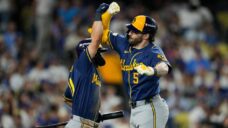
The combination of the Brewers’ playoff underperformance in recent years and their lack of star power compared to the Dodgers made them seem far more like underdogs than they truly were entering the NLCS. While it’s easy to say with the benefit of hindsight, the way the Brewers took it to the Dodgers should be far from shocking.
A sweep is always an extreme result, and the four games of the NLCS featured some peculiar outcomes — like the Brewers out-homering the Dodgers 7-1. Still, over the course of 162 regular-season games, Milwaukee was the better team. The Brewers didn’t top the Dodgers by every single metric, but they beat out the two-time defending champs in almost every critical number that wasn’t power-related, including runs, OBP, walk rate, ERA and K/9.
The Brew Crew also stole 90 more bases than the Dodgers and had better defensive production by OAA (+19 to +14). In past years, residing in the NL Central created a lower degree of difficulty for Milwaukee and may have juiced its numbers, but this year the division was respectable as the Brewers' divisional opponents produced a 323-325 record. Meanwhile, the Dodgers’ NL West rivals went 300-348.
The regular season validated the Brewers’ credentials as an elite team, but it’s understandable that the post-season would be perceived differently. The Dodgers are about as proven a playoff team as you’re going to find, while the Brewers got swept out of the NLCS last year and lost in the wild-card round in each of the two seasons before that. Even so, the way Milwaukee was built fits October baseball nicely.
The pitching
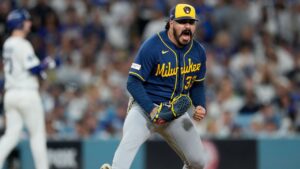
That starts with pitching. The Brewers have a true ace (Jacob Misiorowski) — albeit one on the young side whose workload is overseen with a close eye — who has a good chance of tipping any game he’s in. Their second starter, Logan Henderson, is a pitcher who doesn’t necessarily go deep into games but is extremely efficient on a per-inning basis, an excellent October profile when bullpen usage is heavy. He has posted a 2.33 ERA in his young career with a 2.92 xERA, suggesting he hasn’t fluked into those results in his first 123.2 innings as a big leaguer. Robert Gasser is more steady than spectacular as the third option, but the bullpen is an overwhelming positive.
Milwaukee’s relievers ranked third in the majors in ERA during the regular season (3.40) and fourth in fWAR (7.0), so they projected to be a playoff asset. After all, their most-used post-season quintet — Aaron Ashby, Trevor Megill, Abner Uribe, JoJo Romero and DL Hall — combined for 286 innings of 2.53 ERA ball during the regular season with a 10.17 K/9 and a collective average fastball velocity of 97.1 m.p.h. It was always fair to assume the Brewers’ core relievers would be potent in October, but they’ve exceeded even lofty expectations. That group has pitched 35 of Milwaukee’s 71 total innings in the playoffs and conceded just four runs. The Brewers have allowed four runs in the 5.2 frames pitched by other relievers, but additional rest days of a post-season schedule allow Milwaukee to stick to its stable of top arms.
The offence
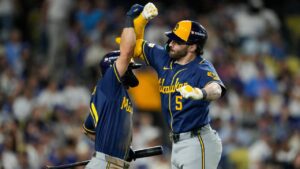
On the hitting side, it’s difficult to define what makes a group particularly suited to post-season action. The conventional wisdom about the importance of power hitting for quick-strike offence or contact hitting to nullify elite pitchers’ strikeout abilities is shifting over time. One asset Milwaukee has going for it is diversification. Teams reliant on a single world-beating hitter (like the New York Yankees with Aaron Judge) are always in danger of a significant reduction in offensive capability if that player gets hurt or has a poorly timed slump.
The Brewers have five regulars who produced 3.0 fWAR or more during the regular season and nine players with a wRC+ over 100 in 200 plate appearances. Milwaukee’s offence can come from anywhere, and that balance was apparent in the NLCS when the team had six players with an OPS above .800 and its seven home runs came from six different sources.
None of this means Milwaukee was always head and shoulders above the Dodgers, or that this NLCS result was predestined. The .185/.270/.250 batting line Los Angeles managed was truly awful, even in a small sample against elite pitching. Yoshinobu Yamamoto couldn’t even manage three innings in his only start, and Blake Snell allowed three home runs after not conceding one in his previous 10 starts. Freddie Freeman went 1-for-14. The Brewers’ execution played a role in these anomalies, but there is probably some luck (and perhaps a little exhaustion for an older team making another deep playoff run) that accounts for so many of the Dodgers’ proven playoff performers being stifled.
The Brewers still deserve plenty of credit. Milwaukee was slightly better than Los Angeles during the regular season, and far better in the playoffs. The team’s regular-season production was outstanding, and the structure of its roster fits post-season baseball well. A sweep over the defending champs is solid proof of concept for that.
This Brewers club isn’t just a feel-good story, it’s an elite team — and it will be a worthy World Series favourite against whoever comes out of the ALCS.
 2:32
2:32