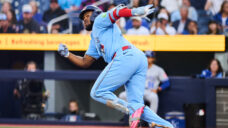
TORONTO — Ernie Clement fouled a ball off his sensitive area and the pain was so bad he spent over a minute lying in the batter's box, writhing in agony. Even so, he doesn't plan to wear a protective cup.
"I've just never worn one," Clement says. "I'm not gonna change now."
The incident during the eighth inning of Tuesday’s game at Rogers Centre caused Toronto Blue Jays manager John Schneider and head trainer Jose Ministral to rush out of the dugout. Clement fouled a low, 98-m.p.h. sinker from Kansas City Royals right-hander Nate Pearson into the ground before it ricocheted into his nether regions.
Clement eventually shook it off and stayed in the game and, once it was over, Schneider sought to find humour in the ordeal.
“Wear a cup tomorrow,” the manager quipped when asked what his conversation with Clement was like on the field.
That's just not going to happen, though. Clement has always found cups uncomfortable and chose not to wear them in Little League or high-school hockey, he claims.
Yes, being struck in that area while batting is extremely rare, but what about the fact that Clement’s job as a major-league infielder routinely exposes him to rockets he must square up?
“I always feel like if I miss a ground ball, it's my fault and I deserve to get hit in the nuts,” says Clement.
This is not a story about the bravado of Clement. Rather, it’s on the reality that his perspective on protection is more common than you’d think.
His experience on Tuesday was identical to what New York Yankees infielder Jazz Chisholm Jr. endured at the plate a few months ago. After the pain had lessened, Chisholm Jr. told reporters, “that was just an unlucky instance,” before adding, “I’ve never had a reason to wear one. Now I have a reason to wear one — but that doesn’t mean I’m going to wear one.”
Blue Jays outfielder Myles Straw agrees with Clement and Chisholm Jr. He stopped wearing the item when he was eight years old. It's a comfort thing, according to Straw. Players simply don't like the feel of a hard plastic or carbon fibre object between their legs when they're moving around.
Straw believes no outfielder should wear a cup and proclaims they're irrelevant for MLB infielders, as well.
“As a kid you were told to wear it, and I guess you listened to your mom, dad, or coach at that point, but once you start to become a little bit more of a developed player, you trust your hands, your instincts,” Straw says.
“And now, especially on a major-league field, you don't see really bad hops. That's kind of where it gets scary — like, you can get a bad hop on a high-school field, but (here, they rake) the field every three innings.”
Schneider doesn't understand why this generation of players has chosen to eschew cups. He estimates less than 10 per cent of big-leaguers wear them — “That's my guess. I'm not cup-checking everyone, you know what I mean?” — a vast difference from his playing days in the early 2000s, when seemingly every player was strapped, regardless of position.
The 46-year-old former catcher once witnessed a University of Delaware teammate take a line drive off a cup before it landed in foul territory on the nearby tarp.
“Guys now are more comfortable not wearing it and they say they trust their hands,” says Schneider, who notes that he makes sure his seven- and nine-year-old sons wear cups in their youth games. “Balls take weird hops off the bat and off the dirt. So, I'm a big believer in a protective cup, and fortunately I had to wear one in my position. But it's kind of weird how guys don't.”
Fellow catcher Brandon Valenzuela is on Team Cup.
“I have to protect the nuggets,” Valenzuela says.
The Blue Jays rookie recalls enforcement from Little League coaches in Mexico. Kids weren't allowed to play without a guard, and Valenzuela says that taught him to associate the cup with his uniform, making it feel as though the equipment was just another piece of clothing.
He opts to adorn it when playing first base or if he’s in the lineup as designated hitter. In fact, Valenzuela even uses the safeguard during batting practice.
“I feel naked without it,” he says.
That viewpoint leaves Valenzuela in the minority and he's okay with that, just as Clement and Straw are content with their choice.
During Straw's first year of pro ball, he laced a pitch down the right-field line and hustled into second base. As he dove toward the bag, the relay throw landed underneath Straw and he rolled on the ball, sans cup, of course. He remembers being unable to breathe for about 10 minutes and felt like throwing up.
Did that lead him to reconsider?
"It's just not worth it,” replies Straw. "That's the only incident I've had in 12 years of baseball and pro ball. It's just the comfort."
The pain eventually subsides after running its course. Straw knows that and so, following Tuesday's contest, when enough time had passed from Clement’s incident, Straw decided to check on his teammate.
"I just said, 'How you feeling kid?'" says Straw. “And he's like, ‘Oh wow, it's shaped kind of weird.’ So, I was like, ‘Alright, yeah, go see the trainers.'"

 1:15
1:15

 6:53
6:53