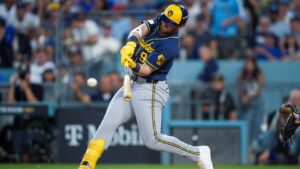
TORONTO — Sean Keys didn’t enter 2026 believing he was on the cusp of his MLB debut. It wasn’t even a consideration. He was surprised merely being invited to the major-league side of Blue Jays spring training in February.
“Obviously, it's what I've been preparing for. It's what I've been playing for,” the left-handed hitting corner infielder says. “But it’s kind of moved fast on me.”
Drafted less than two years ago, Keys spent all of 2025 at high-A Vancouver, finishing with a .773 OPS and 119 wRC+ over 119 games. Those are fine numbers. But they weren’t even close to the best on his own team. You won’t find him on anyone’s top-10 Blue Jays prospects list.
Yet the Blue Jays were encouraged with Keys’ peripherals, particularly the way he controlled the strike zone, and believed his surface stats were weighed down by poor batted ball luck. A .250 BABIP on the year — fifth lowest among all Northwest League hitters to make at least 250 plate appearances — supports the theory.
And Keys wasn’t coming to Blue Jays camp just to rub shoulders with veterans in a big-league environment. He was there to play, receiving regular run at first base in place of Vladimir Guerrero Jr. during the World Baseball Classic. That’s when Blue Jays coaches started noticing all the little sophisticated things the 23-year-old does. All the ways he fits in like he’s been doing it for years.
“For us, it was the first time really being around him. And he was impressive in terms of his knowledge of his swing and understanding how it works, his competitiveness,” says Blue Jays manager John Schneider. “He’s a good player. The power is real. The offence has been really good. He put himself on the radar, for sure. You know, 21 homers is 21 homers.”
Tough to fake that. Nor the 1.028 OPS Keys produced while hitting those 21 homers this season in 286 plate appearances spread between double-A and triple-A, which earned the New Yorker his first big-league call-up Saturday afternoon.
Doing it all against advanced competition, while enjoying batted ball results closer to what you’d expect for someone who hits the ball as consistently hard and on a line as Key does, propelled him to the majors.
And the hope is all the refinements he’s continually found in his game — Keys, who’s deeply interested in science and mathematics, graduated Bucknall University with a degree in mechanical engineering — will continue to come and help keep him there.
“There’s some under the hood stuff we like in terms of the swing, where he's hitting it, how he's hitting it. And then his own awareness as to the why is pretty advanced. He’s a pretty mature kid for being so young,” Schneider says. “There’s going to be an adjustment. But all those things lead to you believing that he'll be pretty good. I'm not asking him to save the season or hit 30 homers here. I think the body of work overall says, ‘OK, this should translate.’”
Keys has made a series of swing adjustments in recent seasons, working to reduce forward drift, simplify his load, and be better synced up with a more consistent contact point. That’s helped him increase his peak exit velocity by five miles per hour since he was drafted.
So far this season, he’s layered on improved swing decisions, narrowing his sights, chasing less, choosing better pitches to take chances against, and seldom missing good ones to hit.
He’s made large strides against left-handed pitching in particular, impressing Blue Jays evaluators with how stubbornly he’s stuck to his approach. Keys went 6-for-16 against lefties with Buffalo, hitting three long homers, and will get opportunities against same-sided pitchers in the majors.
“In double-A, it was something I worked on a lot,” Keys said. “But now after being in triple-A, having success off some really good lefty pitching has given me an idea of what I can do against them and how I can contribute every single day in the lineup.”
That contribution will ideally come in the form of extra-base hits, which the Blue Jays — bottom-five in isolated power and hard-hit rate this season — have been chasing all year.
During his brief stop in Buffalo, Keys’ EV90 — a measure of a hitter’s top end power that tells you how hard they hit their 90th percentile ball — was 109.2-m.p.h, an elite number that ranked within the top two per cent of triple-A hitters. For context, Kyle Schwarber ranks 10th among qualified MLB hitters this season with an EV90 of 109.1-m.p.h.
Meanwhile, Keys’ barrel rate — small sample caveats apply — also ranked within triple-A’s 91st percentile. That, combined with hitting a little over a third of his balls in the air to the pull side, is why Keys left the yard seven times in his final 10 triple-A games.
Those results have only increased Keys’ comfort and confidence in his approach, creating a positive feedback loop that’s helped sustain his production as he’s encountered higher-level pitching for the first time.
“Confidence is key, for sure,” he says. “Whatever the game plan is, whoever I'm facing, righty, lefty, changes the approach in terms of swing and pitch selection. But most of the time, it’s just confidence. Have fun, be loose, don’t be anxious in the box. Just let it happen.”
Now, Keys was promoted to play regularly, which will require a bit of lineup manipulation going forward. And one way the Blue Jays will create opportunities is by using George Springer in the outfield one or two times per week, which opens the designated hitter spot. Springer last played outfield in September, 2025, but he’s been taking regular pre-game reps in the corners for a couple weeks now, preparing to return to duty.
Keys will also get the occasional start at third base to give Kazuma Okamoto a day off his feet, and first base to do the same for Guerrero. Those are the only positions he’s played since college, and the Blue Jays aren’t about to ask him to learn a new one at the highest level. But gaining familiarity with both corner outfield spots could be a focus this coming off-season and into next spring training.
For his part, Keys is described as an instinctual, reliable defender who makes the plays he’s expected to. As a larger athlete — he’s listed at 6’1, 232-lbs. — his defensive posture and first-step jumps will always be an area of focus. He’ll likely never rank among MLB’s best third base defenders, but league average territory ought to be achievable.
First base is still a work in progress, as Keys has played only a handful of games there since first picking the position up after he was drafted. In recent weeks, the Blue Jays sent three-time all-star first baseman Sean Casey to Buffalo as a guest instructor to help Keys with the finer points of the position.
Of course, Keys isn’t in Toronto for his defence. He isn’t making his big-league debut with only 286 plate appearances above high-A because the Blue Jays needed another corner infielder. He slugged his way to the majors and, if he can keep doing all the little things underlying his very big home runs, he might just stick around.
“A big word for me is consistency,” Keys says. “I’m not superstitious. But having routines so that I can trust that I'm doing all that I can before the game is important. And then, once it’s game time, all right, take a second, take a deep breath, and just let it happen. Let it play.”


 2:31
2:31