From the moment the Toronto Blue Jays selected Spencer Miles in the Rule 5 Draft, they were hoping he could be a massive outlier.
In a sense, that’s true of every Rule 5 pick, who are all asked to perform at the MLB level over the course of an entire season as rookies, despite not being valued enough by their own organizations to get a 40-man roster spot.
Even though teams are incentivized to hold onto Rule 5 players because they can’t be optioned to the minors without leaving their new club, that protection only goes so far, and many wind up back where they started or with another team altogether.
The 2025 Rule 5 Draft is a good example of how few breakthroughs happen, as it has a large class (13 players) and only two have provided positive value for new clubs at the MLB level: Daniel Susac and Miles.
Player | Position | Original Team | Selected By | Current Team | Basic Status |
RJ Petit | RHP | DET | COL | COL | 60-Day IL |
Jedixon Paez | RHP | BOS | CWS | BOS | Injured in AA |
Griff McGarry | RHP | PHI | WAS | LAD | 7.30 ERA in AAA |
Daniel Susac | C | ATH | MIN | SFG | 0.6 fWAR in 37 MLB PA |
Carter Baumler | RHP | BAL | PIT | TEX | -0.1fWAR in 5.2 IP, on IL |
Ryan Watson | RHP | SFG | ATH | BOS | -0.1 fWAR in 27.2 IP |
Matt Pushard | RHP | MIA | STL | STL | 0.0 fWAR in 3.1 IP |
Roddery Muñoz | RHP | CIN | HOU | HOU | -0.3 fWAR in 4 IP |
Peyton Pallette | RHP | CWS | CLE | CLE | -0.1 fWAR in 19.2 IP |
Spencer Miles | RHP | SFG | TOR | TOR | 0.3 fWAR in 24.2 IP |
Cade Winquest | RHP | STL | NYY | STL | 12.00 ERA in AAA |
Zach McCambley | RHP | MIA | PHI | MIA | 2.66 ERA in AAA |
Alexander Alberto | RHP | TBR | CWS | TBR | 3.63 ERA in AA |
The early success of Miles — who enters Thursday’s action with a 2.55 ERA and just three runs allowed in his last 19 innings — isn’t just unusual because he’s a Rule 5 pick. Nothing about his career before reaching Toronto followed a typical path.
Due to a litany of injuries, his pro experience before 2026 amounted to 14.2 innings of regular-season minor-league ball split between 2022 and 2024 (none of it above Single-A) and 8.2 frames of Arizona Fall League action last year. The last time he had a meaningful workload was college, where he produced a 6.27 ERA in 145 innings over three years.
A resume like that rarely results in a chance to pitch in the major leagues. The fact that it did implied that the Blue Jays felt strongly enough about his stuff.
Even after an uneven spring, the club was willing to carry him on the Opening Day roster — likely envisioning him as an extremely low-leverage option who might be able to overpower hitters enough to survive at the MLB level. That’s the profile of many Rule 5 picks: bullpen arms who try to make up for their lack of polish with talent. Based on his lack of experience, that seemed like a best-case scenario for Miles.
That description hasn’t fit the right-hander at all early in his career. While the 25-year-old wields above-average velocity (96.1 m.p.h.), he has the profile of a savvy vet, not a raw rookie.
Miles is already adept at mixing and matching, throwing four pitches (his sinker, four-seamer, slider and curveball) between 19.8 per cent and 34.6 per cent of the time. He doesn’t even have a favourite strikeout pitch yet, as he has either five or six Ks with each of the offerings.
Blue Jays on Sportsnet
Watch coverage of the reigning AL champion Toronto Blue Jays throughout the season on Sportsnet and Sportsnet+.
Blue Jays on Sportsnet
Opponents’ inability to sit on a pitch with Miles could help explain why they make such soft contact against him (84.2 m.p.h. — a number in the 97th percentile league-wide), though it’s too early in his career to know if that will hold up.
It’s not just the repertoire variety and sequencing that give Miles an unexpectedly veteran flavour. It’s also the strike throwing. The right-hander’s walk rate (7.0 per cent) is well below the MLB average for rookie relievers (11.4 per cent), and relievers overall (10.3 per cent). He also consistently pitches ahead in counts, getting the first pitch strike 64 per cent of the time. Miles has faced 100 batters in his young MLB career, and just three have gotten to a 3-0 count.
While Miles has been generally impressive, he’s also demonstrated some of the negatives commonly associated with pitchers deeper in their careers. Specifically, he hasn’t been overpowering.
While his strikeout rate (23 per cent) is approximately average for an MLB reliever (22.3 per cent), he hasn’t missed many bats. His whiff rate (22.7 per cent) is in the 31st percentile, and his 16th-percentile chase rate (25.8 per cent) suggests opponents can track his stuff. That makes sense considering the movement on it is fairly standard.
In the image below, note how closely the movement of his pitches aligns with the shaded MLB average — outside of his curveball, which has some extra glove-side run.
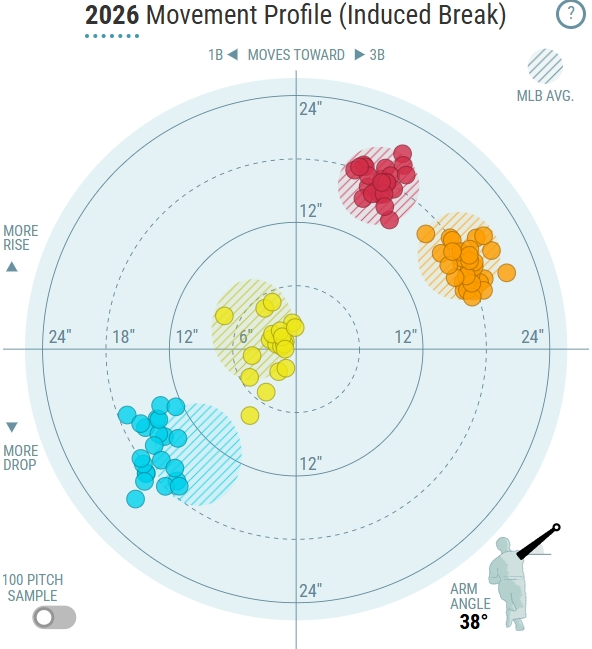
The Stuff+ model also rates all four of his pitches as almost exactly average (which it presents as 100).
Pitch | Stuff+ Rating |
Sinker | 100 |
Four-Seamer | 98 |
Curveball | 100 |
Slider | 101 |
Some of these results relate to how Miles has been used. The Stuff+ might look a bit better for his fastballs in a season full of single-inning outings consisting of all max-effort offerings. There isn’t much evidence that would change the movement profile much, though.
While the break on the rookie’s pitches varies game-to-game, they haven’t spiked in short outings, like his debut, or fallen off drastically in his longer appearances — like his last two.
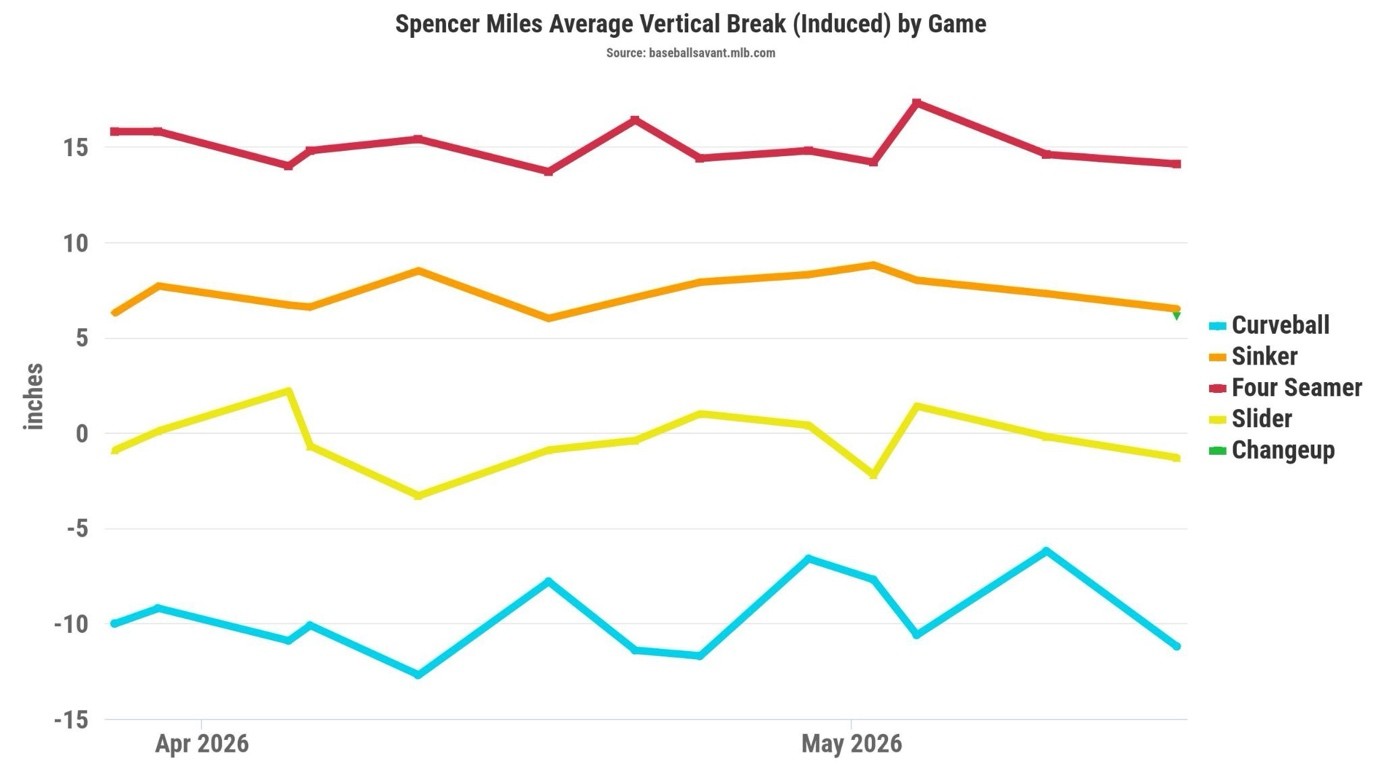
Miles is adjusting to the multi-inning role he’s been given, but it’s also true that role seems to fit him surprisingly well. Entering 2026, it would’ve been unfair to expect a significant contribution from Miles due to his non-existent track record. If you were going to be optimistic, you might project him as a high-K, high-BB reliever with enough pure stuff to get by.
His immediate arrival as a pitcher with a deep repertoire whose game looks more like a fourth-starter in his 30s than an up-and-coming fireballer is remarkable considering his background. Whether he’s ever used as a traditional starter is a question complicated by his minimal career workload, injury history and whether the team has a spot in its rotation for a developmental project in the years ahead. That can be put aside for now.
At the moment, Miles is more starter-ish than the Blue Jays had any right to expect when they selected him in the Rule 5 draft. Considering the state of the back of the club’s 2026 rotation, putting his starter-like traits to use in a starter-like role is a welcome bridge to a more sustainable solution.


 1:59
1:59
 0:49
0:49 2:16
2:16