The Toronto Blue Jays’ signing of Kaima Taira on Tuesday was a large commitment to a player unproven at the big-league level.
Taira’s 2026 season (1.36 ERA in 146 IP) was nothing short of spectacular, but a $93.88-million outlay, including his salary and posting fee, is still a large bet on a player who hasn’t stepped on an MLB mound. Taira’s NPB results matter, however, there are numerous players who thrive in Japan but either struggle in the majors or never get an MLB opportunity at all.
Clearly, Toronto believes Taira is different. Part of that is his age. Taira just turned 27 and still has plenty of his prime left to give. Perhaps more importantly, Taira’s results are built on a foundation of skills the Blue Jays strongly believe will translate to the world’s toughest league.
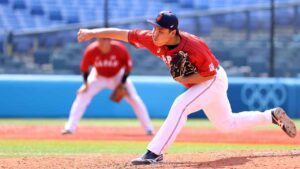
By moving past the right-hander’s results in Japan and into precisely what his pitching repertoire looks like, it’s easy to see why Toronto took a chance on the man whose unusual five-foot-eight, 209-pound build earned him the nickname “The Fire Hydrant”.
Velocity
While velocity is no guarantee of success as a starter, understanding where Taira sits is helpful to understand how he projects at the MLB level. His 95.7 m.p.h. average fastball velocity led qualified NPB starters in 2026, but that number means something different in the majors.
Last season, 84 right-handed starters pitched at least 100 innings. Throughout this article, we’ll compare Taira to that group as it’s solid shorthand for full-time starters with a solid sample of work, and there is too much of a fundamental difference between how lefties and righties perform for southpaws to be reasonable comps for Taira. If the newest Blue Jay were placed into that subset of pitchers, his fastball velocity would rank 32nd, in between Griffin Jax and Christian Scott.
There were 13 starters whose velo was within 0.5 m.p.h. of Taira’s in either direction:
•Hunter Brown (96.2 m.p.h.)
•Yoshinobu Yamamoto (95.1 m.p.h.)
•Bryan Woo (96.1 m.p.h.)
•Nolan McLean (96.0 m.p.h.)
•Bryce Miller (95.9 m.p.h.)
•Griffin Jax (95.9 m.p.h.)
•Drew Rasmussen (95.8 m.p.h.)
•Shane Baz (95.8 m.p.h.)
•Christian Scott (95.5 m.p.h.)
•Emerson Hancock (95.4 m.p.h.)
•Zack Wheeler (95.2 m.p.h.)
•Zebby Matthews (95.2 m.p.h.)
•Andre Pallante (95.2 m.p.h.)
That’s an impressive group. Those 13 starters combined for 1390.2 innings of 3.53 ERA ball and 36.3 fWAR. Only one (Zebby Matthews) had an ERA above the MLB average for starters (4.24), with eight striking out at least one batter per inning.
While it’s unfair to assume Taira’s velocity will carry him to the kind of success these pitchers enjoyed, pitchers who bring his type of heat tend to keep runs off the board. Taira’s velocity won’t be as overpowering as it was in Japan, but it’s still a notable asset. For a little context, since the beginning of the pitch-tracking era in 2008, 73 right-handed starters have managed at least 50 innings in a season for the Blue Jays. Just two had a higher average velocity than Taira managed in Japan last season: Dylan Cease and José Soriano in 2026.
Release point
Taira’s height is a major talking point, often in relation to whether he’ll be durable or not. Time will tell on that count. Something that we can say with more certainty about his short stature is that it will result in a low release point. Last season that reportedly sat at 4.94 feet, which would be third-lowest among right-handed pitchers with 2,000-plus pitches thrown — an approximation of a starter’s workload — in the majors in 2026, below just Joe Ryan (4.73), and Logan Webb (4.88). The other pitchers with the 10 lowest release points in the sample? Zack Wheeler, Aaron Nola, Emerson Hancock, Bryan Woo, Luis Castillo, Brady Singer, Jacob Misiorowski, and Freddy Perlata.
Although that’s not a uniformly elite group, it’s not a bad one to be a part of. Taira’s low release point also pairs with high extension (6.8 feet). Not many notable pitchers had that precise number in 2026, but he shared it with Casey Mize and Blue Jays rookie John Klein, and it would’ve ranked in the 83rd percentile league-wide. Featuring a high-extension heater has worked to make pitchers who lack prototypical height, like Shane McClanahan and Spencer Strider, get the most out of their fastballs by increasing their perceived velocity. Taira doesn’t have quite the velocity or extension of either of those pitchers at their peak, but the general principle holds.
Taira’s fastball is his signature pitch, and raw velocity isn’t the only reason why. The offering is also tricky because it comes out of an extremely low release point hitters aren’t accustomed to, with extra extension that juices its perceived velocity. Taira’s build may ultimately have its disadvantages, but it comes with an upside too.
Pitch variety
Taira’s size isn’t the only thing that makes him an outlier. He also has a deeper pitch mix than most starters, despite spending much of his career as a reliever. Last season he threw a four-seamer, cutter, sweeper, changeup, splitter, sinker, slider, and curveball. The curve was the only offering he used less than 150 times, and he threw his most-used pitch (the four-seamer) just 31.9 per cent of the time. No other pitch had a usage rate above 20 per cent overall, and even splitting the usage up by handedness shows extreme balance.
A pitch-mix structure with a most-used offering below one-third usage and nothing else above one-fifth is extremely rare. Among the aforementioned group of right-handed starters who threw 100-plus innings in 2026, just three pitchers fit that description: Davis Martin, Seth Lugo, and Brandon Pfaadt.
That trio combined for a respectable 4.36 ERA and 6.6 fWAR in 454 innings, but none of them feel like good comps for Taira. None of the three had an average velocity above 93.8 m.p.h. or a strikeout rate above 7.52 K/9. They used unpredictability as a weapon in place of plus stuff. Taira might just have both.
Better examples of pitchers with a similarly deep repertoire to Taira, but more life in their stuff, are Zack Wheeler and Nolan McLean. Both of them throw their heaters slightly more often (35.7 per cent for Wheeler and 34.7 per cent for McLean), but not by a massive margin, and neither has another pitch with 20 per cent usage or more. That pair posted a 3.08 ERA over 341.2 innings last season, with a collective average velocity similar to Taira's (95.5 m.p.h.). That would be too high a bar for the Japanese import, but their success shows the potential of combining arsenal variety with above-average velo.
Pitch characteristics
The information above provides a sense of the scope of Taira’s arsenal and why his fastball could be special, but looking at how his pitches move adds another layer to understanding how he might perform as a big leaguer. Using his NPB pitch movement plot based on Yakyu Cosmopolitan data, it’s possible to look at each of his pitches and find a reasonable MLB comparable. We’ll leave out his curveball as he threw it less than 100 times.
Four-Seam Fastball (31.9 per cent usage)

This comparison is intriguing because Houser is more of a sinkerballer, and his four-seam fastball is his secondary heater. Despite that role in his repertoire, it has been an effective pitch, with a Statcast run value of plus-six over the last four seasons. Last year it was Houser’s best offering by the metric (plus-four).
A complicating factor, as laid out in Lance Brozdowski’s detailed breakdown of Taira entering free agency, is that the difference between the NPB and MLB ball could affect its movement. Other pitchers coming from Japan recently, like Yoshinobu Yamamoto, Roki Sasaki and Tatsuya Imai, have seen the vertical movement on their four seamers decline when they hit the majors.
If that happens with Taira, his signature pitch’s movement profile won’t be particularly impressive, and its success will depend on the combination of raw velocity and unusual release point.
Cutter (18.4 per cent usage)

This is an encouraging comparable, as the cutter has long been a big part of Eovaldi’s success. His cutter’s pitch value has varied significantly in recent years, coming in between plus-12 and minus-five in the last four seasons, but the average per year over that period is plus-3.5.
Eovaldi has significantly above-average induced vertical movement on his cutter (plus-2.1 inches), and its subtle arm-side movement has utility biting the inside corner to lefties, or the outside edge to righties.
If Taira can replicate that formula, the cutter is likely to be a useful tool in his arsenal.
Sinker (11.1 per cent usage)

Black is a little-known reliever with the Kansas City Royals, but the match is so close it couldn’t be ignored. He also delivers the pitch with a low arm-angle (27 degrees) and above-average extension (6.7 feet), so its presentation is similar to what hitters will see from Taira.
Unfortunately, saying Taira throws something like the Mason Black sinker means almost nothing. Black has less than 100 MLB innings under his belt and used the pitch just 144 times last season.
Taira’s sinker is eerily similar to one that is the most-used offering of a major-league pitcher that had a positive run value last season (plus-one). That’s not bad for a pitch that isn’t considered one of his best weapons. Beyond that, the only thing worth stopping on here is that Black’s sinker is slightly below-average on vertical movement and above-average in terms of arm-side run.
Slider (11.0 per cent usage)

There are years where drawing comparisons to Seth Lugo is a complement, but 2026 isn’t one of them. The veteran just posted a 5.17 ERA, and his slider was a relatively unremarkable pitch in his deep but ineffective repertoire.
To Lugo’s credit slider had slightly above-average movement in both directions…
… but it’s telling that he used it less than 10 per cent of the time. If it had the ability to get him out of trouble, he might have gone to it more.
The categorization of sliders vs. sweepers is somewhat inconsistent in the NPB data, so it’s impossible to make firm judgments on it for now. For what it’s worth, according to NPB Basement his whiff rate on the pitch (38.9 per cent) was the second-best of all of his pitches.
Sweeper (9.9 per cent usage)

As is the case with the slider, the data here is probably the least reliable, so any optimism needs to be exceedingly cautious. Still, it is interesting that Taira’s sweeper closely resembles the top strikeout pitch of an established MLB starter, albeit one coming off a rough season.
Regardless of where the upside on this pitch tops out, it holds an important place in Taira’s repertoire, as nothing else has nearly as much glove-side movement. It’s likely to be used far more against right-handed hitters than lefties.
Changeup (9.6 per cent usage)

While Montero’s change is fairly close to Taira, it’s not as clean a comparable as some of the others. The Detroit Tigers right-hander is coming off an excellent season where he produced a 3.48 ERA in 155 innings, but his change was his fifth-most used pitch.
Even so, that offering had a run value of plus-four, and opponents hit just .167 off of it. Montero’s changeup was notable for having limited vertical movement and above-average run, leading to a relatively flat shape that Taira is likely to feature as well.
Splitter (8.2 per cent usage)

It was tempting to use Kevin Gausman as the comp here (84.0 m.p.h., 4.3 inches of IVB, 13.9 inches of arm-side run), but Johnson fits a little bit better. While Johnson’s overall numbers (5.04 ERA in 100 IP) last season aren’t encouraging, his splitter was a solid pitch. It induced a 32.5 per cent whiff rate and a .181 opponents batting average for a plus-one run value.
Taira could do better than that with the vertical movement advantage he has. He doesn’t use his splitter much, but the small-sample results are enticing. Last season he got a 46.9 per cent whiff rate with the pitch, and in his other campaign as a full-time starter (2023) that number was a solid 38.8 per cent. Pete Walker and the Blue Jays pitching staff have had success with pitchers featuring splitters in the past, and it will be interesting to see if they can coax more out of this pitch from Taira.
None of the pitches explored above are likely to work exactly like the MLB comparables. Location, sequencing, and their pitch-tunnelling relationships with each other all matter. That doesn’t mean it isn’t notable that Taira has so many pitches that look an awful lot like ones we’ve already seen in the major leagues which have found success at that level.
The overall package
Part of what makes Taira so enticing is also what makes him so difficult to project. There simply isn’t a crop of five-foot-eight, high-velocity, low release-point/high extension, diverse-repertoire pitchers around the majors that he can easily be compared to.
It’s not hyperbole to describe the Japanese hurler as unique. At the same time, a few things are clear. Taira’s fastball could be a special pitch. Most starters can’t match his velocity, and the unusual release point is likely to increase its effectiveness. No other individual pitch in his repertoire looks like a sure bet to mow down major-league opponents, but they have credible and familiar movement/velocity profiles. His splitter, in particular, might have some latent upside that could be explored when he joins the Blue Jays.
Every free-agent pitching contract is a risk from a health standpoint, and it could be argued that Taira’s risk is greater because of his status as a physical outlier and a role-fluid history that’s led to just two seasons as a full-time starter. His status as a player with no MLB experience also gives him a relatively risky profile from a performance standpoint. Those things cannot be ignored when evaluating this signing, but it’s also true that everything we know about his repertoire and the unusual way it’s delivered suggests Taira has stuff major leaguers may struggle to hit.
MORE FROM SPORTSNET





 5:57