By Brad Taschuk
I identify myself as a hardcore MMA fan. If there was a category beyond that, I’d probably identify myself in whatever that category was. I’ve been to events live, and not just UFC events, but all sorts of regional events since the sport was legalized in my home province of Ontario just last year.
Aside from a period last year when I was out of the country and had no access to PPV and limited internet access, I haven’t missed a numbered UFC card live since UFC 90. Prior to that, it was UFC 55. That’s a lot of MMA to commit to over the past seven years, but I’m not looking for a medal or anything. I was there many a Saturday night rather than out socializing because I love the sport, love taking in as much of it as possible.
I’m the type of person who would just as soon stay home on a Friday night to watch some mediocre card on HDNet AXS TV as go out to a party. I’d rather watch an internet stream of something going on over in Asia, Russia or the U.K. than… whatever normal people do on a Saturday morning or afternoon. I’ve got a collection of MMA DVDs that got so large I literally had to go out and purchase a case to store them all.
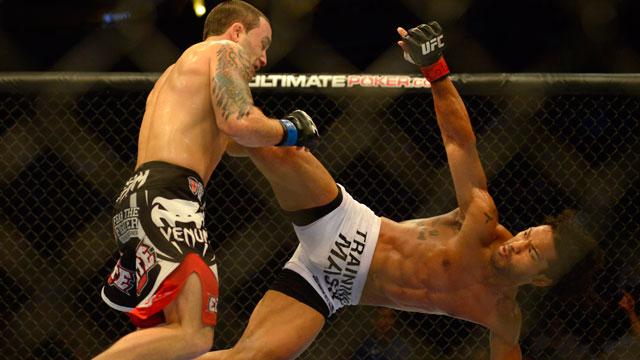
Yet when UFC 150 rolled around, I found myself over at a friend’s house, playing board games, Super Spike Volleyball, and just generally having a good time without a care in the world to what was happening in the fights. Don’t get me wrong, I got caught up on the results first thing Sunday morning (and boy was I glad I wasn’t watching live, having picked and bet on Frankie Edgar), but the thirst I’ve had for so many years to NEED to watch the fights happen live just wasn’t there. The same thing happened for the Rousey-Kaufman Strikeforce card.
I wondered what prompted this change in me, and then I went back through the list of UFC events for the entire year of 2012 and realized that aside from Anderson Silva-Chael Sonnen 2, there hasn’t been a single fight that could be considered both big and competitive. Here’s the list of PPV main events thus far this year: Edgar-Henderson 2, Faber-Barao, Silva-Sonnen 2, Silva-Franklin 2, Dos Santos-Mir, Jones-Evans, Edgar-Henderson, Diaz-Condit, Aldo-Mendes. Some of those were big fights (like Jones-Evans), but they were big with a side of “Well, Jon Jones is probably going to win this pretty easily, but at least there’s some hype.” Everything else really wasn’t a big fight, wasn’t competitive, or both. After a year’s worth of fights that haven’t necessarily lived up to the hype (or even had hype to begin with), who could blame a man for taking a Saturday night off for what was already the UFC’s 21st card of the year?
My thinking now is, if this is the attitude of someone who has followed the sport with such vigor for an extended period of time, how does a less involved fan feel?
My answer was pretty clear when looking at the downward trend in PPV buys as the year has progressed. Two of the past four PPV offerings from the organization (UFC 147 and UFC 150) have produced the lowest buyrates since 2005. To be absolutely clear, the last PPV to produce fewer buys than those two (UFC 55) featured Paul Buentello in the main event.
Some may instantly jump to the argument that the UFC is putting on too many pay-per-views as the reason for the decline in buys, however with only 13 PPVs scheduled for the year, the organization is putting on the same number of paid cards as in 2009 (its highest year of buys/PPV) and fewer than in both 2011 and 2010. Despite this, the organization is drawing approximately 200,000 fewer buyers per card than in both 2009 and 2010. (Numbers according to Wrestling Observer.)
To really understand the issue, you have to look beyond PPVs to the 31 scheduled events the UFC has in 2012, which amounts to a 55 per cent increase from 2009 and 30 per cent from 2010 (the second most successful PPV year for the organization). The issue obviously isn’t asking fans to pay for cards, as more people have paid for more frequent cards in previous years. The bigger problem seems to be convincing fans that an event every 12 days is worth watching.
From this perspective, I believe the loss of UFC 151 will actually be good for the organization. Rather than having to sell a PPV with a strong main event but no support on Sept. 1 followed by a far deeper card lacking a true draw on Sept. 22, the organization can now promote a single card that is more in line with the cards we saw during their most successful years. Putting all the Jon Jones drama aside, this has now turned in to a card that features the most visible fighter in the UFC, the first-ever flyweight title bout, and a top middleweight contender’s fight. That is what a PPV should look like.
One thing that I’ve noticed of late is that the line between a card that fans are supposed to pay for, and one that they can get for free has become too fuzzy, and as a result people don’t treat PPVs as the must-see fight cards that they did in years past. For example, even with a far smaller roster than the promotion currently boasts, the main event of the free card that preceded Chuck Liddell and Randy Couture’s third bout was Tim Sylvia vs. Assuerio Silva. It is clear which of those two was a PPV-worthy fight and which belonged on free TV.
In contrast, look at a recent example from 2012. We saw two top-10 lightweights in Gray Maynard and Clay Guida face off, and the very next night watched Rich Franklin and Wanderlei Silva fight. We even brought up the question of which was the more attractive main event pre-fight in a point-counterpoint piece and 59 per cent of people agreed that it was Maynard-Guida, yet that was the headliner of the free card that weekend. No wonder the buys for UFC 147 were historically low.
Zuffa brass need to re-examine their priorities when it comes to selling their product. If they want to keep using the same PPV-based model that has brought them such success, they need to make those cards special again. If they want to move towards the TV model, then they need to continue putting big fights on Fox like they are in December.
One thing is for sure right now, and that is the fact that the organization still has plenty of growing to do and growing pains to go through. We often forget that this is still the first year of seven in the FOX partnership, and both parties are still learning on the fly. However there is no reason that the UFC can’t leverage their increased TV exposure to create PPV stars and return to their past successes in that medium. MMA fans may be fickle, but they certainly aren’t dumb. If the UFC puts on fight cards that are worthy of people laying down money, the fans will. If not, we may see the floor for PPV buys redefined again and again.
Brad Taschuk is a freelance writer and sportsnet.ca guest blogger. Follow him on Twitter @bradtaschuk.