CHARLOTTE, N.C. — There were mornings when St. Xavier High School football coach Steve Specht would walk into his office and find his young linebacker, Luke Kuechly, sitting in front of the television studying game video of the team's next opponent before sunrise.
Kuechly would hit play on the old VHS, pause the tape, and then rewind to play again, jotting down notes as he went.
Over and over again it went until it was time for class.
He'd often return at lunch. And then again following the team's late afternoon practice (the only time film watching was considered mandatory under Specht).
Kuechly would ask questions to Specht along the way: How should we attack if they audible to this formation? What tells should I be looking for? How do we shut them down?
It is there, in Specht's tiny office, where Kuechly's would spend endless hours learning the art of breaking down game film and utilizing the knowledge he picked up about an opponent's tendencies to give him an edge on game day.
It's a skill that would become Kuechly's calling card — and one that helped propel him to greatness.
On Saturday, Kuechly will be inducted into the Pro Football Hall of Fame at Tom Benson Stadium in Canton, Ohio — the same field where he led St. Xavier to a state championship in 2007.
Kuechly is the second-youngest player to enter the Hall
Kuechly only played eight seasons with the Carolina Panthers before concussions cut short his career at age 28 while he was still in his prime.
But what he accomplished in those eight seasons was remarkable.
After earning the Bronko Nagurski Award as the nation's top defensive player at Boston College, Kuechly was selected ninth overall in 2012 by the Panthers.
His impact was immediate. He earned NFL Defensive Rookie of the Year. A year later, he was named NFL Defensive Player of the Year and led the Panthers to Super Bowl 50 in the 2015 season.
He would be named All-Pro five times.
On Saturday, he'll become the second-youngest player inducted into the Hall of Fame.
“He’s as good of a linebacker as I’ve ever been around,” said former Panthers defensive co-ordinator Sean McDermott, who coached Kuechly for five seasons before leaving to become head coach in Buffalo.
McDermott said that had Kuechly continued to play "I have no doubt he would have been considered the best ever. And in his prime, I think he might have been the best ever.”
The art of calling out plays before they happened
Opposing quarterbacks hated playing against Kuechly.
It meant three hours of the opposing middle linebacker standing across the line of scrimmage and calling out their plays before they happened.
When teams tried to audible, Kuechly often knew what was coming then, too.
Quarterback Jameis Winston once estimated in an NFL Films segment that Kuechly knew at least 60 per cent of Tampa Bay's plays when he was the Buccaneers' quarterback. And former Eagles centre Jason Kelce joked that Kuechly must have had "insider trader information" when it came to the opposition's strategy.
None of it surprised Specht.
“Luke’s intelligence, it was God-given,” said Specht, who still coaches at St. Xavier and plans to bring his team to the Hall of Fame ceremony. “The football IQ part of it was really interesting to watch evolve. Luke absorbed everything that we were trying to coach him up on. He just wanted to learn. A lot of kids, they go to film session for 35, 45 minutes because everybody else is going. Luke came to learn."
The film study carried over to Boston College.
By that time the technology had evolved significantly, and Kuechly could watch opponents' plays broken down by different formation groups, down-and-distance and other easily labelled categories.
“That was like Disney World to me,” Kuechly said with a laugh.
His goal was always one thing: to be better prepared than his opponent.
“You want to do anything you can to help your team win, right?," Kuechly said. “Watching tape, talking to coaches and having a good feel for what the other team was going to do, to me, helps you win. And it takes zero athletic ability. It takes zero talent. It’s just how much time you’re willing to put in.”
McDermott said by the time Kuechly arrived in Carolina, he was at a “different level” than other players when it came to his knowledge of the game and instincts.
“The good ones, they see things through the lens of a quarterback,” McDermott said. “Luke's ability to process things so quickly was so rare. I've only seen it in a few players."
Kuechly had other attributes as well that led to the Hall
It was often said that Kuechly looked like Clark Kent with the dark hair and rimmed glasses and gentle persona off the field, but that he played like Superman.
He had physical tools and a demolition mentality to go along with his high football IQ. At six-foot-three, 238 pounds, he once ran a 4.58-second 40-yard dash at the NFL scouting combine.
It was not uncommon to see No. 59 sprint from his middle linebacker position and drag down a running back near the sideline behind the line of scrimmage.
He had 75 tackles for a loss in his career.
He was a menace who had a knack for shedding blocks and locking up on tackles. He became the fastest player in NFL history to reach 1,000 career tackles, doing so in 107 career games.
“Luke had qualities you can't teach," said Fox sports analyst Greg Olsen, a former tight end who played eight seasons with Kuechly in Carolina. “You can’t teach instinct. You can’t teach feel. And then you combine that with his physical ability and his desire to win and you've got what every team is looking for — a Hall of Famer.”
The abrupt end to a great NFL career
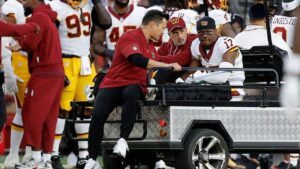
On Nov. 17, 2016, Kuechly made his 14th and final tackle in a Thursday night game against the Saints on Tim Hightower, but caught the running back's helmet under his chin strap. Kuechly fell backward and was then clipped in the back of the helmet by teammate Thomas Davis.
What followed was a scary scene that brought Charlotte's Bank of America Stadium to dead silence.
The Panthers' star middle linebacker and seemingly unbreakable leader was carted off the field while sobbing uncontrollably, the result of a second concussion in two years.
He would miss the remainder of the season.
Kuechly returned for the 2017 season and vowed not to change his physical approach to the game, but suffered another concussion and missed more time.
Despite his history of concussions and a nagging shoulder injury, Kuechly returned to play all 32 games over the next two seasons, earning him All-Pro first team in 2018 and second team in 2019.
But just weeks after the 2019 season concluded, Kuechly abruptly announced on the team's social media account that he was retiring from football, sending shockwaves throughout the NFL. Kuechly said he only knew one way to play the game — fast, physical and strong.
“I don't know if I'm able to do that anymore,” Kuechly said, as his eyes welled up with tears. “That's the part that is the most difficult.”
Carolina fans, who had come to adorn Kuechly with long cheers of “Luuuuuuuke!” after big hits and big plays on Sunday, had lost one of their all-time favourites.
“Fans, teammates, coaches, his family — everyone in Charlotte was heartbroken, just completely heartbroken,” Olsen said. “They were heartbroken for Luke because everyone knew how much he loved the game.”
Kuechly said he's at peace with the decision to walk away from the game while still in his prime, calling it “the right one.”
“I look at it from the perspective of this: I was so fortunate to have had the opportunity to play for eight years in the NFL and live a childhood dream," Kuechly said. "You can't beat that.”