It’s American Thanksgiving. Do you know where your NHL team is?
The U.S. holiday has long served as an unofficial measuring stick to gauge teams’ likelihood of making the playoffs. Put simply, clubs sitting in playoff position at this time of year have a roughly 75 per cent chance of remaining there by season’s end.
How accurate a benchmark is it?
While far from a perfect rule, it’s generally pretty accurate. Take the past two seasons, for example — of the 16 teams inside the playoff window at Thanksgiving in back-to-back years, 12 ultimately clinched a spot. The rate was higher in 2022-23 and 2023-24, with 13 sitting and staying in a playoff spot. To round out our five-year sample size of recent examples, the 2021-22 campaign also showed a 75 per cent clinch rate of teams in playoff position at the U.S. Thanksgiving mark.
Who are the most notable recent outliers?
When we think about noteworthy exceptions to this benchmark, the 2018-19 St. Louis Blues always jump to mind. By Thanksgiving of that season, the team was sitting last in the Central, lagging seven points behind the Dallas Stars for the second wild card spot, and had just made a coaching change by firing Mike Yeo and promoting Craig Berube in his place. (Of course, what made that squad particularly special was the fact they remained in last place early into the new calendar year, not launching their dramatic and historic comeback until January.)
While the Blues are the most extreme case, the past five years show some interesting instances, too — just look at last year’s standings.
The 2025-26 Buffalo Sabres brought us the closest thing to those 2018 Blues, sitting last in the Eastern Conference by November’s end, five points outside of the final wild card spot. By April, they’d clinched the top spot in the Atlantic and ultimately proved dangerous in the post-season. The Montreal Canadiens, the team that bested them in the playoffs, were also on the outside looking in at U.S. Thanksgiving, though barely, and leapfrogged the wild card race to finish third in the division.
On the other side of the equation, a collapse in the Metropolitan saw the New Jersey Devils fall from first place in the division to second last. The Capitals and Islanders also fell out of the picture after holding spots at the Thanksgiving benchmark, while the surging Philadelphia Flyers took advantage of the openings and sprinted down the stretch.
Things unfolded much less dramatically in the West, where the only significant movement post-Thanksgiving was the free-fall of the Seattle Kraken from third in the Pacific to being out of the playoff picture, while the Edmonton Oilers notably took their spot. Save for some jockeying for position in the Pacific, the rest of the West remained consistent, with no one able to disrupt the dominant top trio of Colorado, Minnesota, and Dallas in the Central.
Which brings us to this year — a season that’s brought surprising struggles from some squads and unexpected surges from others in the early-goings of the campaign.
Here’s what the Eastern Conference playoff standings look like today
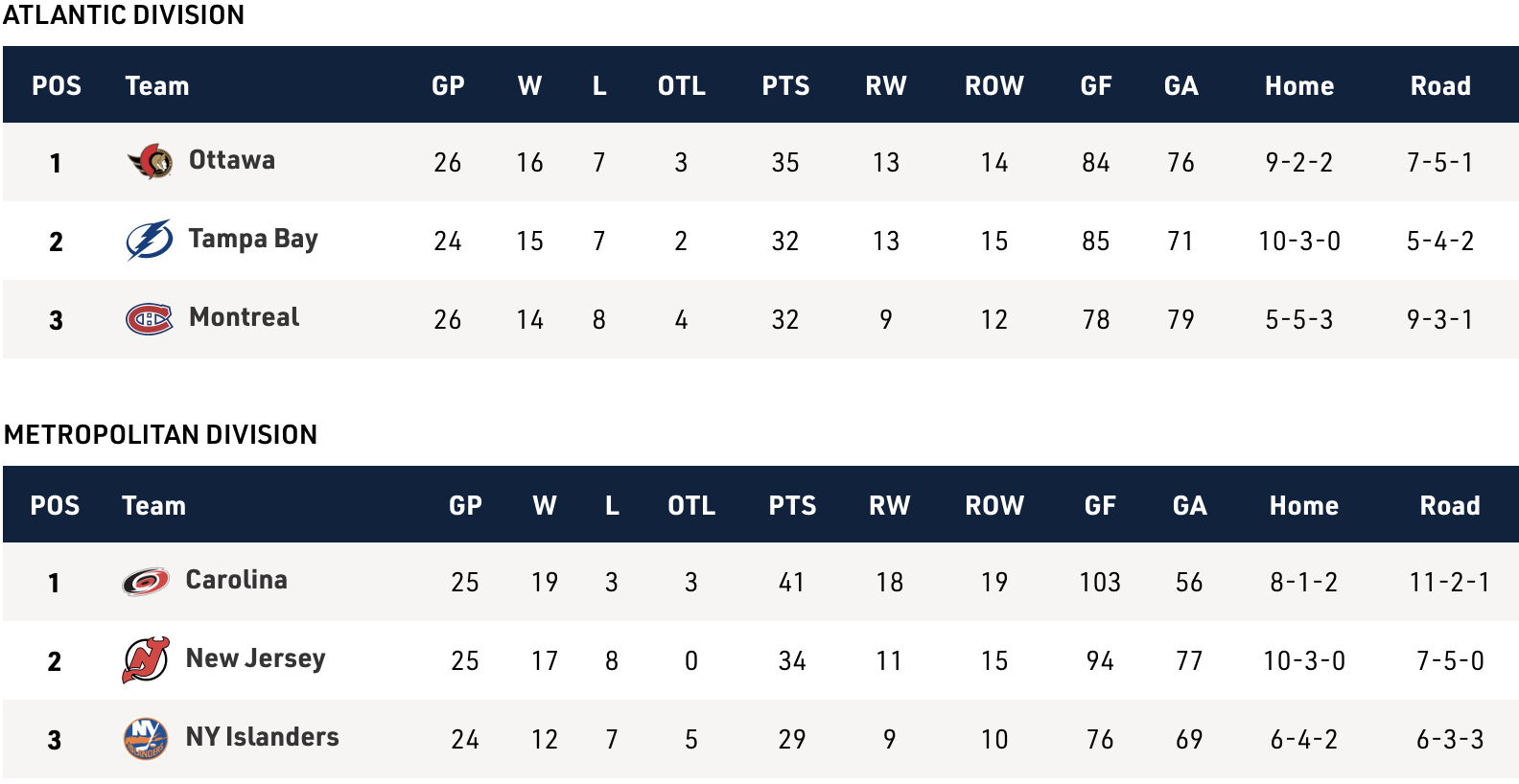
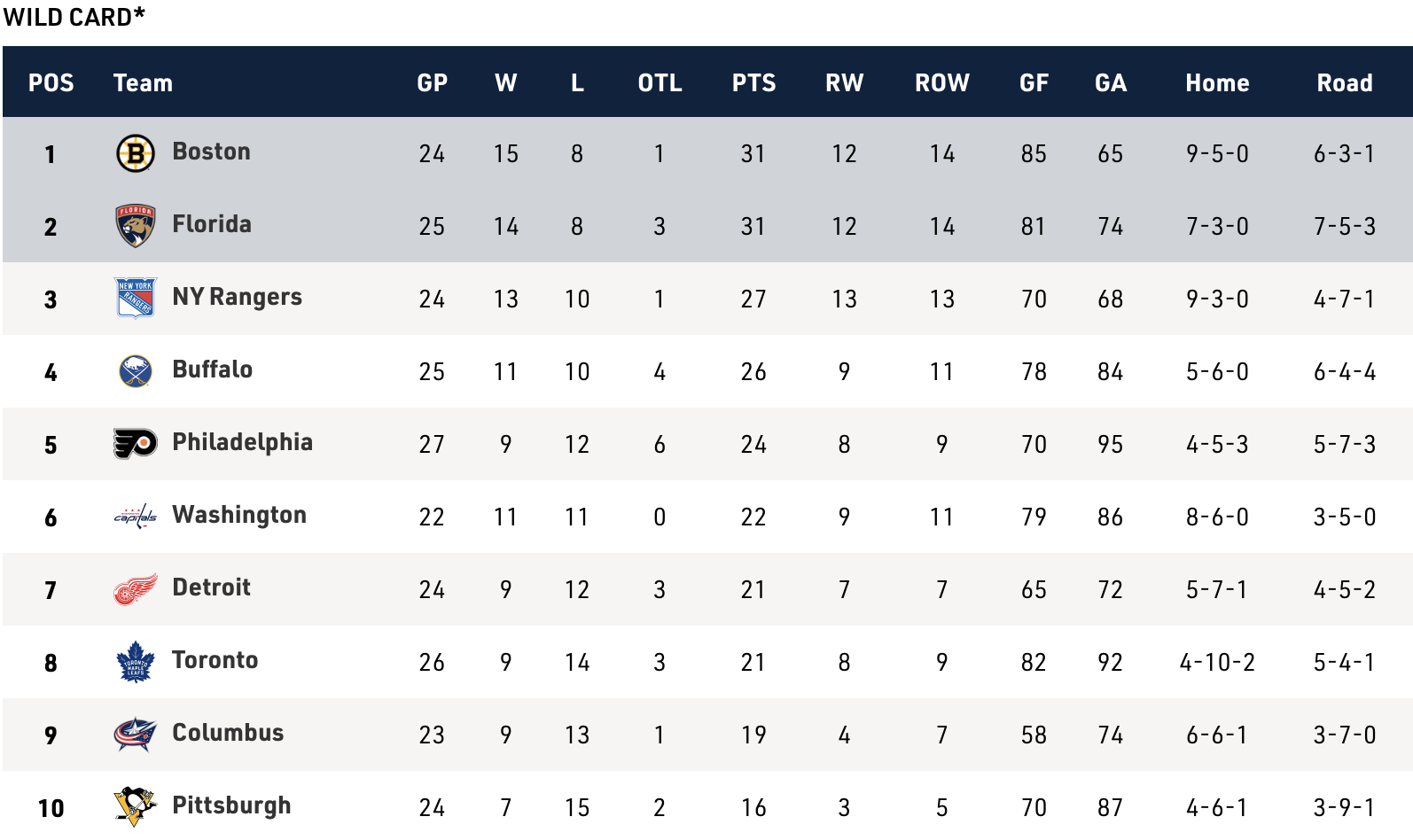
Unlike last year, when parity reigned in the Atlantic, we’re already starting to see some real separation between the teams above the playoff cutoff and those below. While only two points separate the New York Rangers from the Islanders in the Metropolitan, there is a five-point gap between the Florida Panthers sitting fifth in the Atlantic and the Buffalo Sabres in sixth.
Interesting teams to watch in the East:
Montreal Canadiens: Their acquisition of Dylan Larkin shouts their intentions of going all in to win, and their current playoff position amplifies that. And yet, we cannot help but notice the minus-one goal differential. A three-game losing streak opens the door for Boston or Florida to surpass them in the standings, and has them looking a little vulnerable. While there are few doubts about the abilities of this roster, especially once it’s back to full health, it’s worth wondering if we’ll see a few more growing pains before they hit full speed — and whether any challengers will try to take advantage.
Buffalo Sabres: After last year’s Cinderella-like run to the playoffs, it’s hard to muse about them doing it again. But while we can wonder whether the magic is there, we can clearly see the pieces that are not. The Sabres’ significant off-season losses, including Alex Tuch and Bowen Byram, and their swing-and-miss on landing big-fish trade target Connor Hellebuyck, raise questions about whether last year was the new norm or the outlier.
Washington Capitals: After falling out of playoff position last year and suffering a disappointing end to the season, the Capitals went on a shopping spree. All those new faces, plus Alex Ovechkin’s struggles as he makes his rounds for the final time, have resulted in a talented team that has yet to really gel. Can they make a run in Ovi’s swan-song season? What a fun story that would be.
Here’s what the Western Conference playoff standings look like today
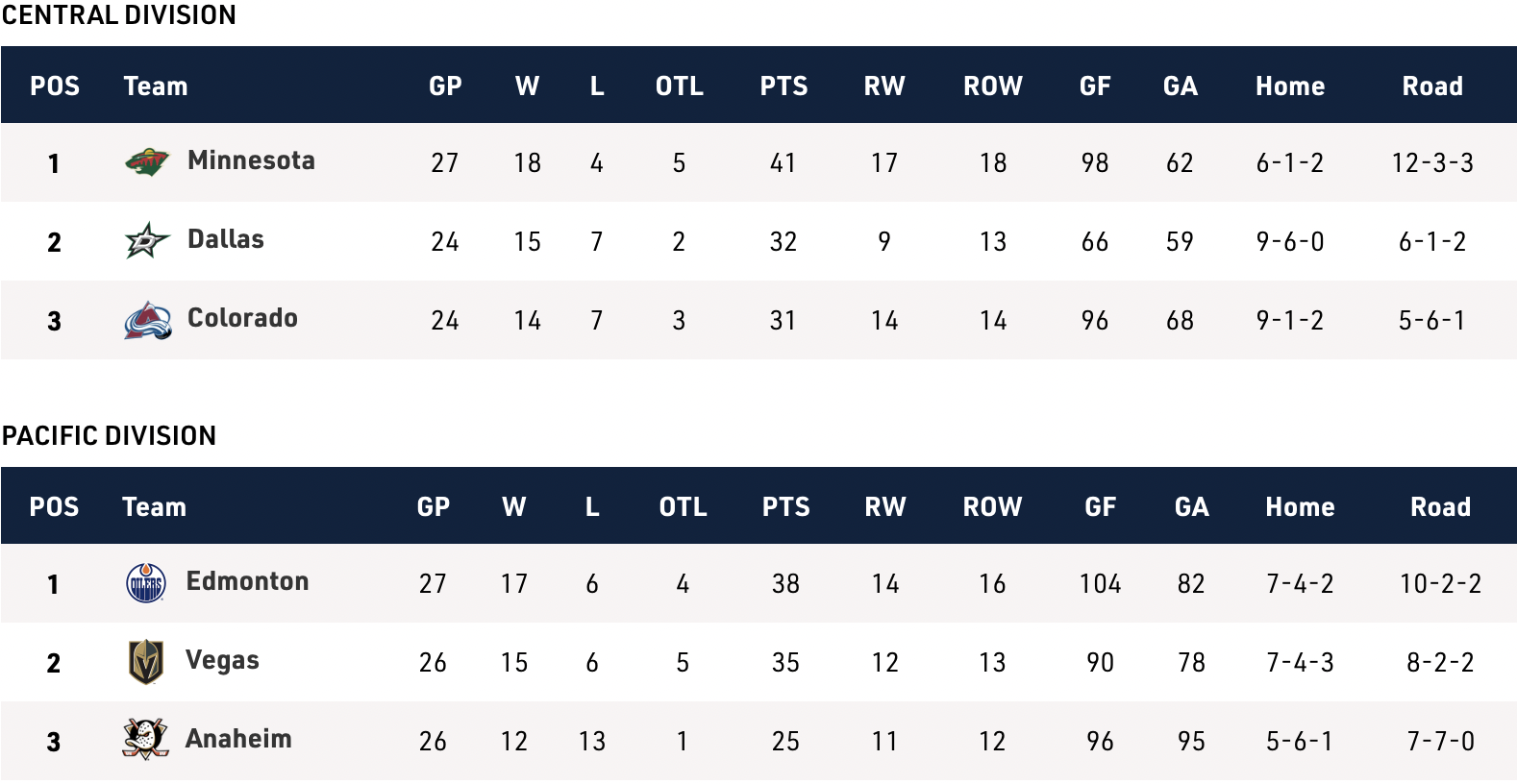
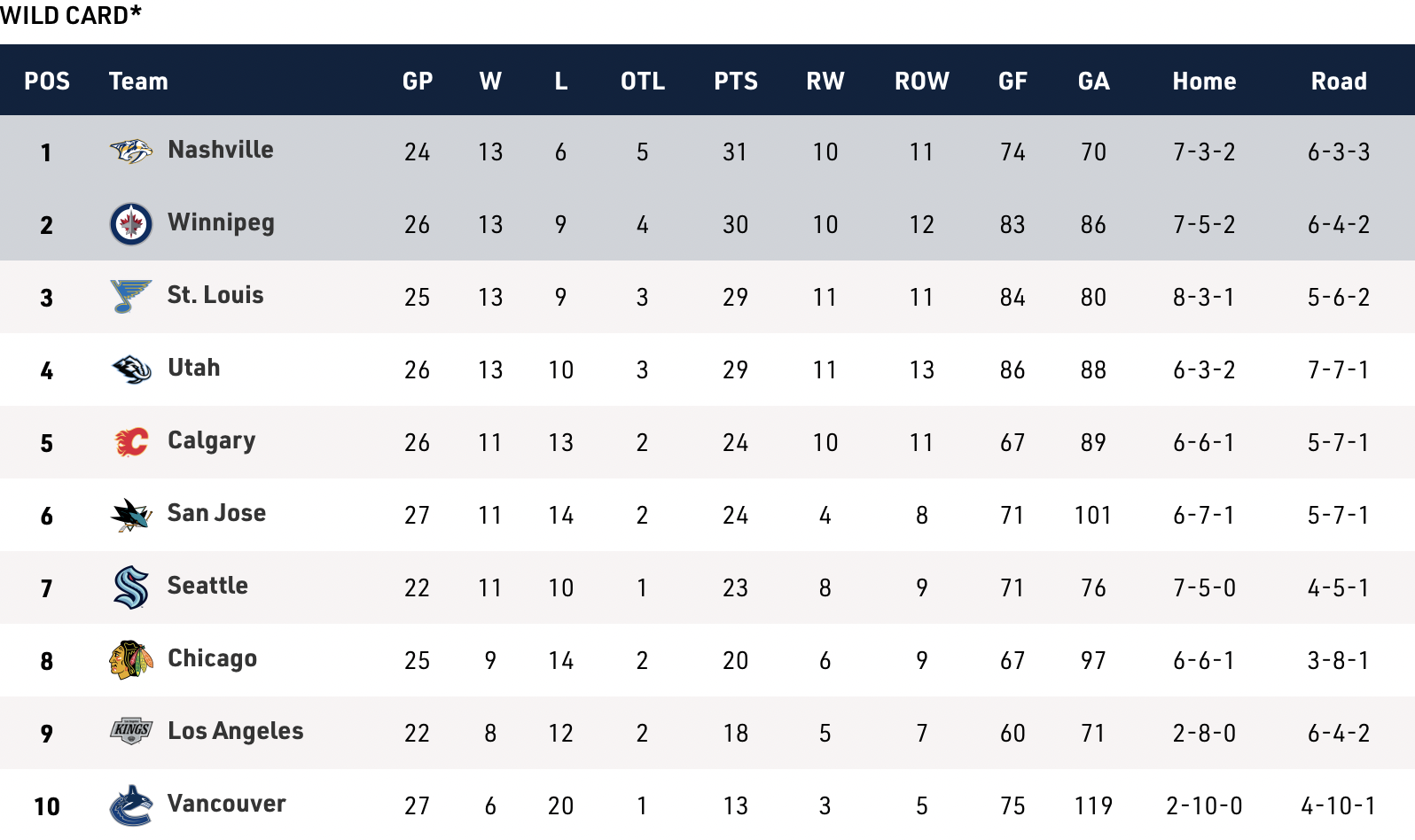
While the same three characters are leading the Central once again, this time it’s the Minnesota Wild setting the pace. After the Edmonton Oilers were the lone team last year to climb into the race post-Thanksgiving, they needed little runway to hit full speed this year. The same cannot be said about much of the rest of the Pacific, which has been slow to pick up. (Case in point: Earlier this week, Calgary woke up in playoff position, despite a sub-.500 win percentage.
After last season’s playoff picture looked more or less set in stone in the Central all year, things are looking different this time around as more challengers try to take advantage of Colorado’s recent slump.
Interesting teams to watch in the West:
Nashville Predators: Honestly, take your pick of Central teams. Save for the Wild, who have asserted their dominance with a nearly 10-point lead over their closest divisional foes, the Central looks far less certain than it did a year ago. Even Colorado looks vulnerable, thanks to injury setbacks for stars Cale Makar (now returned) and Nathan MacKinnon and surges from the teams sitting just below them. That the two wild-card teams are Nashville and Winnipeg is… surprising, to say the least. Both have jumped in on the power of remarkable win streaks — Nashville is 8-2-0 in its last 10, and the Jets posted an 8-1-1 record in theirs. While both are impressive, they share concerns, too, about their ability to truly contend. The Jets are the lone team in the Western playoff picture with a negative goal differential, while the Predators follow a similar pattern from years past of toeing the line between contending and rebuilding. Nashville’s second-place .905 team save percentage is hard to ignore. Can Juuse Saros keep up these heroics? And will GM Chris MacFarland make a statement about this team’s direction, one way of another?
Utah Mammoth: After a strong start to the season, the Mammoth have slowed down and it’s not hard to identify one of the biggest reasons why. Their .869 team save percentage ranks them 29th in the league, far below what their place in the standings should dictate. How the team looks at its goaltending — a blip on the radar for a typically strong Karel Vejmelka? An opportunity to give new-guy Sebastian Cossa a longer run? A door opened to go after a trade target? — will be interesting. We’ve seen Vejmelka back his team with confidence. Can he get his game back on track?