Many people in positions of power in the NHL, usually former professional hockey players, will tell you that one thing analytics can’t measure is heart. It’s become this uniting cry that holds up against Big Data, at least in the court of public opinion.
The Carolina Hurricanes are challenging the idea, which we’re going to get into today.
First: I get the desire to push back against numbers in hockey (generally speaking), which certainly don’t hold all the answers and aren’t what the game is about. This is a game made up of humans with human nature battling against themselves and others. It creates stories rooted in that truth, and that’s what we love to follow.
Both current and former players often don’t like numbers because in a dressing room, you know when a struggling teammate is battling an off-ice issue or an injury. You know when a coach likes one player more than another and puts them in a better position to succeed. You know that concepts like “positive regression” often take physical adjustments and effort, and that numbers miss these individual stories.
And finally, as a player, you also know the past is the past and it doesn’t have to predict what comes next. Each shift is a chance to rewrite the narrative about yourself. A guy with trash numbers can still have big moments (not sure why Miguel Rojas hitting a ninth-inning homer against the Jays in the World Series popped in my head here), so it doesn’t help to worry for 10 seconds about what the data has to say.

Real Kyper and Bourne
Nick Kypreos and Justin Bourne talk all things hockey with some of the biggest names in the game. Watch live every weekday on Sportsnet and Sportsnet+ — or listen live on Sportsnet 590 The FAN — from 4 p.m. to 6 p.m. ET.
Full episode
But a core principle in psychology is that past behaviour is the best predictor of future behaviour, so when you draw data from a big enough sample, it smooths out a lot of these individual ups and downs.
And so with that, there’s a fair case to be made that the data does measure heart. Because if you play with it, that means you demonstrate it regularly, so it will have a positive influence on your results and, thus, your numbers.
What stands out to me watching this playoff run is that the Carolina Hurricanes, both the “heart” side and the “numbers” side, should be getting what they want. The Hurricanes have used data to find guys who have routinely demonstrated a ton of heart and then handed that roster to a coach who demands a ton more of it, and suddenly the most analytically entrenched organization is also the team with the most heart. Which is funny, because heart is the very characteristic less analytically inclined organizations claim to be prioritizing as attribute 1A, only they’ve set out to find it by virtue of “We can just tell” vs. tracking past results.
To me, “heart” in hockey shows up in a ton of ways, but one of the most obvious is persistence and relentlessness. It’s exhausting to constantly skate hard, and the truth is, you often find yourself doing it in the cause of something that didn’t matter (like the player you’re chasing moves the puck well before you can get to them). Knowing that, it’s easy to conserve your energy and wait until you’re near the puck, but the Hurricanes don’t allow themselves that rest.
In Game 3, the Montreal Canadiens had more icings (15) than shots on goal (12), largely because the Canes' relentless forecheck ground them to powder, and so eventually Montreal started to just unload the puck as soon as they’d touch it, knowing they wouldn’t get much time to handle it, let alone to get their heads up.
To me, the NHL’s best forechecker over the past five years has been Zach Hyman, who, yes, does throw body checks, but he leads with his stick on the puck and then uses the following contact to push the defender's body to a place where playing the puck becomes a challenge. Hyman stops the defenceman retrieving the puck, and works for the first touch.
I grabbed just a few random clips from overtime of the Canadiens-Hurricanes game on Monday to show what I mean. Watch as the Canadiens go back on pucks and how it just seems like they never have two seconds to do something with it.

Maybe a better example is in the next clip, where the Canes aren’t clean on forechecks, but are pursuing puck recoveries. See if you can count to one full second that a Canadiens player gets to handle the puck before having to move it. They just kinda have to whack it up to the next guy, and no one has firm control.
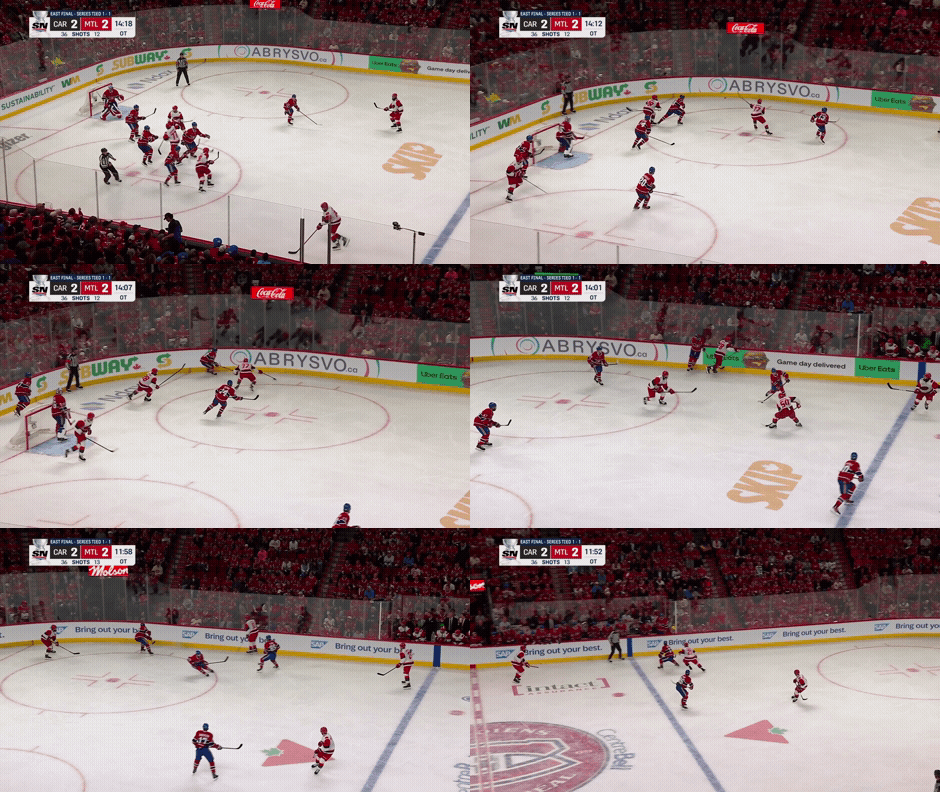
There’s just a maze of sticks; it has to be so frustrating to play against. I found as these games have gone on, Montreal’s defence — which is so talented and good at making little plays with the puck — was almost thrown off when it did have a second with the puck. Noah Dobson had some moments in the back half of the game where he seemed like he just didn’t want it, and would pass the problem off to someone else rather than find a solution.

It’s almost like the “rest vs. rust” debate wasn’t going to be settled in the first period of Game 1, but would play out the longer the games and series would go. The Hurricanes have run out of gas trying to play this way in past playoffs, but that long layoff is allowing them to keep the pedal down through three games in the Eastern Conference Final.
What’s fascinating now is watching how the greater media and hockey world is choosing to talk about the Hurricanes, who are 10-1 through 11 playoff games. To me, they are unquestionably the team that deserves to be lauded with praise for its heart and work ethic. The Hurricanes are doing what they are from Rod Brind'Amour's mould, and they’re doing it without superstars. The lack of top-end guys could catch up with them eventually, of course, but so far it hasn’t been their undoing.
Here’s what the expected goals look like for their four lines at five-on-five:
Staying on offence by checking is a demonstration of work ethic, heart and grinding, the very playoff-specific traits we have lionized for decades. Yet because the Hurricanes have been assembled using analytics to help identify the guys who’ve been shown to do that consistently, it seems incongruous to many.
In hockey, we love guys who have heart. In hockey we also sometimes hate analytics. But if analytics help you find the guys with heart, we’re … perplexed?
The good news is, you don’t have to care how the Canes were assembled. The players don’t have to look at those things either, they can acknowledge that they got a big goal from a forward in Andrei Svechnikov who needed one. They can credit sweat and pain for the grinding work that forced the Canadiens into making mistakes. They can credit their smart sticks and everyone can be happy.
Today, more than ever, hockey’s data analysts recognize that heart is an attribute of huge value in the NHL and, like everyone else, they seek to find it. Whatever helps you stay on offence is a win. The data confirms what these same players I’m talking about have correctly known forever: compile enough heart, and you’ll have a chance to win.