TORONTO — Mike Gillis wasn’t chasing goals, he was chasing culture when he made his aggressive pitch to free agent Mats Sundin.
The general manager of the Vancouver Canucks paid a hefty price to bring in a 37-year-old Sundin as a late-December gamble in the 2008-09 season.
That’s both in terms of dollars per goal — one of the greatest Maple Leafs of all-time, Sundin plummeted from 32 goals in his final Toronto season to a mere nine in 41 games as a Canuck, while raking in $5 million — and in terms of blowback from fans, media and fellow execs.
Gillis later explained that Sundin’s leadership and citizenship were more attractive to him at that point than the former Leafs icon’s on-ice production.
Vancouver had a young core of Scandinavian studs in need of a mentor. Sami Salo, Alex Edler and the Sedin twins all bubbled with admiration for Sundin. Seeing how a European Hall of Famer conducted himself at the rink and carried himself off it was invaluable, even if it was for just four months before Sundin hung up his skates.
“We got crushed for it, but he was instrumental in changing the fabric of that team,” Gillis later explained at the 2019 TeamSnap Hockey Coaches Conference in Toronto, addressing one of his most controversial moves.
“He elevated our level of professionalism internally, even though there was a cost associated with it. We didn’t realize people would be so critical of Mats. It took him a while to get going, but the level of criticism he got was just remarkable.
“We can’t even calculate the benefit we got out of that guy.”
Sundin, Gillis believes, improved the culture of a core that would enjoy the best years of Vancouver hockey and come one win shy of a Stanley Cup.
Now, funny enough, both men have been linked to a Maple Leafs front office in flux and in need of alignment and a culture boost. They share a mutual respect.
Sundin, whose No. 13 hangs from the Scotiabank Arena rafters, was in Toronto last week to discuss increased involvement with the franchise to which he devoted his best playing years. No doubt upping the profile of the classy 55-year-old Leafs legend in this city would be splendid PR.
Sundin would bring in the headlines and hook some drifting fans.
It is the 67-year-old Gillis, however, who would bring the hockey operations experience, having served as the architect of some elite Canucks teams and as a successful player agent before that.
Skepticism over Gillis running the show in Toronto stems from the fact that he hasn’t worked for an NHL team since being fired from the Canucks in 2014, but he’s an outside-the-box thinker who has always embraced sports science and analytics.
He has studied the U.S. military and teams in other sports to learn how to maximize human performance. Gillis credits his deep dive into sleep, recovery and nutritional science for improving the Canucks’ road record. He built algorithms around fatigue analysis and brought in specialized coaches for both offensive and defensive skills.
Many of these performance-boosting methods are now commonplace across the league. They weren’t when Gillis pushed the problem-solving in the early 2010s.
That Gillis already has a vision for how an NHL team’s front office should be structured and backs his decisions with data would make him attractive to MLSE president Keith Pellley, with whom he has reportedly met multiple times during the Leafs’ job search.
Gillis’s leaked pitch deck to be president of the Pittsburgh Penguins in 2021 — a gig that ironically went to Sundin’s final Leafs GM, Brian Burke — includes the following organization chart and stresses autonomy:
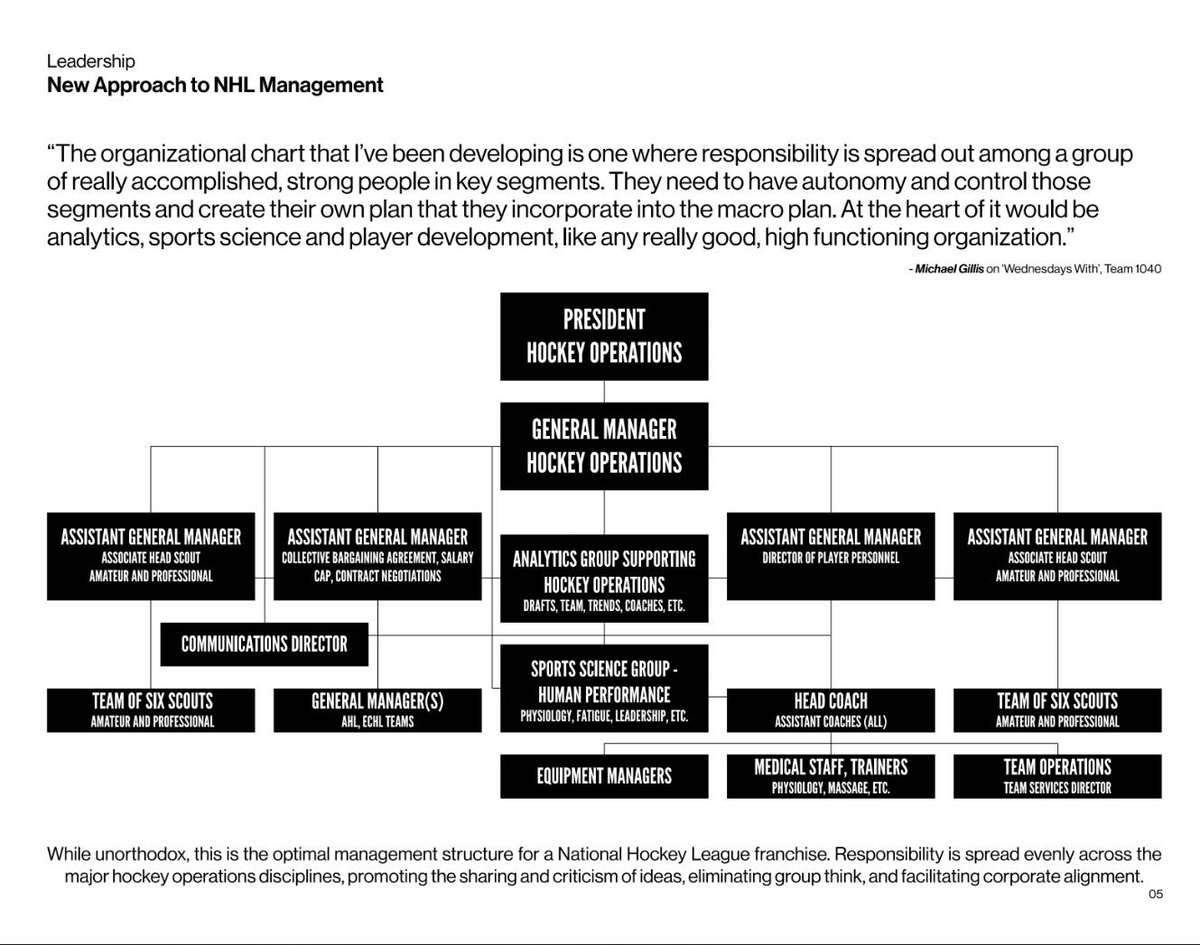
After studying best practices in other sports, Gillis believes hockey decisions must be made only after a thorough process that involves and empowers multiple stakeholders.
“I’ve thought long and hard about what an organizational chart should resemble for a National Hockey League team in today’s day and age,” Gillis told the On Air podcast in a fascinating 2021 interview. “Technology and analytics and human performance, that science is there, and it can be utilized in a really effective way, provided the organization wants to.
“General managers in Canada get way too much credit when things go really well, and they get way too much blame when things don’t go well. And if you had a high-functioning organization, it would include a variety of different people that were filling in roles that were highly critical to the team’s success, but were allowed to also participate in designing that team success and were part of the decision-making process.
“Where teams stumble is they don’t have a decision-making process. They don’t stick to it, no matter what the stress level is or what the circumstances are. You know, they’re kind of flying by the seat of their pants and not having a real plan to move the organization forward.”
Gillis believes players and surrounding staff must feel like they’re part of something bigger, a vision they understand, are committed to, and feel integral to.
“If those features are in place, I think you’re going to be successful. I know you are,” Gillis said. “If any of those features aren’t in place, your likelihood of success is remote.”
Today’s Maple Leafs do not have those features in place.
As Pelley phrased it upon firing Brad Treliving: “We didn’t have the alignment, we didn’t have the culture, we didn’t have the structure that we needed.”
Gillis has a specific idea of how a hockey team should operate and has claimed he can be “picky” about the next job he takes.
Just as the Maple Leafs are interviewing Gillis, he is interviewing them.
“I don't need to work in hockey in a way where I just have a job in hockey. If there isn't an opportunity to contribute and make changes and put things in place that you believe in over quite an extensive period of time of thinking and looking at them, then it’s not going to make sense to me,” Gillis said.
“If you have everybody contributing at an optimal level, you’re going to have success. And I have some firm beliefs in how to set that up, and there hasn’t been a place yet that was willing to view it that way.
“I think it’ll come, because other teams and other organizations and businesses are successful using organizational science to design the most optimal working environment. And if I can’t do that, then I'll do other stuff.”