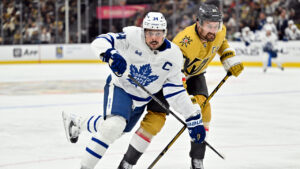
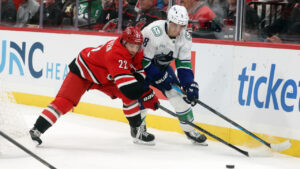
After seven seasons, plenty of tumult, and too little progress, the Yzerplan has officially come to an end in Detroit.
On Wednesday, the Red Wings announced that franchise icon Steve Yzerman would be stepping down as the club’s head of hockey operations, relinquishing his role as executive vice president and general manager and moving into a new position as a senior advisor to CEO and governor Chris Illitch.
The move brings to a close an ultimately disappointing return to the franchise for Yzerman, who played his entire 22-year career with the Red Wings — a Hall-of-Fame run that saw him captain the club to three Stanley Cup championships and establish himself as one of the most prolific offensive talents the game has ever seen.
In the wake of that sterling on-ice career, Yzerman’s front-office journey has been more of a mixed bag.
An eight-year run as general manager of the Tampa Bay Lightning saw him help the Bolts become a perennial contender, setting the stage for their eventual back-to-back Cup wins. Then came the return to Detroit in April 2019.
It was all hope and optimism then. Yzerman arrived with a sterling reputation, the Red Wings seemed to have the early seeds of a promising core, and the club held a top-10 pick in his first NHL Draft at the helm.
But seven seasons later, the Canadian icon’s tenure leading the Red Wings’ front office has yielded little. A playoff drought that sat at three years when he arrived — and seemed downright bizarre in those early years, after the franchise’s historic quarter-century post-season streak — has now snowballed into a 10-year drought.
The club finished seventh in its division the season before Yzerman was given the reins. It finished eighth in Year 1 of his tenure, and never managed to rise higher than fifth over the course of his seven seasons. Detroit enters 2026-27 in much the same position as when Yzerman took over — fresh off a disappointing campaign near the bottom of the division, with the playoffs looking a ways away, and true, meaningful post-season progress seeming a far-off dream.
Still, there were signs of progress for the Yzerplan, at least early on. As the 61-year-old’s run as Red Wings GM comes to a close, let’s take a look back at the best and worst of his time at the helm.
THE HIGHS
Landing foundational pieces in the draft
The first few seasons of Yzerman’s tenure were full of promise. In the club’s first draft with the former captain leading the way, Detroit added defenceman Moritz Seider with the sixth-overall pick — a curveball decision that surprised even Seider himself.
But Seider looked elite from the jump, winning the Calder Trophy courtesy of a 50-point rookie campaign that saw him log 23 minutes a night. Fast forward a half-decade, and coming off a career-best 60-point season that earned him Norris and Hart Trophy votes, Seider has become a pivotal leader for the Red Wings.
A year after drafting the German blue-liner, Detroit added winger Lucas Raymond fourth overall in 2020. He has since blossomed into a 30-goal, 80-point threat, and has thus far been the second-most productive player from his draft class, behind only Seider’s countryman Tim Stutzle.
Bringing in sniper DeBrincat
If there was one genuine win for Yzerman on the trade market, it was the 2023 move to bring in sniper Alex DeBrincat. After a promising run in Chicago and a lone season in Ottawa, DeBrincat was brought home by his boyhood club in exchange for Dominik Kubalik, Donovan Sebrango, a conditional first-rounder, and a fourth-rounder.
The 28-year-old has increased his production in each of his three campaigns as a Wing, culminating in a career-best 41-goal, 85-point season in 2025-26 — the first 40-goal effort from a Red Wing since Marian Hossa's nearly two decades ago.
Adding productive veterans
Dotted among a collection of largely uninspiring moves, there were some swings that seemed to land, namely a few that added some veteran savvy to the Red Wings’ young squad.
Netminder John Gibson was acquired ahead of the 2025-26 campaign — in exchange for Petr Mrazek, a second-round pick, and a fourth-rounder — to bring some stability to Detroit’s cage. Patrick Kane joined the Wings in 2023 and proved over a three-year stint that he can still move the needle in the twilight of his career. David Perron was signed in 2022 and posted one of the most productive campaigns of his career in Detroit colours. Shayne Gostisbehere was brought aboard for one season before heading back to Carolina and winning a Cup, and posted the second-most productive campaign of his career for Yzerman’s squad.
That said, there were plenty of other rolls of the dice that brought more mixed results. That brings us to the decisions that paved the way for Yzerman’s change of role this week.
THE LOWS
Too many questionable signings
While there were some worthwhile additions, the majority of the pieces added as part of the Yzerplan simply fell short of moving the needle. And others simply left the hockey world puzzled.
Depth pivot Andrew Copp was inked to a five-year deal at a $5.6-million AAV back in 2022 (the sixth-highest cap hit handed out by Yzerman in Detroit). Fellow middle-sixer J.T. Compher was signed to a five-year deal at $5.1 million per year.
Defender Ben Chiarot was signed to a four-year deal at $4.75 million per year, then extended at age 35 just this past January with a three-year, $11.6-million pact that takes him to age 38. Fellow blue-liner Justin Holl, at 31 years old, was signed for three years at $3.4 million per year — he often wound up a healthy scratch, was sent down to the AHL, and eventually traded out of town.
Too many swing-and-miss trades
There were costly misses on the trade market, too. The most significant might’ve been Jake Walman, originally acquired by Detroit in 2022 as part of a deal that sent veteran Nick Leddy to St. Louis after just half a season with the Wings.
After three years of seemingly steady progress for Detroit, Walman was traded to San Jose in a head-scratcher that saw the Wings throw in a second-round pick as a means of convincing the Sharks to take Walman off their hands, for nothing more than future considerations. The blue-liner then put up a career-best 32 points in 50 games with the Sharks, and San Jose flipped him to Edmonton for a first-round pick and a prospect. The Oilers just signed him to a seven-year, $49-million deal.
Then there was the deal that sent Anthony Mantha, Detroit’s 20th-overall pick in 2013, to Washington in exchange for Jakub Vrana, Richard Panik, a first-round pick (more on this in a moment), and a second-rounder. While Mantha has had a journeyman career of his own, the four-time 20-goal scorer had more of an impact in his subsequent stops than the pieces Detroit got back in the swap.
Incidentally, the 2021 first-rounder Detroit acquired in that deal (23rd-overall) was flipped to Dallas in a swap that saw Detroit trade Nos. 23, 48 and 138 to the Stars to move up to No. 15. With the 15th-overall pick, the Red Wings selected goaltender Sebastian Cossa, who wound up playing just one NHL game before being traded to Utah at the most recent draft.
And with the 23rd-overall pick, originally held by Detroit, the Stars selected Wyatt Johnston.
32 Thoughts: The Podcast
Hockey fans already know the name, but this is not the blog. From Sportsnet, 32 Thoughts: The Podcast with NHL Insider Elliotte Friedman and Kyle Bukauskas is a weekly deep dive into the biggest news and interviews from the hockey world.
Latest episode
Too used to the status quo
In truth, despite the handful of misguided signings and trades Yzerman authored, the pivotal flaw of his tenure leading the Red Wings’ front office might’ve been the moves he didn’t make. More than anything else, it was Detroit’s inability to build a competitive team around its young stars over the past seven seasons that led to Yzerman’s exit this week.
If there’s anything that will define the Yzerplan, it's the club getting stuck in the mud, getting stagnant, falling short in finding a path back to relevancy. Rather than aggressively building around what they had, too often, Yzerman’s Red Wings simply stood pat and got passed by.
Club captain Dylan Larkin — whose request for a trade away from his boyhood club last month likely factored into the organization’s decision to change direction — essentially said as much at the end of the 2024-25 season, when he called out his front office for not adding down the stretch.
“It was hard that we didn’t do anything,” Larkin said at the time. “We didn’t gain any momentum from the trade deadline, and guys were kind of down about it. It’d be nice to add something and bring a little bit of a spark on the ice, and maybe a morale boost as well.”
Answered Yzerman: “I’m counting on our best players, our leaders, to give us a bit of a morale boost. That’s what they’re paid for, and that’s the expectation from them.”
There’s no question that something more was needed. Year after year, the Red Wings faded late in the season, when a playoff berth was on the line — over the past four campaigns combined, the club put together a 17-35-5 record in March, winning just 30 per cent of those late-season tilts, and ultimately finishing on the outside looking in.
Making matters worse, the division around them has continued to evolve and improve. While Yzerman’s Red Wings were seemingly unwilling or unable to take the type of franchise-altering swings we consistently see from the league’s elite, the clubs around them have added, built, and found progress. A new voice will get the opportunity to lead Detroit down a similar path.