The Vancouver Canucks have the best record of any Canadian team in March at 8-3-1. That’s good for seventh-best in the NHL. What’s fascinating about their success this month is how they’ve achieved it.
Elite goaltending and the best power play in the league – that’s the good. An even-strength game that ranks near the bottom of the NHL offensively and defensively – that’s the bad. The Canucks are a team that is pulling in opposite directions lately with spectacular strengths and equally spectacular weaknesses.

We’ve covered the remarkable play of Thatcher Demko and why he should be in the Vezina Trophy conversation. So, let’s take a look at the three elements driving the Canucks’ recent power play success.
One – The Breakout
A major improvement on the Canucks’ power play this month is its ability to transition the puck up the ice and into the offensive zone. This had been a problem area for the Canucks this season, who in January and February ranked 22nd in successfully transitioning the puck from their own end into the attacking end. In March, the Canucks rank third in the NHL, doing so successfully 93 per cent of the time. These clean and successful breakouts have directly led to half of their eight power play goals in March.
The Canucks are throwing different looks at opposing penalty-killers and doing a good job of not only getting into the offensive zone to set up, but quick-striking as well, evidenced by this power play goal against Toronto.

Two games earlier against the Leafs, Tyler Myers led a breakout that looked like a reverse Flying-V. Jake Virtanen capitalized on a nice zone entry with a shortside goal.

There’s an element of unpredictability that is working for the Canucks on their breakouts lately. We all know Quinn Hughes can skate the puck, but their exits and entries have been working because they are using different schemes which makes it tougher to game plan against them.
Two – Shot Recovery
A critically important element to any successful power play is the ability to recover shot attempts to extend possession in the offensive zone. The Canucks have done a great job of doing this during their recent hot stretch on the power play.
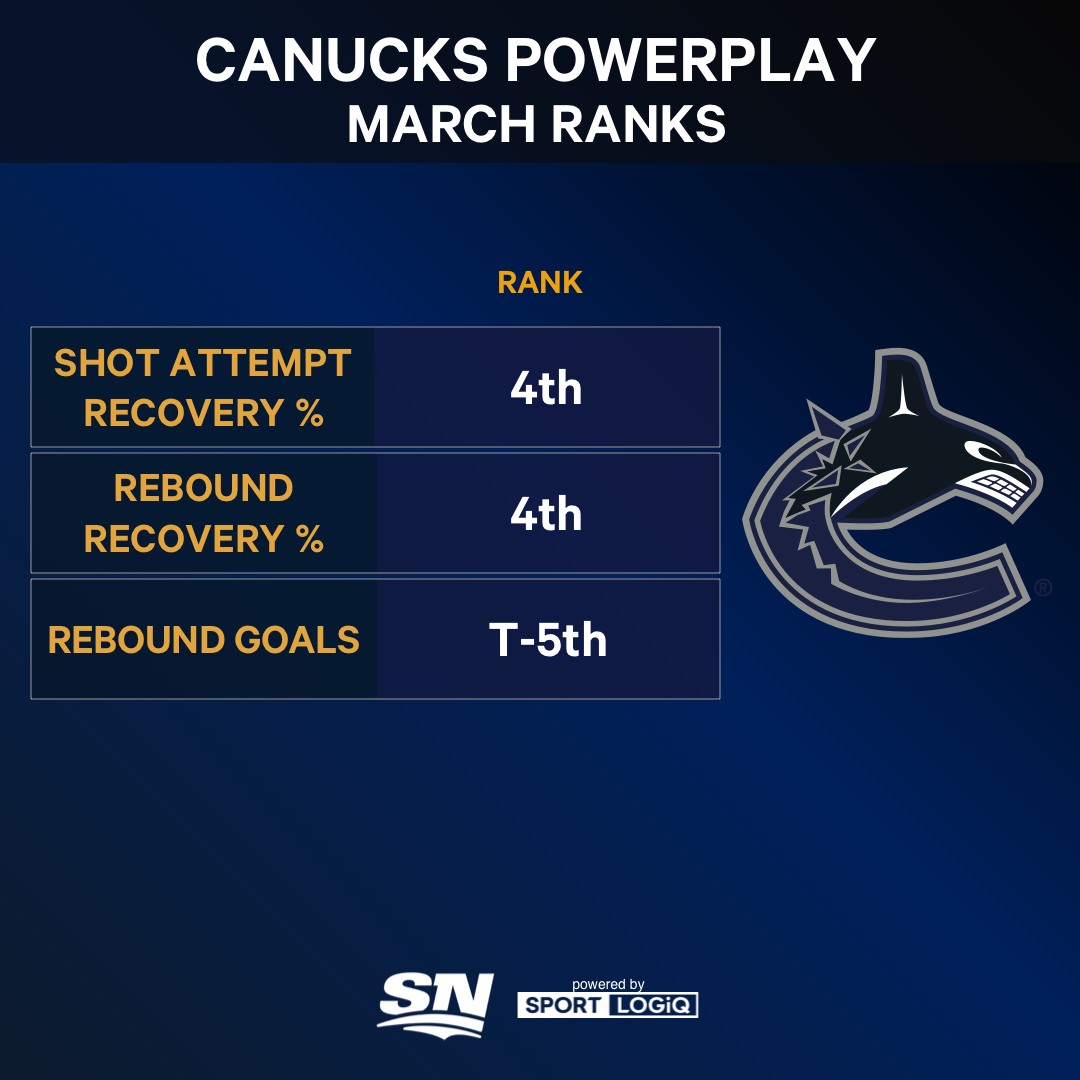
The best example of this was against the Edmonton Oilers when Bo Horvat recovered a shot attempt in the slot to maintain possession for the Canucks. Moments later he poked the puck into the net after a scramble in front of Mikko Koskinen.

Three – Brock Boeser
As important as it is to execute in areas like breakouts and shot recovery, having a guy like Brock Boeser who can wire one-timers is a nice luxury. Boeser’s booming shot from the left face-off circle is responsible for three of the Canucks’ eight power play goals in March. With Elias Pettersson out of the line-up, Boeser has stepped his game up in all situations including the power play. Boeser’s three power play goals in March are tied for fourth in the NHL.

With Horvat — who plays a pivotal role in the bumper spot on the power play — listed as a game-time decision, Boeser becomes that much more important for the Canucks on the man advantage.
Vancouver is already without centres Pettersson and Jay Beagle, and Horvat and Brandon Sutter are listed as day-to-day. If the Canucks are forced to play without their four starting centres, it will be pretty unfair to expect them to wind up on the right side of things at even strength. However, that is where Vancouver will have to improve to make a serious run at a playoff spot. Demko is keeping his team in games and the power play success in March has provided a welcomed and much-needed boost offensively. Before this month, the Canucks were converting at a rate of 15.9 per cent, good for 24th overall.
The special teams battle will be one to watch Wednesday as the Canucks get set for their rematch with the Winnipeg Jets. Both teams were 0-for-1 on Monday, but like the Canucks, the Jets’ power play is also converting on over 30 per cent of its opportunities in March – 30.8 per cent to be exact which ranks sixth overall.
[relatedlinks]