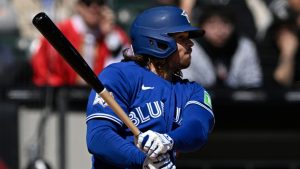
Getting Addison Barger back over the weekend won’t be a cure-all for the struggling Toronto Blue Jays, but his skill set neatly matches what the team is lacking.
The slugger got off to a rough start in 2026, but he’s coming off a season where he hit 21 home runs and slugged .454, the kind of numbers that would be helpful to a team that currently ranks 22nd in round-trippers.
Barger should provide a major upgrade on the .203/.260/.301 line Toronto is getting from its right fielders, resulting in a dismal 55 wRC+. He’s also likely to hit fourth — a spot where Toronto has gotten a mediocre 98 wRC+, good for 18th in the majors.
In Barger’s absence, the Blue Jays have struggled to hit for power overall and get production from his spot in the lineup or position on the field. They’ve also lacked the most important offensive element he brings: left-handed punch.
Lineup talent is more important than lineup balance, but many pitchers are far better at retiring hitters when they have a platoon advantage. Batting orders without credible threats from both sides of the plate are much easier to exploit in the late-inning matchup game and are vulnerable to certain starters. So far, that description fits the Blue Jays, who have gotten far more production from righties than lefties.
The Blue Jays entered 2026 expecting to get strong production from right-handed hitters, largely thanks to the presence of George Springer, Alejandro Kirk and Vladimir Guerrero Jr. — with Kazuma Okamoto as a high-upside wild card. However, the numbers from their left-handed hitters have come in well below expectations. Not one of them has a wRC+ above league average, outside of Yohendrick Pinango, who has fewer than 10 MLB games under his belt.
Andrés Giménez’s 91 wRC+ is hovering around reasonable expectations, and Nathan Lukes had his numbers dragged down by vertigo issues early in the year before landing on the IL. That means the shortfall of difference-making hitting from the left side primarily lies with two hitters: Daulton Varsho and Jesús Sánchez.
Daulton Varsho
To be fair to the centre fielder, his 97 wRC+ isn’t far from his career number (99), and his .716 OPS beats his 2023 and 2024 marks. With strong defence at a premium position, his overall contribution is strong.
Even so, coming off a season in which he slashed .238/.284/.548 and hit 20 home runs in just 71 games, the Blue Jays could’ve reasonably expected more offensive impact. The 40-plus home run season he was on pace for in 2025 was never in the cards, but something that built on last year didn’t seem like too much to ask. The Blue Jays might yet get that, but the shape of Varsho’s early-season production isn’t suggesting it. Not only are his overall offensive numbers middling, but the power that drove his success in 2025 is also absent.
Varsho has never been a Statcast wizard, but his average exit velocity of 85.7 m.p.h. is in the ninth percentile, and his expected wOBA on contact (.338) is way down from last year (.434) and below his career average.
One factor driving that lack of forceful contact is reduced bat speed. Varsho’s average swing (73.1 m.p.h.) is significantly slower than it was last year (75.6 m.p.h.). In 2025, he ranked 36th of the 671 hitters who took at least one swing in the majors. This year, he’s 145th out of 471. That’s still above average, but not close to elite.
That drop, combined with a major decline in sprint speed from the 77th percentile last year to the 40th percentile in 2026, shows Varsho isn’t as explosive athletically right now as we’re used to seeing. That could be as simple as lingering effects of a knee issue in mid-April that may wear off at any time, or it could be a broader concern.
Either way, the result is that Varsho has been essentially the hitter he was in 2024 in terms of overall effectiveness, rendering him an adequate lineup cog rather than an impact bat from the left side. He’s cut down on whiffs and strikeouts, but any gains have been erased by weak contact.
Jesus Sanchez
Sánchez’s production has to be more concerning for the Blue Jays than Varsho’s, considering he has spent more time in crucial spots in the team’s order and provides minimal defensive value.
The 28-year-old got off to a hot start in the first few games of the season but has hit an ugly .210/.234/.340 since April 1. Unlike Varsho, he has some solid contact quality and expected numbers, but much like his fellow outfielder, his bat speed has fallen off — dropping from the 93rd percentile in 2025 (75.9 m.p.h.) to the 63rd in 2026 (73.1 m.p.h.). His sprint speed has also fallen from the 40th percentile to the 21st.
Much of Sánchez’s struggles have come from poor swing decisions as he’s chasing a far higher percentage of pitches outside the zone in 2026 (40.8 per cent) than he did last year (30.6 per cent) — resulting in a plummeting walk rate.

The results alone could be interpreted as a slump, but a large part of the appeal of Sánchez when he was acquired was his bat speed — and the latent power potential it hinted at. That is now coming into question, and he needs to clear the wall with some consistency to be valuable, as he’s a suspect fielder and runner who isn’t getting on base at an impressive clip. A healthy Lukes would likely be eating into his playing time, and Pinango may prove an existential threat if he continues to show well at the major-league level.
When the Blue Jays began the season, Barger looked like the team’s best candidate to wield a game-changing lefty stick, but Varsho had flashed a new level of power production, while Sánchez had a quick bat and a track record of success against right-handed pitching.
Nearly a quarter of the way through 2026, Barger remains the team’s best internal hope for lineup balance. What other left-handed hitters have done in his recent absence has only clarified his importance to the middle of the Blue Jays' order.