With the trade deadline fast approaching, teams have to focus on filling specific needs for the playoffs as they examine the marketplace. It’s very rare that you can land a player who truly transforms your team, although a couple of those types are available this season. Teams are more likely going to address weaknesses in certain areas of the roster.
That means you might not be trading for the best player available, because that player may not fill your team’s need. With that in mind, we decided to do a short series of articles that focus on specific skill sets and identify who the best players are in each category. The first area we’re focusing on are the best available goal scorers.
It would be easy enough to pull up a trade bait list and sort by goals scored, but that isn’t always a great predictor of goals to be scored heading forward, so we’ll dig in a little bit deeper.
Let’s look at 5-on-5 scoring first.
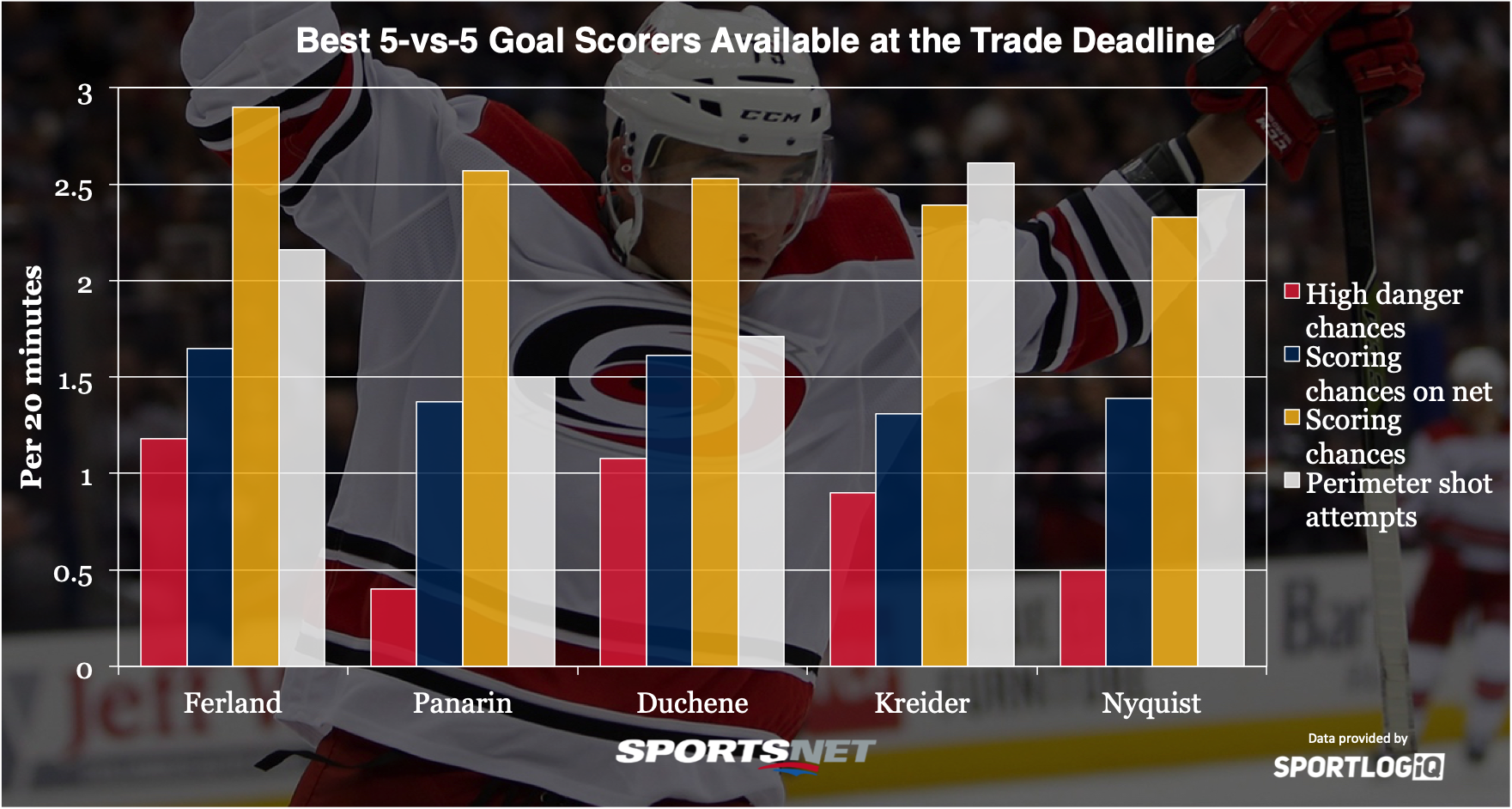
The key thing to note is that there is more than one way to score goals and be consistently effective at it. Obviously, the ideal that most coaches strive for is to create as many high danger chances as possible, which makes sense because the closer you get to the net the higher your expected shooting percentage is. But sniper-type players tend to shoot from the high slot where there’s a bit more space and time, and where you’re more likely to receive a clean pass.
If what you’re looking for at the deadline is a player who gets to the dirty areas, though, look no further than the highly marketable Micheal Ferland, who has been brilliant this season for the Carolina Hurricanes. He leads the field in high danger chances and scoring chances overall, but the problem is the Hurricanes might not be as keen to sell him as they were earlier in the season. They’ve been surging lately, both in games and post-win celebrations, and are just a single point back of the Montreal Canadiens for the second wild card spot, plus Carolina has more regulation and overtime wins so the tiebreak leans their way.
Unfortunately for buyers, that means the already-lofty price for Ferland’s services is likely to be even higher. But a team that needs a net-front finisher is probably willing to pay that price if they see themselves as a legitimate contender, especially if they believe they can extend Ferland.
Artemi Panarin barely needs an explanation; he’s the best player available at the deadline, period. He’s a transition beast, scores from everywhere with a deceptive wrist shot that can beat goalies both off the rush and cycle. He’s clearly one of the best scorers available, but he’s also one of the few transformative players who have been available at the deadline in recent years.
Matt Duchene is probably the big surprise on the above graph. That’s not because he can score – we always knew that — but because he’s been so willing to get to the dirty areas to do it. Centres don’t often get to the net front and instead focus more on playmaking than scoring. Even shoot-first centres like Steven Stamkos usually tend to set up at the edge of the slot as snipers to finish off plays. Duchene, amidst a disaster season for the Senators, has been incredible this season, showing great versatility as a goal scorer and playmaker. His speed off the rush is apparent, as is his nose for the net once the zone has been gained.
Chris Kreider is another versatile scorer who also happens to be one of the better defensive wingers in the game today. He can attack and score with speed off the rush, and he can use his size to fight through checks to score in tight. That he’s on pace for a career year in goals may lead to Kreider being a very expensive buy at the deadline, but he’s worth it.
Gustav Nyquist is a player who seems to fly under the radar because of the extremely high expectations placed upon him after scoring 28 goals in 57 games in his first full NHL season. He’s never been able to match that 18.3 shooting percentage since — and in fact he’s scored on less than 10 per cent of his shots for the past three seasons, — but he shoots a ton at even strength and I think he’s a player who would thrive on a team with more depth than the Detroit Red Wings.
Nyquist may only be on pace for 21 goals this season, but he’s been terribly unlucky on the power play and is on pace for 19 even strength goals, which is actually quite a lot.
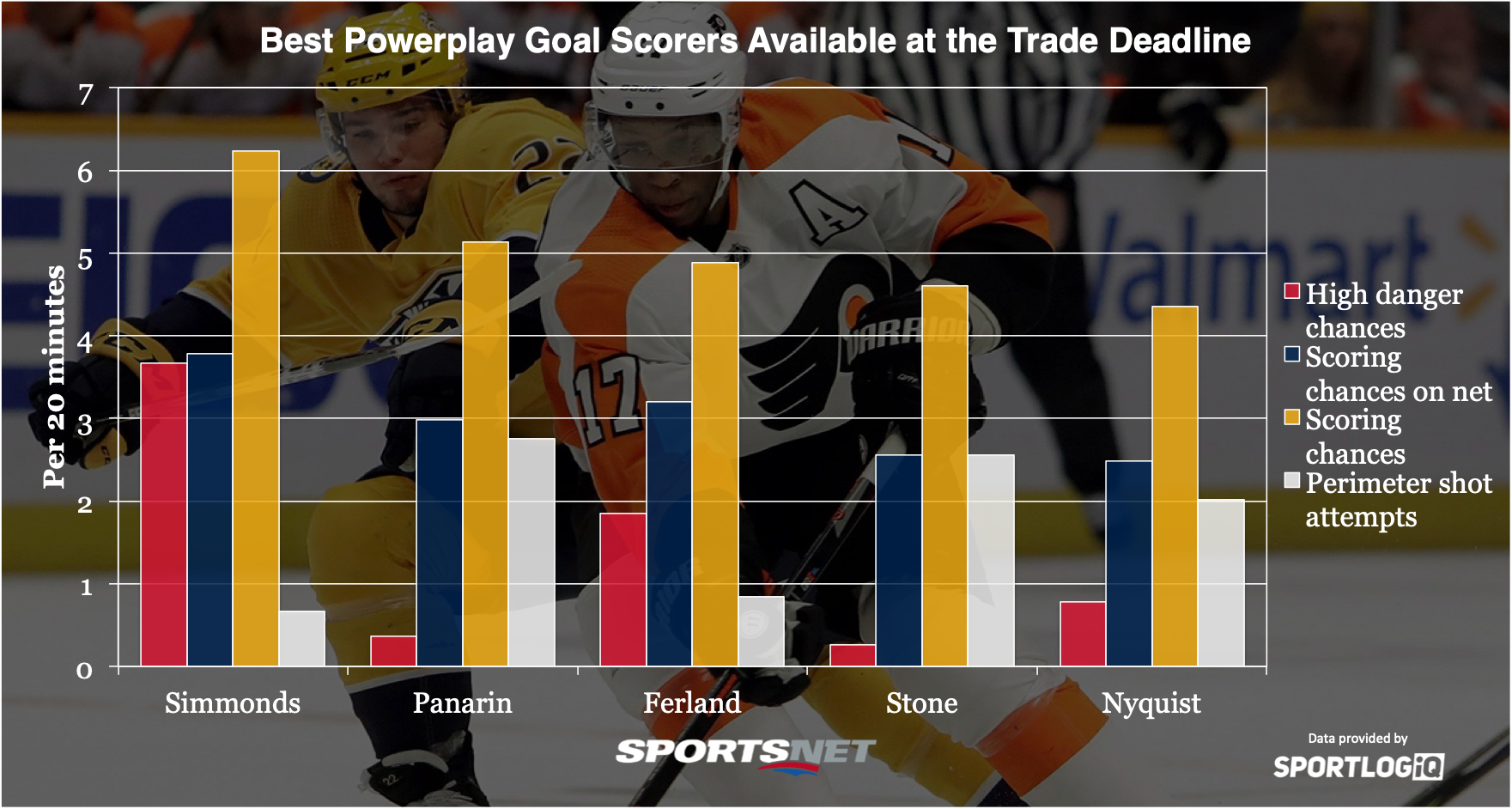
Though I warned against spending too much on him recently, there’s no better power play net front presence available at the deadline than Wayne Simmonds. He deflects pucks well, and his ability to win battles for loose pucks and roof rebounds is among the NHL’s elite with the man advantage.
Over the past couple of seasons the only player to get more chances in tight on the power play than Simmonds has been James van Riemsdyk, who the Flyers recently paid big money to as an unrestricted free agent. That, combined with injuries, has depressed Simmonds’ internal value a little bit, but he could be a big difference maker for someone else’s struggling power play that needs more focus on getting shots from in tight and screening goalies.
Panarin appears here again — his laser wrist shot from the high slot is a highly dangerous weapon for any team. His ability to make plays also forces defenders and goalies to be careful not to overplay his shot, which only makes it easier for him to pick an open space.
[snippet ID=3322139]
If a team misses out on Simmonds to boost their power play, the next best option is Ferland, who comes with the bonus of being a great 5-on-5 scorer as well. Ferland gets up to the same tricks on the power play that we saw above, shooting from a bit further out than Simmonds on average, but getting a higher proportion of his scoring chances on net.
Mark Stone is already having a career year in goal scoring with 28 in 59 games, and one reason why is he’s shooting a bit more dangerously on the power play. He’s not going to sit in front of the net because that would be a waste of his skill set — he’s similar to Panarin in that he forces defenders and goalies to respect his playmaking ability and give him space.
Stone has a deadly shot, with a career average shooting percentage of 16.2, and a 19.3 per cent shooting rate this season. He’s also the best defensive winger in the game, and a smart transition player. Stone isn’t quite as highly impactful as Panarin, but he’s at the same elite level that can turn a team from good to great.
Lastly we have Nyquist again, who has been putting in the work and rifling shots at the net from the slot, but only has one power play goal to show for it this season. I fully expect that anyone who acquires him would see a big uptick in scoring due to some overdue regression to the mean alone, not to mention a bit more talent around to surround him with.
[relatedlinks]