ARLINGTON, TX — All told, the Toronto Blue Jays have had better weekends.
A stuff-dependent staff ace featuring the lowest velocity of his career on Friday, performing so concerningly that he’s sent out for an MRI the next day. A litany of defensive miscues, including an ugly sequence — walk, hit batter, throwing error, wild pitch — that led directly to Saturday’s game-winning run. A lineup linchpin mired in a never-ending slump exiting on Sunday due to an injury he’s carried for most of the season.
And the lone consolation, salvaging a 7-2 win over the Texas Rangers on Sunday to avoid a sweep, is potentially too little too late. The Blue Jays already lost ground in this series to a direct contender in an American League wild-card race rapidly running away from them. And they have no remaining games against teams they trail, meaning they can only do so much to reverse the once-surging post-season odds that have cratered at their feet:
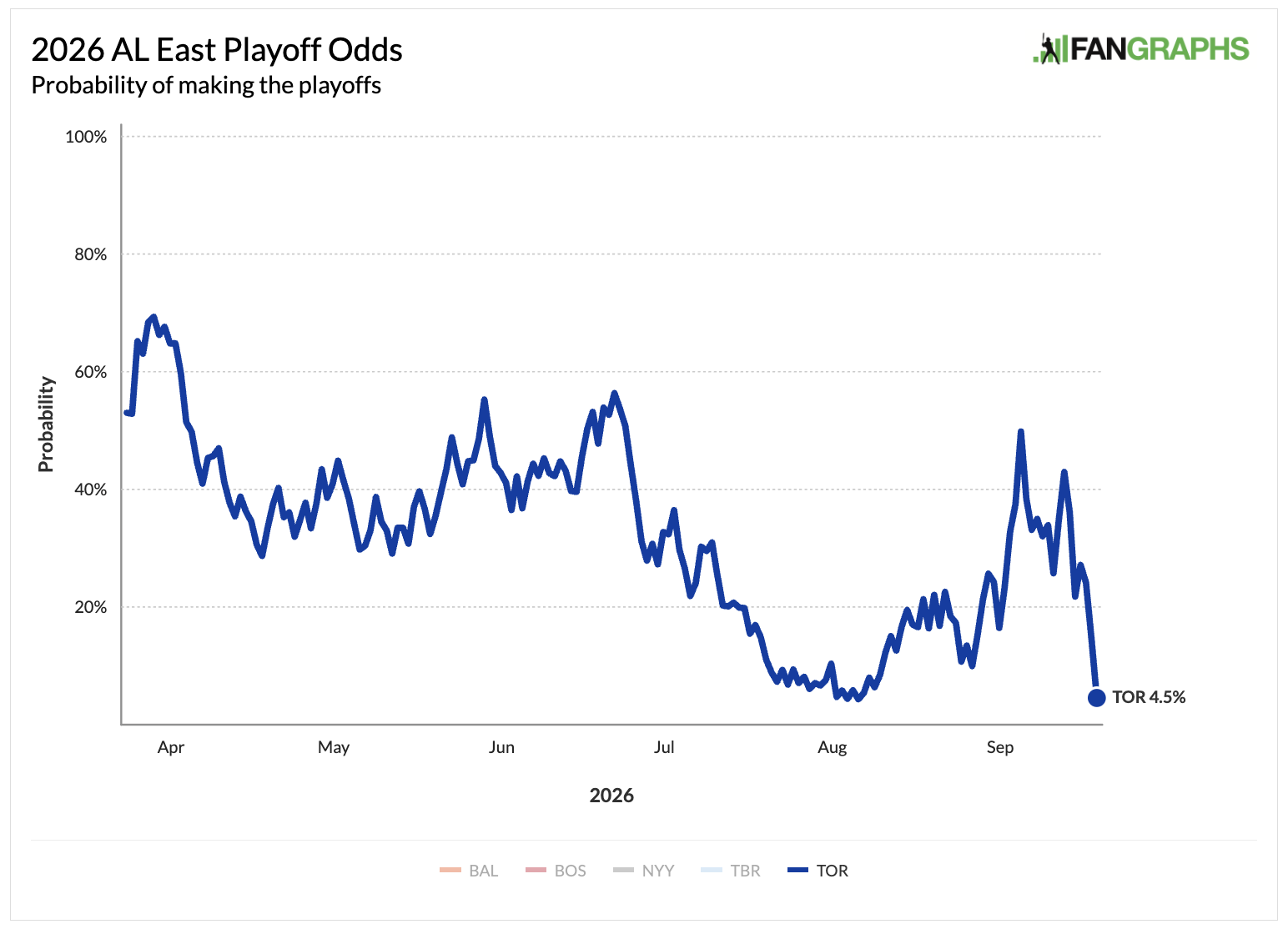
That peak to the right was Sept. 4 after the Blue Jays took the opener of a series in Kansas City, 9-2, on a run of eight wins in 10 games. Above .500 for the first time since early April when the season was only 9 games old, Toronto held a share of the American League’s third wild-card spot (technically it was theirs alone thanks to possession of a tiebreaker over Cleveland) with fewer than 20 games remaining and a run of exclusively sub-.500 teams before them.
That’s when the bottom fell out. The Blue Jays lost eight of their next 12, averaging 3.58 runs per game with a -14 run differential. And they were remarkable frontrunners along the way, with only one comeback win and one blown lead loss. Since July 29, the Blue Jays are 18-3 when scoring first — the highest winning percentage in the majors.
That’s fine if you frequently score first. But what if you concede the first run, as the Blue Jays have in two-thirds of their games over the last two weeks? Then you need the resilience to battle back, which the Blue Jays have done only once over the 9 times they’ve fallen behind early since Sept. 4.
The good news Sunday was the Blue Jays got on the board quickly, as Brett Bateman drew a leadoff walk, aggressively took third on a Vladimir Guerrero Jr. chopper the other way, and scored on a Nathan Lukes sacrifice fly. They cashed another with two out in the third when Lukes, who reached via single, took off in a 1-2 count and scored as Sean Keys laced a double over his head into right-centre.
In the fifth, Bateman walked again, reached second as Myles Straw singled behind him, took third on a Lukes flyout, and scored when Kazuma Okamoto bounced a base hit back up the middle. Similar story in the seventh, when Bateman doubled, Straw walked, and Lukes singled in a fourth run. Later in the inning, Charles McAdoo’s two-out, two-strike double brought in a couple more.
If the Blue Jays aren’t going to drive the ball consistently — Toronto’s .265 slugging percentage over the week of play entering Sunday was dead last in MLB — this is how they’ll need to generate offence. Working deep counts with a measured approach. Stringing together hits and walks. Starting runners in unusual situations. Taking calculated risks on the basepaths. Competing with energy up and down the lineup.
“Just put good at-bats together. Be a dog, get on base,” Bateman said. “That’s all you can ever do.”
It was particularly encouraging that the Blue Jays took such high-quality plate appearances against Rangers starter Jacob deGrom, who may be 38, but remains Jacob deGrom. His fastball’s still 97-m.p.h. with a ton of induced vertical break — its backspin fights gravity, making it appear to be rising as it approaches the plate — while his slider is tied for the 10th-highest run value of any single pitch in the majors this year.
“It's a good approach against a really good pitcher. And on a day like today, you need that when you're running through the bullpen,” said Blue Jays manager John Schneider. “Up and down, just kind of grinded him and got his pitch count up.”
No one did that better than Bateman, who saw 30 — 30! — pitches on the day, including 19 from deGrom. Feeling that he’d grown too aggressive over his last five games — Bateman didn’t have a walk over that stretch but still went 6-for-21 — the 24-year-old leadoff hitter vowed to make an adjustment Sunday and exhibit more discipline.
“I told myself today, I didn't want to chase against deGrom. He has really good stuff and I was just like, ‘If I get out swinging at good pitches or pitches in the zone against a guy like him, I'll be happy with it,’” Bateman said. “I want to be aggressive because I think a lot of pitchers think, 'Oh, he doesn't hit for power, let's go at him. Let's not let him get on base.' But at the same time, I want to be a little more selective. Just to mix it up.”
After expanding twice while still working a walk in the first inning, Bateman put a strike in play during his second plate appearance and worked a determined, 10-pitch walk in his third, refusing to chase any of the four pitches deGrom threw him outside the zone while fouling off 97-m.p.h. fastballs both in and away.
“I love long at-bats. Love them,” Bateman said. “If you're not going to hit for power, you have to do something in the box. Any at-bat over eight pitches, I don't care if I get out. I don't mind at all. Especially against a starter like him.
“All you want to do is run up his pitch count. If I get out with a 9-, 10-, 11-pitch at-bat, that's two to three at-bats for one guy. That can get rid of a whole inning for a starter. I feel like I did that. I'm pretty happy with my at-bats against him.”
Meanwhile, Guerrero was lifted from the game following the fourth inning due to left lower back tightness, an issue he’s battled off and on throughout the season. Guerrero aggravated the injury Friday, attempting to corral a wild Kazuma Okamoto throw at first.
Sunday, he didn’t get out of the box well following either of his plate appearances, carrying his bat halfway up the first base line in a deliberate jog after hitting a groundball back to deGrom in the third inning.
“It was a little tight before the game,” Schneider said. “So, just wanted to be careful. Hopefully he's good for tomorrow.”
Losing Guerrero for any of this week’s three-game set in Baltimore would be another blow after Dylan Cease was bumped from his scheduled Wednesday start after flying to Toronto on Saturday for an MRI of his right shoulder, which he’s been battling fatigue in for weeks. That means Toronto’s pitching plan for the series is currently: bullpen day, Max Scherzer, TBD.
It’s a hell of a way to live following Sunday’s bullpen day and a Rangers series in which Toronto starters combined for 10.2 innings while relievers covered the remaining 14.1. But some stability came in the form of Spencer Miles providing the Blue Jays an excellent, needed three innings to open Sunday’s game, allowing only two hits while striking out four.
Of course, starting Miles reflected the urgency of this moment. He was originally being held for Monday to support Trey Yesavage, who will come off the IL to start vs the Orioles but is capped at three innings or 45-50 pitches — whichever comes first. But following losses in the first two games of this series, while both the Cleveland Guardians and Chicago White Sox won on Saturday, the Blue Jays chose to bump Miles up and put everything they could into salvaging Sunday’s win.
The gambit worked. Yet the competition didn't cooperate as Cleveland and Chicago both won again. That leaves the Blue Jays effectively four games back of the White Sox for the third wild card spot when factoring in the tiebreaker. It also decreases Toronto's post-season elimination number to three.
Say the Blue Jays sweep their final two series. That would give them 83 wins. Both Cleveland and Chicago would only need to go 3-3 over their remaining games to top that. Say the Blue Jays go 5-1. Then those AL Central teams only need to go 2-4. If the Blue Jays go 4-2, the Guardians and White Sox can eliminate them by finishing 1-5. Lose three more times and the Blue Jays will eliminate themselves regardless of what happens in the AL Central.
That's why Toronto will wake up Monday with lower post-season odds than it had Sunday. It's a precarious position. Just add it to the list of misfortunes from what was already a weekend of setbacks for the Blue Jays. But in this game of inherent, daily challenges, you keep fighting until there’s nothing left to fight for.
“It's easy to get caught up with those losses and stuff like that,” Bateman said. “But it's a team game. We win as a team, we lose as a team. Losing the first two here was disappointing, for sure. But I don't want to carry that over into my next at-bats and start swinging at things I shouldn’t. I'm just trying to be the same guy every day. It’s all you can do.”



 1:43
1:43