The idea of George Springer serving as a trade chip for the Toronto Blue Jays at the Aug. 3 deadline has gone from inconceivable to a distinct possibility rather quickly.
Altered circumstances for the team were the biggest catalyst for that change. Coming off an appearance in the World Series, the Blue Jays were projected to be the kind of club that would add pieces at the deadline rather than sell, but they now sit at 50-59, the fourth-worst record in the American League and 5.5 games outside the last wild card spot.
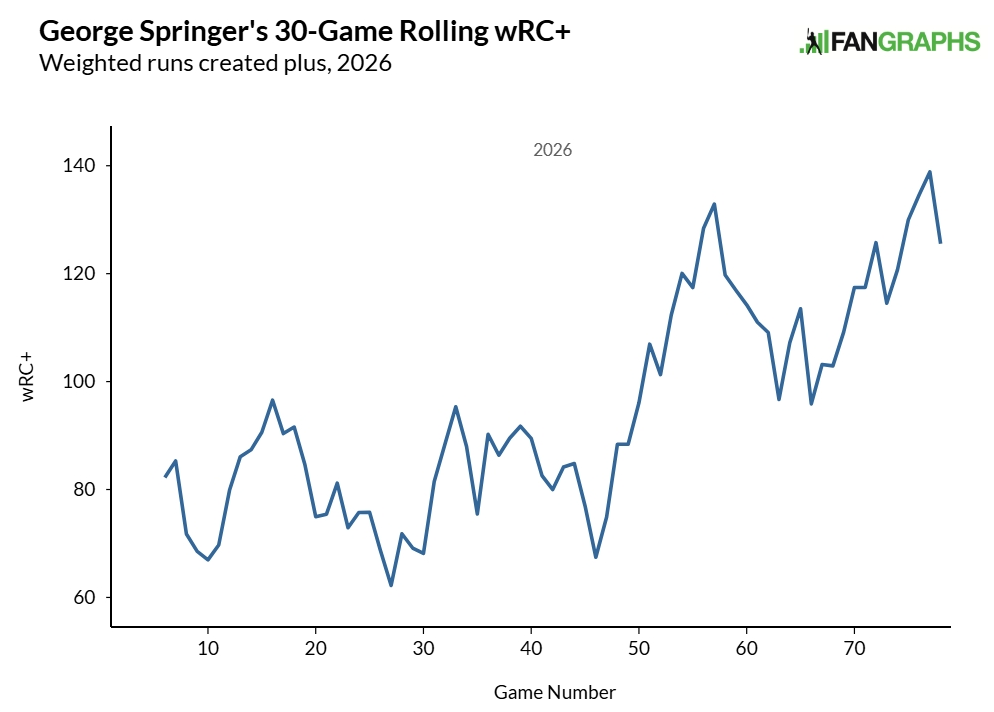
Equally important to that development is that Springer has picked up his game significantly in recent weeks. While he posted elite numbers in 2025 and his playoff resume — including a World Series MVP — is spectacular, the demand for a 36-year-old who almost never plays the field is inextricably tied to his current offensive production. For much of the year, Springer was a below-average hitter who limited his team’s flexibility by hoovering up DH at-bats.
A toe fracture on April 11 helped explain that outcome, but even precisely two months after that, Springer was carrying a .204/.291/.343 line, resulting in an 80 wRC+. That number ranked 20th among 23 primary DHs with 200-plus plate appearances at the time.
In the 31 games since, Springer has turned a corner hitting .279/.355/.492, good for a 138 wRC+. That still falls short of his incredible standard last season (166), but he’s looked like a middle-of-the-order bat for more than six weeks.
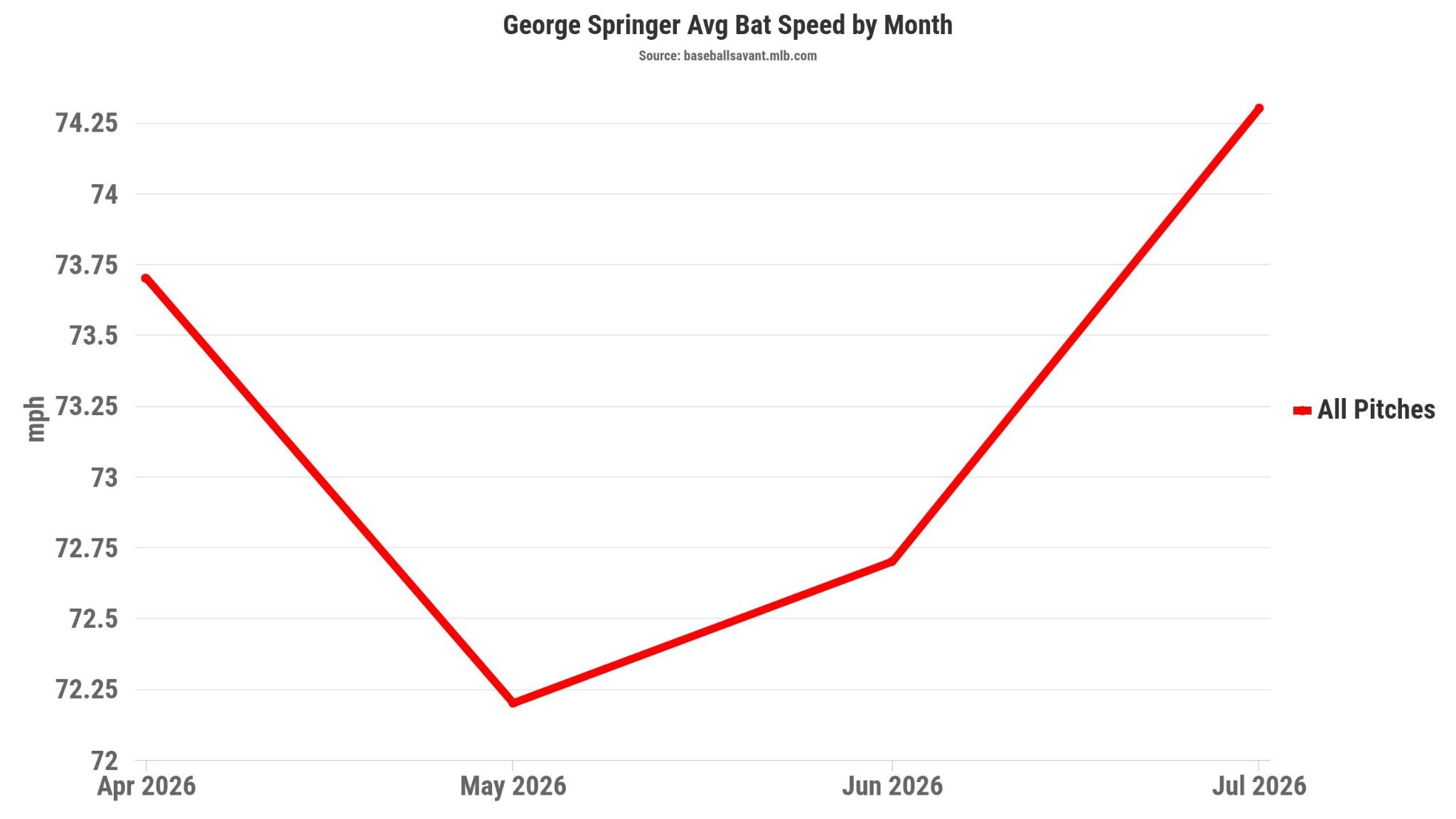
That production jump is also backed by some encouraging underlying trends. One of the most notable examples is his bat speed, which looked good out of the gate but floundered when Springer first returned from his injury, and has reached an average in July (74.3 mph) that is even better than his 2025 season mark (73.7 mph).
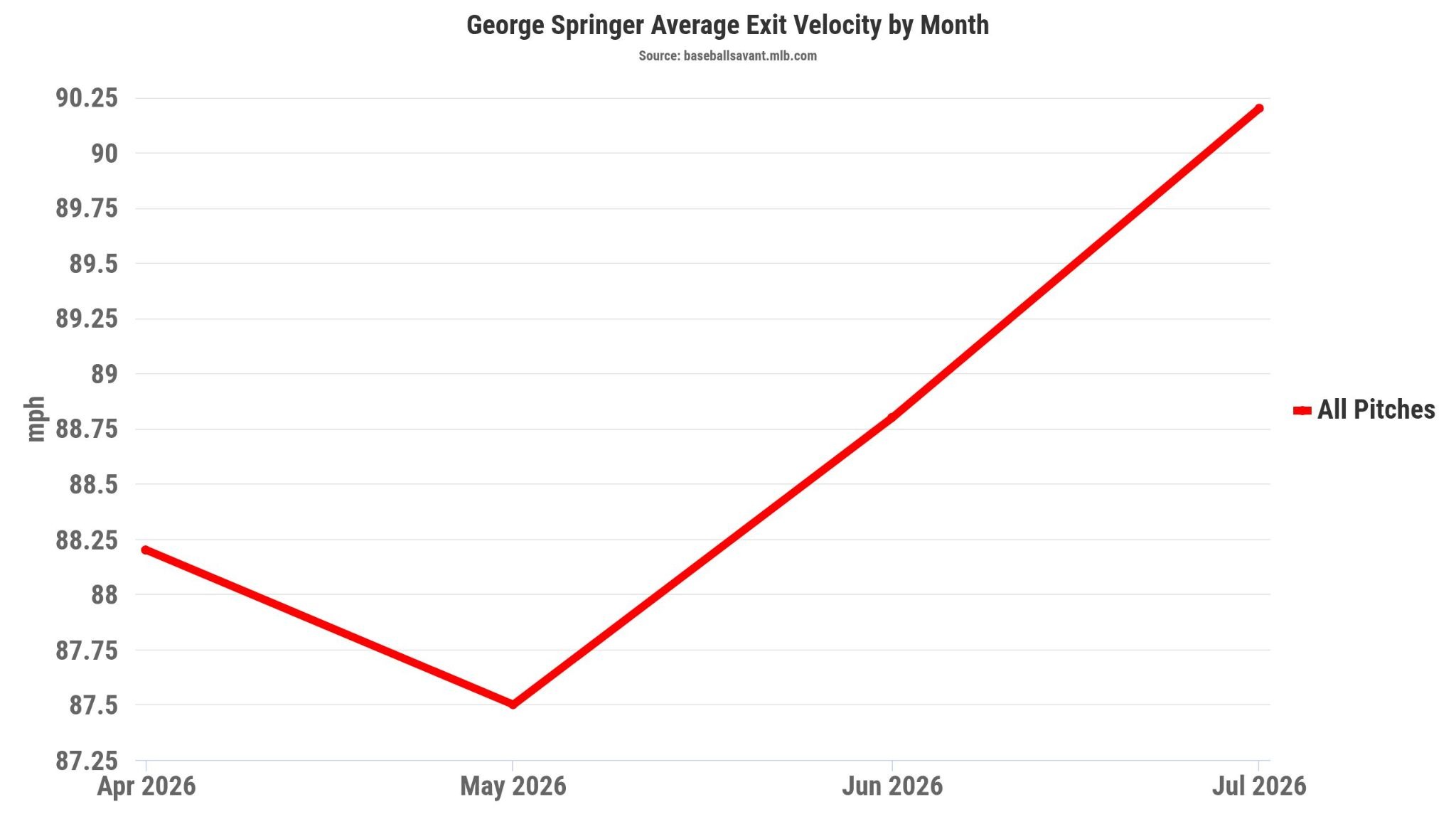
Unsurprisingly, more forceful contact has also become more abundant for Springer as his swing has hastened.
When teams around the majors look at Springer now, they don’t just see a player with limited defensive utility and approximately-average production at the plate (104 wRC+) — they see a hitter who is clearly moving in the right direction.
With that context in mind, he looks like a significantly better add and factors like his playoff success and clubhouse presence become relevant again because there’s more confidence his tangible production will be there. That doesn’t mean he’s the right fit for every team, and he has 10-and-5 rights that allow him to veto any trade. It’s not a guarantee that Springer is going anymore, but he could make sense for a few clubs:
Boston Red Sox
Boston is getting a disappointing .233/.307/.355 line from its DH position this season, and an in-season acquisition who might’ve been able to help — Curtis Mead — fractured his wrist in his Red Sox debut.
Adding Springer would lengthen a Red Sox lineup that is solid up top but lacks reliable producers through the middle, and the team’s current playoff odds sit at a solid 70.6 per cent per FanGraphs. Masataka Yoshida gives Boston more handedness variety in the lineup and his season-long production isn’t too dissimilar from Springer’s (101 wRC+), but he’s a low-ceiling option with as many home runs this season (4) as the Blue Jays veteran has in July.
Pittsburgh Pirates
Sitting two games out of the playoffs, the Pirates might not be big enough threats to attract Springer’s interest, but his fit with them is perfect.
Pittsburgh took a chance on an aging right-handed DH in Marcell Ozuna before the season, and he has been dismal for them — hitting .202/.286/.324 — dragging down a potent lineup that ranks second in the majors in run-scoring. Springer would be a massive upgrade who could make the Pirates even more difficult to pitch to and create more room for error for a pitching staff that is wobbly outside of some of its talented starters.
Chicago White Sox
The White Sox are upstarts rather than top World Series threats but running out Andrew Benintendi and his 98 wRC+ in the middle of the team’s order isn’t particularly threatening. Springer would also bring some right-handed balance to a lineup that skews the other way.
Making a move for Springer would likely mean finding some outfield at-bats for Benintendi, but at 32 he should be physically capable of playing the field and did so on a part-time basis last year. It’s hard to envision Springer opting to head to a team with so little pedigree, but his clubhouse presence might be more valuable in Chicago than elsewhere, and the White Sox currently lead the AL Central. Joining an ahead-of-schedule underdog run in Chicago could seem more satisfying than sticking it out in Toronto down the stretch for the 36-year-old.
Chicago Cubs
The Cubs have spread DH at-bats around this season to solid effect, but the player who’s taken the most (Moisés Ballesteros) is back in triple-A, and adding Springer would provide some certainty at the spot.
Chicago has enough competent hitters to share the DH spot and is already thriving offensively, but Springer has ceiling-raising potential for the group. The idea of rejoining former Astros teammate Alex Bregman on a team with 91.1 per cent playoff odds could also be appealing from the veteran hitter’s perspective.
Those teams aren’t the only ones who might check in, particularly if they are confident he can log far more outfield innings than he has with the Blue Jays lately, but most clear contenders have fit obstacles when it comes to adding a DH.
In a few cases, they have more-or-less full-time options at the position that Springer isn’t a clear upgrade over. Teams in this boat include the New York Yankees (Ben Rice), Los Angeles Dodgers (Shohei Ohtani), Philadelphia Phillies (Kyle Schwarber), Texas Rangers (Joc Pederson), Tampa Bay Rays (Yandy Díaz), Houston Astros (Yordan Álvarez) or Milwaukee Brewers (Christian Yelich). The Seattle Mariners also fit the bill to some extent, as Dominic Canzone has been extremely productive as a platoon DH against right-handed pitching they won’t be looking to upgrade on and keeping Springer on the bench exclusively as the short side of a platoon without defensive utility wouldn’t provide much return on investment.
Other teams have highly intentional DH rotations they probably aren’t looking to mess with, like the Atlanta Braves, who use the spot to keep catcher Drake Baldwin in the lineup every day, and the Cleveland Guardians, who have been getting good production from Chase DeLauter and make a concerted effort to give 33-year-old star José Ramírez rest via DH days.
Moving a DH can be difficult, but with Springer it’s gone from impossible to imagine, to extremely improbable from an execution standpoint, to something to watch for before the deadline on Monday.


 2:06
2:06