Several factors will determine the Toronto Blue Jays’ fate in the complex multi-team playoff race they find themselves in entering September, but the simplest one might be the most important.
If the Blue Jays are going to make a run to snag a post-season berth, their offence will need to be better than the 29th-ranked group it's been. The top of the rotation is strong, and Max Scherzer’s electric performance on Sunday might indicate he’s got a good finishing kick in him. The back of the bullpen built on the Louis Varland-Tyler Rogers duo is excellent. This team is capable of giving its pitchers excellent defensive support. Despite those positives, the lineup simply must produce more if Toronto is going to reach the playoffs.
There are multiple ways that can happen, from better performance with men on base to finding a little more of the home run power that’s been elusive all season. One of the more direct routes to more runs is to have an individual player (or two) produce a special September. That’s a simplistic recipe for improved offensive performance, but it’s arguably what the Blue Jays have missed more than anything in 2026. Toronto has 11 players with 200 or more plate appearances this season, and not one of them has a wRC+ above Alejandro Kirk’s 115.
Dividing up the group, there is a small cohort of hitters notably above average, but not elite in terms of overall production with wRC+ marks between 109 and 115 (Kirk, George Springer, Kazuma Okamoto and Jesús Sánchez), Nathan Lukes on an island with a 101 wRC+, four players between 92 and 94 (the departed Daulton Varsho, Vladimir Guerrero Jr., Brandon Valenzuela and Ernie Clement) and the defensive specialists bringing up the rear (Andrés Giménez and Myles Straw). No one is having a truly disastrous season compared to reasonable expectations outside of Vladdy, but no one has done nearly enough to be the best hitter in a solid lineup. There are 327 hitters with 200-plus plate appearances this season, and 83 have a higher wRC+ than Kirk.
A September surge will likely require at least one Blue Jays hitter to deliver the type of elite production nobody has managed from April through August. Below is a look at the candidates divided into tiers based on their likelihood of becoming the offensive hero the club needs.
Track record meets recent performance
The Blue Jays most likely to deliver star-level performances are the hitters who have done it before and have been doing it recently.
Alejandro Kirk: Kirk isn’t a prototypical offensive star, as he’s never topped 15 home runs in a season and his career-high wRC+ (129) is more excellent for his position than team-carrying overall. But he’s still the Blue Jays' best hope for a special month. The star catcher has not only been Toronto’s best hitter in 2026 on a per-plate-appearance basis, but he’s also turned it on in recent weeks.
Since the all-star break, his 153 wRC+ ranks 12th among all qualified hitters. The Blue Jays don’t need to dream of him finding a critical adjustment down the stretch; he just needs to keep doing what he’s doing, particularly in the power department. His five home runs in August were the most he’s hit in a month since June 2022.
Kirk has an excellent offensive floor due to his ability to draw walks and avoid strikeouts. To reach his ceiling, he has to consistently drive the ball. Right now, he’s finding success with that, and while he may slow down in September, he’s just provided proof of concept for exactly the type of stretch the Blue Jays need.
George Springer: Springer is right below Kirk on the wRC+ leaderboards in the second half, with his 152 mark ranking 14th. The biggest difference is that the designated hitter’s production over the last six weeks or so has been backloaded, as he’s hit a scorching .487/.524/.769 in his last 12 games.
The 36-year-old was among the best hitters in baseball last year, has reached significantly higher heights than Kirk offensively in his career and has been better lately. That should theoretically put him atop this list, but Springer’s recent hot streak seems highly luck-aided. Most stretches of otherworldly production are aided by luck to some degree, but there’s a massive gap between Springer’s wOBA (.552) and xwOBA (.347) in that 12-game heater with a .567 BABIP, and no notable jump in exit velocity or bat speed.
Springer’s recent production still counts, but it doesn’t look too predictive of what’s to come in September. However, it does seem like a good indication that his shoulder concerns are behind him. He’s also coming off a stretch where he started on five consecutive days, something he hadn’t done since the beginning of August. Springer needs to be healthy to have a chance at being a difference maker, and it seems like he’s in a relatively good spot physically. That might matter more than his numbers over the last two weeks.
The reliable power source
The easiest way to be an elite hitter is to put the ball over the wall at an impressive rate. Only one Blue Jay has done that in 2026.
Kazuma Okamoto: With a strikeout rate nearing 30 per cent and an OBP just over .300, the rookie third baseman hasn’t been the most complete hitter, but it’s difficult to argue with his 28 home runs.
As Okamoto has adjusted to life in the majors, his production has had numerous peaks and valleys, and he could easily conclude 2026 with the type of hot streak he went on in mid-May, late-June or mid-July.
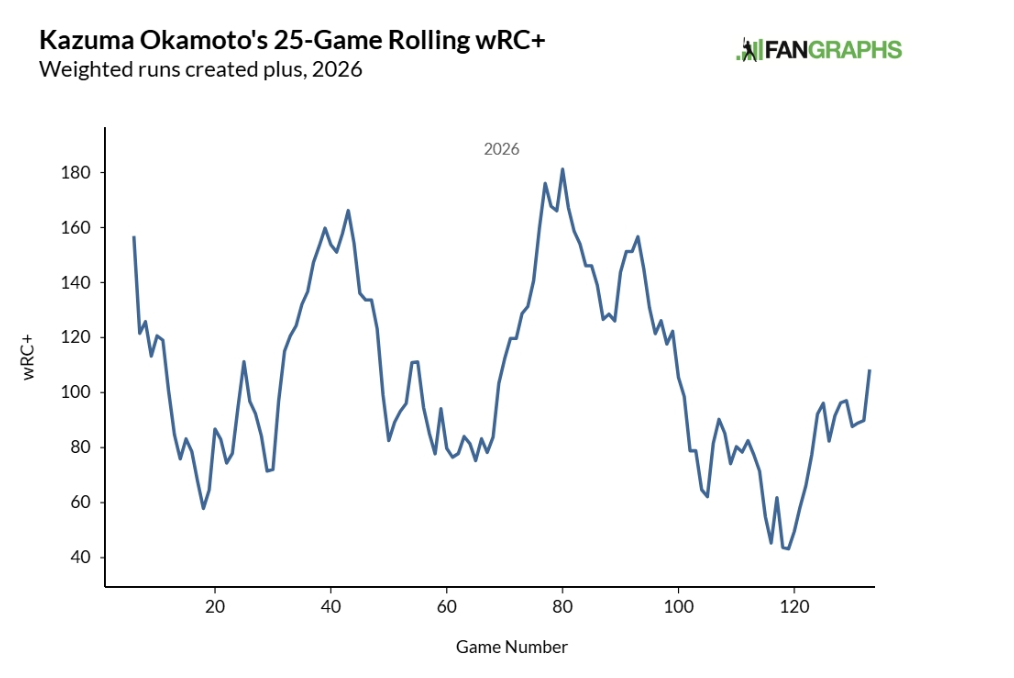
A microtrend worth watching with Okamoto is whether he’s starting to command the strike zone a little bit better. Over his last seven games, he has both the highest walk rate (22.2 per cent) and lowest strikeout rate (11.1 per cent) he’s produced in a seven-game stretch as a big-leaguer. Unsurprisingly, that’s helped him produce a solid slash line (.250/.407/.650).
A tier of his own
Toronto’s star first baseman might author a strong finish to his unimpressive year at the plate, but it’s tough to count on.
Vladimir Guerrero Jr.: A Guerrero turnaround cannot be ruled out, and he has the highest ceiling of any Blue Jays hitter by a significant margin. He’s taking his walks, avoiding strikeouts, demonstrating the same bat speed he showed off in his excellent recent seasons and occasionally demonstrating that he can hit the ball harder than almost anyone on the planet — as he did on Saturday.
At the same time, he’s dealt with minor back and hamstring issues, isn’t far removed from a concussion and wasn’t performing well before encountering any of those ailments. Guerrero Jr. wields a special bat, and he’s extremely likely to return to form as a middle-of-the-lineup force at some point. In the short term, it’s tough to imagine him finding his way back when so much has gone wrong for him in 2026. He’s still a better bet than the vast majority of his teammates, but the fact that he’s not in the top tier for a team with limited firepower speaks to just how little confidence his season has inspired.
Young guys hitting well
There’s always a large range of outcomes for rookies with limited MLB experience. The Blue Jays have a couple who are hitting well now, who could have hot Septembers in them.
Brett Bateman: Bateman has been everything the Blue Jays could’ve possibly expected since coming over from the Chicago Cubs. His speed has provided value in the field and on the bases while his .333/.384/.410 slash line has been a welcome addition to the top of the lineup.
Because the rookie has such limited power — he’s never topped three home runs in a pro season — it’s tough to imagine him delivering truly elite production. At triple-A in 2026, the outfielder has a .106 Isolated Power. In the majors, just 47 qualified hitters in the last five seasons had an ISO that low or lower. Only three had a wRC+ of 120 or above (Steven Kwan, Andrew Benintendi and Luis Arraez, all in 2022). The best version of Bateman is probably the version we’re seeing now.
Charles McAdoo: McAdoo hasn’t been as productive as Bateman, but he may have a higher offensive ceiling. The versatile right-handed hitter is hitting .271/.333/.375 in his second stint with the Blue Jays, good for a 101 wRC+.
The biggest issue with that line is a lack of power production, but the rookie had 16 home runs at triple-A this season with a strong max exit velocity (112.6 m.p.h.) hinting at well above-average raw thump. His bat speed with Blue Jays (73.7 m.p.h.) is also well above the league average (71.7 m.p.h.). McAdoo hasn’t gone deep in 14 games, but he is a threat to ramp up the power based on his tool set and track record. Before he got his August call-up, he’d homered in four straight games with the Buffalo Bisons and slugged .604 in his previous 13 contests. It’s unlikely he’s on the brink of a power surge, but it’s conceivable.
Good bets for average production
This pair of fan favourites have had hot stretches at times, but they have consistently been competent complementary hitters rather than
Nathan Lukes: Lukes has been hot recently, with four home runs and a .321/.387/.750 line in his last nine games, but his 101 wRC+ this year closely matched his 104 mark in 2025. All the evidence available suggests that he’s approximately a league-average hitter. With below-average bat speed (67.0 m.p.h.) and exit velocity (86.9 m.p.h.), it’s unfair to expect him to keep his current power spike going. Lukes can be relied upon for solid, professional at-bats, but if he’s Toronto’s best hitter in September, they’ll be in trouble.
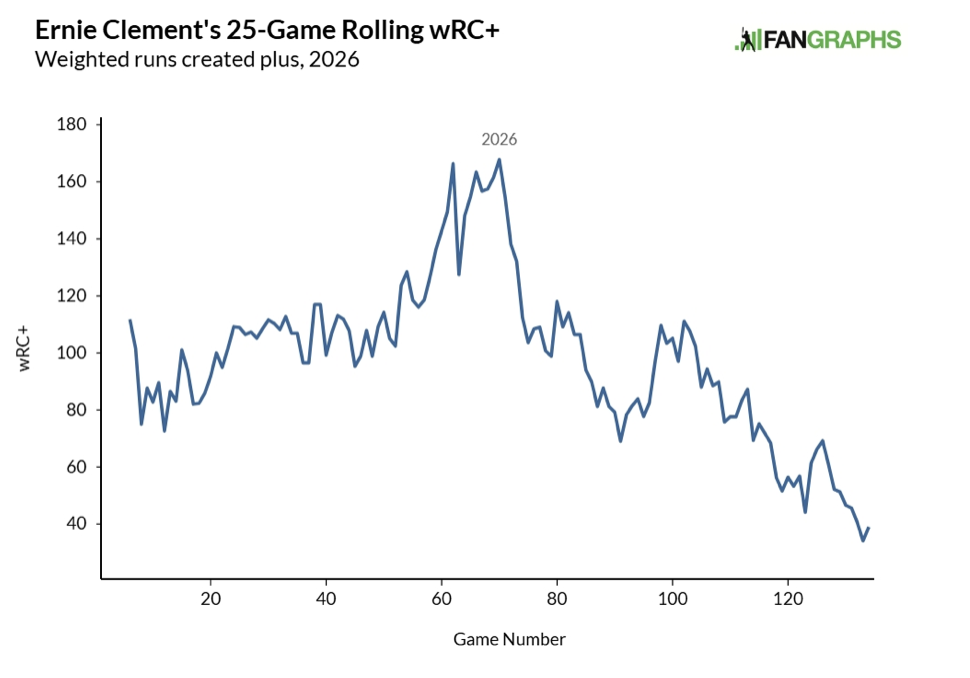
Ernie Clement: Clement has been a slightly worse hitter than Lukes in his Blue Jays career, with his wRC+ hovering between 93 and 98 in his three seasons with consistent playing time. However, he’s probably a better bet to do something special over a short period because his ability to make contact at an elite rate can result in stretches where everything is falling in for a hit.
The infielder’s incredible 2025 playoff run where he hit .411/.416/.562 is a perfect example of the kind of heater he’s capable of, but he doesn’t get a tier of his own because he hasn’t inspired confidence in recent months. While Clement was excellent in May and June, he’s been in a funk recently and has a 53 wRC+ since the all-star break.
Players in limited roles
While the guys in this group have interesting offensive tools, they don’t have a road to the kind of playing time required to be a key engine of Toronto’s offence.
Jesús Sánchez: Sánchez deserves credit for his 123 wRC+ against right-handed pitchers, the best number among eight Blue Jays with 200 plate appearances against them. At the same time, he’s unplayable against southpaws and, even against righties, he hasn’t been a lock to make the lineup recently because of defensive concerns, and Springer getting healthier and taking nearly every DH at-bat available.
Brandon Valenzuela: Backup catchers don’t tend to carry their teams offensively, even if they have a little pop like Valenzuela does. Theoretically, he could play some first base if he takes off offensively, but he’s slowed down with the bat in the second half, slashing just .173/.246/.288.
Daz Cameron: It’s unclear how much longer Cameron will be on the Blue Jays roster. Even if he sticks around, he’s essentially a platoon option against southpaws, and as impressive as his work in Korea and at triple-A has been this season, offensive excellence isn’t a fair expectation from a player with a career 64 wRC+ and a worse number in limited MLB playing time this year (49).
What you get at the plate is a bonus
This pair are paid to play Gold-Glove calibre defence. Even league-average offence is a stretch goal.
Andrés Giménez: Over the last three seasons, Giménez has a wRC+ (78) that ranks seventh-worst among 213 qualified hitters. He deserves credit for his production in big spots and has a solid .281/.324/.438 line in high-leverage situations as a Blue Jay, but he’s not going to carry Toronto’s offence.
Myles Straw: Straw has his moments on offence, often putting his speed to work, but he’s sitting on a 78 wRC+ this season and hasn’t topped 100 since 2019, when he had just 128 plate appearances. He’s strong in his role, but that role doesn’t centre around generating runs.
Not on the current roster
The current roster will change between now and the end of September. A couple of guys who didn’t appear over the weekend might be able to come up with a hot stretch.
Sean Keys: Keys isn’t guaranteed to return to the Blue Jays or carve out a significant role, even if he cracks the roster in September. He also didn’t produce in his first taste of MLB action in late June and July. Even with those considerations in mind, it's tough to ignore his 165 wRC+ at triple-A, the fact he’s slashed .352 /.464/.648 in August, and his profile as a lefty power-hitter, a type of player Toronto lacks.
Josh Smith: Smith has played in rehab games in recent days with the Buffalo Bisons and could return to the Blue Jays roster any day now. He was also an above-average hitter between 2024 and 2025 (107 wRC+), winning a utility Silver Slugger in 2024. He’s never been a top producer, though. He’s more of a jack of all trades with the bat who’s never hit more than 13 home runs or posted an OBP above .337 in a season.
Anthony Santander: It seems unlikely we’ll see Santander at all, but he’s still working toward a return. Unlike most of the players on this list, he’s been an extremely dangerous power hitter at the MLB level for multiple years. He hasn’t come close to that level, or been healthy much, as a Blue Jay. An extreme long shot to provide meaningful help in 2026.

 1:58
1:58